
Entry
Entries A-Z
Articles of Confederation
In 1776, the year of the Declaration of Independence, the Continental Congress appointed a committee to draft a constitution for the original thirteen colonies, which Benjamin Franklin of Pennsylvania dubbed “the Articles of Confederation and Perpetual Union.” The colonies themselves had written constitutional-type documents on which their own governance was based. For example, the Fundamental Orders of Connecticut, dating from around 1638–39, has been called the world’s first written constitution. New Hampshire, after declaring its independence from Great Britain, drafted the first written constitution of an independent state in 1776. These documents followed in the tradition of the ancient democracy of Athens and the republic of Rome, whose written laws were copied down for reference by political leaders and literate citizens. At the time Britain had an unwritten constitution that combined customs and tradition with some written documents, including Magna Carta (1215), the Petition of Right (1628), and the Bill of Rights (1689).
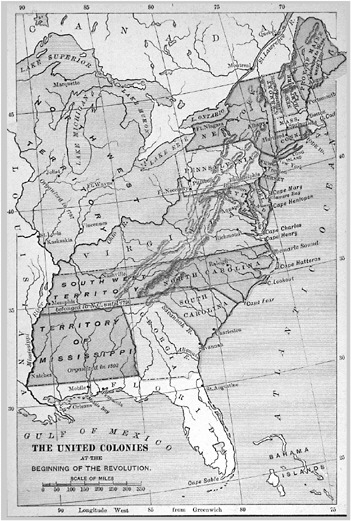
Map of the thirteen colonies and related territories, 1775. At the time of the Articles of Confederation, many in America viewed the individual states as separate entities rather than as components of a single nation. Some of the states, such as Virginia, were considerably larger than their present-day sizes. Altogether, the states stretched about a thousand miles from north to south, which was an enormously large area for a central entity to govern. The Granger Collection, New York
Ratification of the Articles of Confederation by the thirteen newly independent states was officially declared by Congress on March 1, 1781, while the Revolutionary War (1775–83) was still in progress. The document was a product of radical leaders who had advocated independence from a European power, itself a strong centralized government, and were now fighting to ensure the sovereignty and supremacy of their state governments, not a national government. The Articles served basically as an agreement to form a league of states for limited purposes, playing a key role in organizing the newly independent colonies for the successful prosecution of the Revolutionary War. But once the war was over, the states began going their own ways, which was often counterproductive to one another’s interests and to those of the United States as a whole.
That the central government the document provided for after the war was weak and ineffectual might have been expected. Yet in a way the agreement reflected the philosophy of the Declaration of Independence, which concludes with the decree that the states, “as Free and Independent States,…have full Power…to do all…Acts and Things which Independent States may of right do.” This issue of states’ rights— the power of the national government vis-á-vis that of the states—is still debated today.
Sovereign States versus Central Government
The Articles of Confederation delegated only a few powers to Congress, including control of the war effort and foreign affairs and regulation of native Americans living outside the states. The document included no Supremacy Clause making national law supreme over state laws. In fact, it stipulated that no law passed by Congress could infringe on the right of the states to pass their own laws on all other matters. Article 1 named the confederation “The United States of America,” while Article 2 expressly provided: “Each State retains its sovereignty, freedom and independence, and every power, jurisdiction, and right, which is not by this confederation expressly delegated to the United States, in Congress assembled.”
...
Get a 30 day FREE TRIAL
-
 Watch videos from a variety of sources bringing classroom topics to life
 -
Read modern, diverse business cases
-
Explore hundreds of books and reference titles

Read next

More like this
Sage Recommends
We found other relevant content for you on other Sage platforms.
Have you created a personal profile? Login or create a profile so that you can save clips, playlists and searches