
Entry
Entries A-Z
Anthony, Susan B.
In 1893 New Zealand became the first country in the world to grant women the right to vote. Suffrage was not extended to American women until the Nineteenth Amendment to the Constitution was ratified in 1920, 133 years after the country’s supreme law was drafted and fourteen years after the death of Susan Brownell Anthony (1820–1906). Along with Elizabeth Cady Stanton and many others suffragists, Anthony had worked so long and hard for this right.
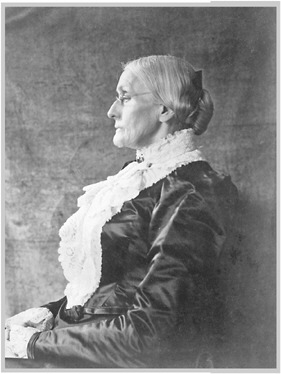
Susan B. Anthony’s static pose in this turn-of-the-century photographic portrait conceals the vocal and often combative role she played in a life-long struggle to secure voting rights for women, a battle won only after her death. Library of Congress
Born in Adams, Massachusetts, on February 15, 1820, Anthony learned to read and write at the age of three. Her father was an ardent supporter of the movement to abolish slavery, working closely with leaders such as Frederick Douglass. Following in her father’s footsteps, Anthony supported the abolitionist movement and worked for passage of the Thirteenth Amendment (1865), which ended slavery in the United States. She also urged, unsuccessfully, that the Fourteenth (1868) and Fifteenth (1870) Amendments, dealing with citizenship rights and granting black persons the right to vote, should extend the vote to women as well.
In 1848 Anthony attended America’s first women’s rights convention, held in Seneca Falls, New York. The convention’s statement of principles—the Seneca Falls Declaration of Sentiments and Resolutions—was drafted by Stanton, whom Anthony met in 1850 and with whom she would become closely allied in the struggle for women’s rights. Although she never married, Anthony led the drive for New York State’s Married Women’s Property Act (1860), intended to secure economic rights for married women. She also helped organize the American Anti-Slavery Society. During the Civil War, Anthony and Stanton organized the National Women’s Loyal League to promote a constitutional amendment prohibiting slavery, which became the Thirteenth Amendment.
“For any State to make sex a qualification that must ever result in the disfranchisement of one entire half of the people, is to pass a bill of attainder, or an ex post facto law, and is therefore a violation of the supreme law of the land. By it, the blessings of liberty are forever withheld from women and their female posterity.”
—Susan B. Anthony,in an 1873 speech
After the Civil War, together with Stanton, Anthony devoted herself to obtaining equal civil and political rights for women. The territory of Wyoming granted women the right to vote in 1869, and that same year the National Woman Suffrage Association was created. This organization and later the National American Woman Suffrage Association served as vehicles for Anthony’s crusade. In 1872 she and fifteen colleagues became the first women to vote in a national election—and were promptly arrested. Free on bail pending her trial, Anthony traveled across the country asking the question: “Is it a crime for a U.S. citizen to vote?” She lost her case and, because her sentence was a nonbinding one, was denied the right to appeal to the Supreme Court, where she would have had a national audience for her arguments in favor of women’s suffrage.
...
Get a 30 day FREE TRIAL
-
 Watch videos from a variety of sources bringing classroom topics to life
 -
Read modern, diverse business cases
-
Explore hundreds of books and reference titles

Read next

More like this
Sage Recommends
We found other relevant content for you on other Sage platforms.
Have you created a personal profile? Login or create a profile so that you can save clips, playlists and searches