
Entry
Entries A-Z
Amendments
Every written national constitution contains procedures for amending the document—correcting, changing, or revising it for the better. Generally, amendments require several steps and often a supermajority vote to be approved. However, amendments to the constitutions of countries with unwritten constitutions, such as New Zealand (1840) and Israel (1948), in theory require only a simple majority vote of the national legislature. Tradition and custom often act as restraints on the amending process of parliaments with such supreme constitutional powers. The U.S. Constitution has been amended only twenty-seven times in more than two centuries, and only once has an amendment—the Eighteenth (1919), which prohibited the manufacture and sale of alcohol (see Prohibition)—been repealed by another, the Twenty-first (1933).
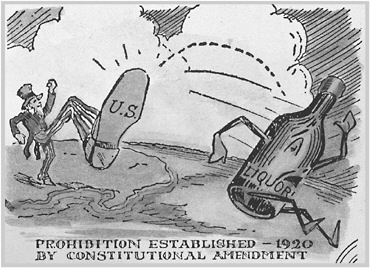
The Eighteenth Amendment prohibited the manufacture and sale of alcohol in the United States. The law was extremely unpopular and was later repealed by the Twenty-first Amendment. The Granger Collection, New York
Modes of Amendment
Article V provides several ways to amend the Constitution: “The Congress, whenever two thirds of both Houses shall deem it necessary, shall propose Amendments to this Constitution, or, on the Application of the Legislatures of two thirds of the several States, shall call a Convention for proposing Amendments, which, in either Case, shall be valid to all Intents and Purposes, as Part of this Constitution, when ratified by the Legislatures of three fourths of the several States, or by Conventions in three fourths thereof, as the one or the other Mode of Ratification may be proposed by the Congress; Provided…that no State, without its Consent, shall be deprived of its equal Suffrage in the Senate.” No constitutional convention has ever been called to propose amendments, perhaps in part because of the fear that such a convention could, like the Constitutional Convention of 1787 in Philadelphia, disregard its specific mandate and attempt a wholesale revision of the document.
The Constitution as ratified by the states after the 1787 convention included in Article V language regarding amendments that became obsolete after 1808, specifically: “Provided that no Amendment which may be made prior to the Year One thousand eight hundred and eight shall in any Manner affect the first and fourth Clauses [having to do with the importation of slaves and requiring that direct taxes be in proportion to the census to be conducted every ten years] in the Ninth Section of the First Article….”
According to Article V, Congress specifies the “Mode of Ratification”—either “by the Legislatures of three fourths of the several States, or by Conventions in three fourths thereof” (see Ratification). Each state’s convention or legislature determines how it will proceed, but states may not call a special referendum to let the citizens ratify the amendment directed to the legislatures (see Direct Democracy). After the last state necessary has ratified the proposed amendment, no further action is necessary except to have the amendment added to copies of the Constitution. States originally notified the secretary of state, but now they submit the information to the archivist of the United States, who is the official custodian of the Constitution.
...
Get a 30 day FREE TRIAL
-
 Watch videos from a variety of sources bringing classroom topics to life
 -
Read modern, diverse business cases
-
Explore hundreds of books and reference titles

Read next

More like this
Sage Recommends
We found other relevant content for you on other Sage platforms.
Have you created a personal profile? Login or create a profile so that you can save clips, playlists and searches