
Entry
Entries A-Z
Administrative Agencies
“Those democratic peoples which have introduced freedom into the sphere of politics, while allowing despotism to grow in the administrative sphere,” observed Alexis de Tocqueville (1805–59) in volume two of his Democracy in America (1840), “have been led into the strangest paradoxes.” The French visitor’s view may have been skewed somewhat by the political “spoils system” introduced during the administration of President Andrew Jackson (1767–1845) from 1829 to 1837, which rewarded his Democratic supporters with plum government appointments.
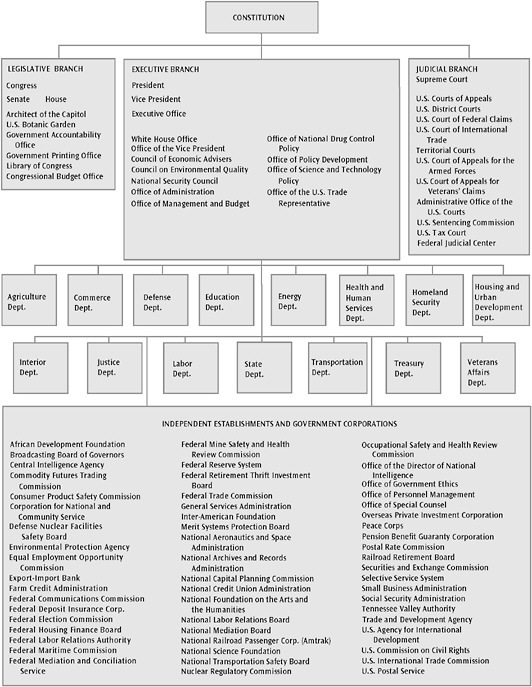

The number of civilian employees in the federal bureaucracy is over four million, located in fourteen departments and fifteen agencies. What is the typical federal employee like? The Office of Personnel Management, which oversees employment with the federal government, developed this composite portrait from 2004 data about federal civilian, permanent, non–Postal Service employees:
AGE: 46.8 years
LENGTH OF GOVERNMENT EMPLOYMENT: 16.6 years
EDUCATION: bachelor’s degree or higher, 42 percent
GENDER: male, 56 percent; female, 44 percent
RACE AND NATIONAL ORIGIN: 31.4 percent minority (17 percent African American; 7.3 percent Hispanic: 5.0 percent Asian/Pacific Islander; 2.1 percent American Indian)
DISABLED: 7 percent
VETERANS: 23 percent
LOCATION OF EMPLOYMENT: inside the United States, 97 percent; inside Washington, D.C., metropolitan area, 16 percent
ANNUAL BASE SALARY: $61,714
AVERAGE GENERAL SCHEDULE GRADE: 9.8
For many people, America’s federal bureaucracy may still conjure up the same negative connotations of a vast, unfeeling maze of offices and officials endlessly shuffling papers and producing red tape with which to ensnarl average citizens. This bureaucracy pervades cabinet departments, such as the Departments of State and Justice; independent agencies, such as the Federal Trade Commission and Central Intelligence Agency; government corporations such as the U.S. Postal Service; and presidential and congressional agencies from the Office of Management and Budget to the Library of Congress, including committees, commissions, and boards. All these types of organizations function as administrative agencies, administering the policies of the federal government created by Congress and the president.
The Constitution does not mention administrative agencies, and surely the Framers of the Constitution could not have foreseen the power and influence that this “fourth branch of government” would one day wield. But certain constitutional provisions lent themselves to the growth of these agencies. For example, besides giving Congress certain express powers and areas of authority, the last paragraph of Article I, section 8, grants Congress the power “To make all Laws which shall be necessary and proper for carrying into Execution the foregoing Powers, and all other Powers vested by this Constitution in the Government of the United States, or in any Department or Officer thereof” (see Necessary and Proper Clause). The appointment powers granted to the president in Article II (see Appointment and Removal Power) and his power to “require the Opinion, in writing, of the principal Officer in each of the executive Departments, upon any Subject relating to the Duties of their respective Offices” contemplated that some federal bureaucracy would be created.
Administrative agencies bring expertise to the government’s regulatory processes. The highly technical and fast-changing nature of the private sector that the government must regulate means that elected officials and judges probably lack the competence by themselves to make day-to-day decisions that affect these highly specialized activities.
...
Get a 30 day FREE TRIAL
-
 Watch videos from a variety of sources bringing classroom topics to life
 -
Read modern, diverse business cases
-
Explore hundreds of books and reference titles

Read next

More like this
Sage Recommends
We found other relevant content for you on other Sage platforms.
Have you created a personal profile? Login or create a profile so that you can save clips, playlists and searches