
Entry
Entries A-Z
Adams, John
Following George Washington as the second president of the United States was a burden for John Adams (1735–1826), Massachusetts lawyer, revolutionary, political thinker, and diplomat. His elitist views, his approval of the Alien and Sedition Acts (1798)—which attempted to narrow protections provided by the First Amendment (1791)—his appeasement of France, and a split in his own Federalist Party doomed him to a one-term presidency. However, he lived to see his son, John Quincy Adams, elected president in 1825. Adams died a year later, on July 4, exactly fifty years to the day after the Declaration of Independence was promulgated and the same day that Thomas Jefferson died.
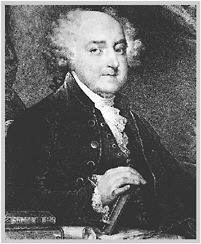
John Adams’s contributions to the development of a new national constitution included his advocacy for separation of powers and the adoption of a bicameral legislature. He became the country’s first vice president and second president. Library of Congress
Born on October 30, 1735, in Braintree, Massachusetts, the eldest son of a farmer and elected town official, John Adams was graduated from Harvard College in 1755 and became a lawyer. In 1764 he married Abigail Smith (1744–1818), the daughter of a well-connected Massachusetts family, and in 1768 they moved to Boston. There he began actively opposing British oppression of the colonists, although he was not as ardent a revolutionary as his cousin Samuel Adams. In 1770 he won an acquittal for the British commanding officer and most of the soldiers implicated in the Boston Massacre, which resulted in the deaths of five colonists.
A member of the Massachusetts colonial legislature, Adams was elected a delegate to the First Continental Congress in 1774 and the following year nominated Washington as commander in chief of the fledgling colonial army. During the Revolutionary War (1775–83), Adams served as joint commissioner with Benjamin Franklin to secure an alliance with France, and after the war was won he worked with Franklin and John Jay to help negotiate peace with Great Britain. From 1785 to 1788 he served as the first U.S. minister (ambassador) to Great Britain, where he moved with his family.
Adams made several important contributions to the development of the Constitution. He had drafted the Massachusetts state constitution (1780), which has been continuously in force longer than any other written constitution in the world. This document was considered by the delegates to the Constitutional Convention of 1787 and served as a model for several provisions in the new national constitution, including life appointment for federal judges and the addition of a Bill of Rights in 1791. The first volume of his three-volume work Defence of the Constitutions of the Government of the United States of America (1787) was also available to the convention delegates in Philadelphia. In it, Adams urged that the new government be based on the principle of the separation of government powers and that there be a bicameral national legislature (see Congress; House of Representatives; Senate; Separation of Powers).
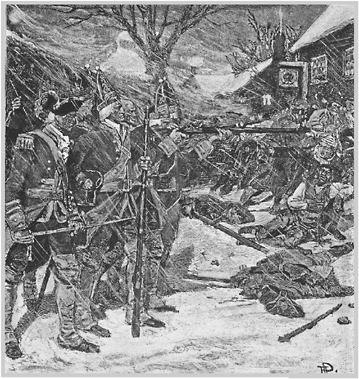
John Adams came to prominence in 1770, when he defended British soldiers who took part in the Boston Massacre. The Granger Collection, New
...
Get a 30 day FREE TRIAL
-
 Watch videos from a variety of sources bringing classroom topics to life
 -
Read modern, diverse business cases
-
Explore hundreds of books and reference titles

Read next

More like this
Sage Recommends
We found other relevant content for you on other Sage platforms.
Have you created a personal profile? Login or create a profile so that you can save clips, playlists and searches