
Entry
Entries A-Z
Punishment
Punishment of crime has been a basis of civil society for at least as long as recorded history. Both the Code of Hammurabi, who was the king of Babylon from 1792 to 1750 b.c.e., and the Bible's Old Testament demand an “eye for an eye, a tooth for a tooth,” as a way of having the punishment fit the crime. In his Commentaries on the Laws of England (1765–70), William Blackstone (1723–80) describes punishment as “evils or inconveniences consequent upon crimes and misdemeanors; being devised, denounced, and inflicted by human laws, in consequence of disobedience or misbehavior in those, to regulate whose conduct such laws were respectively made.” But the ancient Greek philosopher Aristotle (384–322 b.c.e.) argued in The Politics that “just punishments and chastisements do indeed spring from a good principle, but they are good only because we cannot do without them—it would be better that neither individuals nor states need anything of the sort. . . .”
Punishment is addressed in many national constitutions. For example, Singapore's constitution (1963) guarantees that “no person shall suffer greater punishment for an offense than was prescribed by law at the time it was committed.” The Nicaraguan constitution (1987) declares: “In Nicaragua the penitentiary system is humane, and it has as a fundamental objective the transformation of the interned in order to reintegrate him or her into society.”
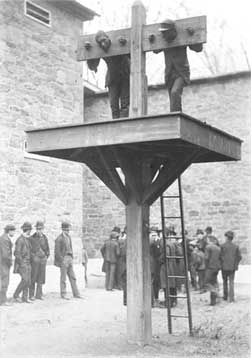
Library of Congress
The Power to Punish
The power to impose punishment for wrongdoing is a basic right of sovereignty for any government. In an enlightened society, that power should not include the power to inflict inhuman, brutal, or, in the words of the Eighth Amendment (1791), “cruel and unusual punishments.” Dissenting from the Supreme Court's rejection in Sweeney v. Woodall (1952) of a habeas corpus appeal in which a prisoner alleged, among other things, that he had been beaten frequently by his jailers with a nine-pound strap bearing five metal prongs, Justice William O. Douglas (1888–1980) said: “I rebel at the thought that any human being should be forced to run a gamut of blood and terror in order to get his constitutional rights.”
The Constitution expressly grants the power to punish for a number of transgressions.
Counterfeiting. Article I, section 8, authorizes Congress “To provide for the Punishment of counterfeiting the Securities and current Coin of the United States” (see Currency). In United States v. Marigold (1850), the Supreme Court upheld Congress's power to criminalize the circulation or importation of counterfeit money. And in Atlantic Coast Line Railroad v. City of Goldsboro (1914), the Court confirmed the authority of Congress to make it illegal to possess counterfeiting tools and dies.
Piracy and Offenses under International Law. Congress is also empowered under Article I, section 8, “To define and punish Piracies and Felonies committed on the high Seas, and Offences against the Law of Nations” (see Admiralty and Maritime Law; International Law). The Supreme Court approved an act of Congress punishing “the crime of piracy, as defined by the law of nations,” in United States v. Smith (1820). The same year in United States v. Furlong, the Court broadly interpreted “high Seas” to cover crimes committed on U.S.. vessels docked in foreign ports. In United States v. Arjona (1887), the Court validated a law punishing counterfeiting of foreign securities in the United States under international law.
...
Get a 30 day FREE TRIAL
-
 Watch videos from a variety of sources bringing classroom topics to life
 -
Read modern, diverse business cases
-
Explore hundreds of books and reference titles

Read next

More like this
Sage Recommends
We found other relevant content for you on other Sage platforms.
Have you created a personal profile? Login or create a profile so that you can save clips, playlists and searches