
Entry
Entries A-Z
Labor
In The Laws, Plato, the Greek philosopher of the fourth century b.c.e., praised “the class of craftsmen who have enriched our lives by their arts and skills,” yet he recommended harsh punishment for work not accomplished in the amount of time stipulated. And in ancient Rome the plebeians (common workers) would occasionally stage a strike to protest their ill treatment by the patricians (upper class).
This struggle between employees and their employers over wages, working conditions, and benefits of employment has endured since the first large-scale human settlements, when a class of free persons emerged to produce goods and services for those who could pay for them. “In the constant struggle about wages between these two classes,” observed Alexis de Tocqueville (1805–59) in Democracy in America (1835), “power is thus divided, and success goes first to one, then to the other.” As the French political scientist noted, however, “It even seems probable that in the long run the workers' interest should prevail. For the high wages they have already gained make them daily less dependent on their masters, and in proportion, as they are more independent, it is easier for them to obtain higher wages.” When the supply of labor is plentiful in relation to the demand, employers are in the driver's seat, but of course the opposite is true when the reverse conditions prevail.
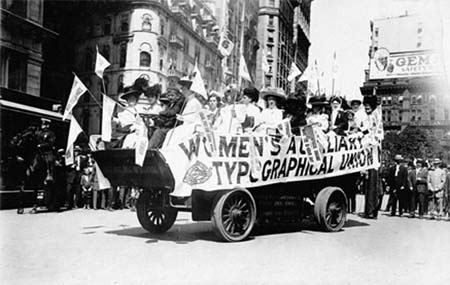
Library of Congress
Although the U.S.. Constitution does not address the rights of workers, modern constitutions of other nations do. For example, Hungary's constitution (1949, revised 1972 and 1989) provides that “everyone shall have the right to work, to freedom of choice of employment and occupation.” It also guarantees “equal pay for equal work,” along with the right to fair compensation for labor performed and the “right to rest and leisure and to regular holidays, with pay.” Greece's constitution (1975) states: “General working conditions shall be determined by law, supplemented by collective labour agreements contracted through free negotiations and, in case of the failure of such, by rules determined by arbitration.”
The Old Deal
In the nineteenth century, international labor conventions were held in Europe to address the industrial revolution's pernicious effects on workers, and then in 1919 the International Labor Organization was founded as an autonomous intergovernmental organization to promote the rights and interests of workers around the world. The growth of and support for labor unions beginning in the first half of the twentieth century played an important role in establishing the rights and protections of workers in America.
However, until the Great Depression in the 1930s triggered the New Deal programs of President Franklin D. Roosevelt (1882–1945), the nation's courts, including the Supreme Court, were generally antagonistic toward the interests of those who labored for others. In a series of cases—Allgeyer v. Louisiana (1897), Lochner v. New York (1905), Adair v. United States (1908), and Coppage v. Kansas (1915)—the Supreme Court struck down legislative attempts by the states and the federal government to promote better working conditions and relations between employers and employees. In Lochner v. New York (1905), the justices ruled that employees' economic liberty was infringed by regulations setting minimum wages and governing the maximum number of hours that they could work in a day.
...
Get a 30 day FREE TRIAL
-
 Watch videos from a variety of sources bringing classroom topics to life
 -
Read modern, diverse business cases
-
Explore hundreds of books and reference titles

Read next

More like this
Sage Recommends
We found other relevant content for you on other Sage platforms.
Have you created a personal profile? Login or create a profile so that you can save clips, playlists and searches