
Entry
Reader's guide
Entries A-Z
Subject index
Web Programming
Web programming is a generic term used to indicate the set of activities for the creation of websites or web applications for the World Wide Web (WWW, often simply called the web). A plethora of web technologies and languages are available for web programming. The core set of technologies for web programming is the one recommended by the World Wide Web Consortium, an international community of organizations that work together for the development of web standards and the exploration of the full capabilities of the web. This entry examines how websites are developed, server-side and client-side web programming, and the website development process.
Developing Websites With Web Tools
One of the primary activities of web programming is developing websites and their functionalities. A website is a collection of webpages stored on a web server. A web server is a computer system that offers services to a web client, an application that communicates with the web server to request specific services. For example, assume that a user wants to access a document from a specific website: The web can deliver text, images, audio, video, animation, and other multimedia content. A document is a file containing one or more types of media content; on the web, this document is called a webpage. The request for the document is performed at the client side by using a browser, which is an application that performs retrieval, visualization, and presentation of information on the WWW. The common communication protocol to exchange information on the web is the hypertext transfer protocol (HTTP), with its respective secure version, HTTPS. Examples of other available protocols are ftp, and its respective secure version, sftp, for file transfer to and from a remote computer; mailto for email service; file for local file system; and callto to initiate calls via Skype or similar applications.
Figure 1 A Sample Hypertext Markup Language File and Its Rendition
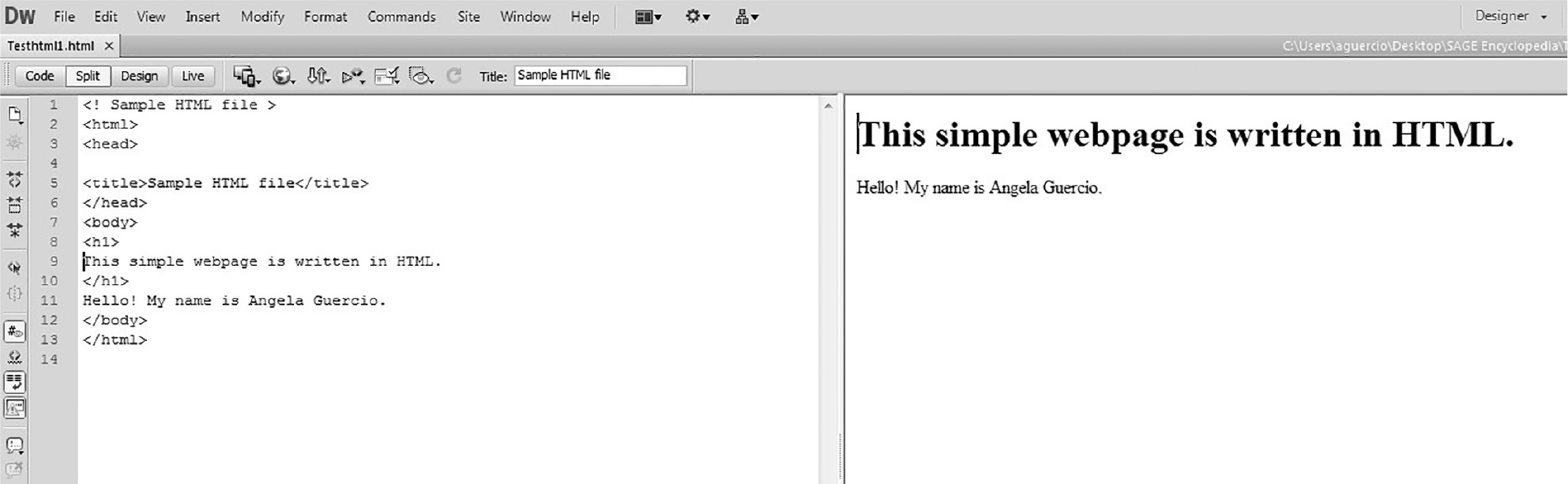
Before retrieving webpages from a website, the website must be created and stored on a webserver. The standard language used for creating webpages is hypertext markup language (HTML), usually used in its latest revision. In 2014, the fifth major revision of the language, called HTML5, was endorsed by the World Wide Web Consortium. Writing markup is not considered pure programming in the classical sense; however, together with coding, it is part of web development. HTML uses tags and other commands to describe the layout of the document that must be rendered by the browser. Figure 1 shows a sample HTML file and its rendition. Tags are meaningful keywords that wrap content and tell the browser how to format and render it. Tags are not displayed by the browser. The <body> tag wraps the entire page content; the <head> tag contains the title of the page to appear on the browser toolbar. While it is possible to describe the style of a document inside the HTML file, it is preferable to express it in a separate file using cascading style sheet (CCS) in its most current available version (e.g., CSS3). CSS is a standard style sheet language for styling, transformation, and animation of a document. The separation of the document structure from its presentation is particularly beneficial since multiple CSS styles can be created for the same document. This is particularly useful considering the different needs of mobile and standard devices. Figure 2 shows how the HTML file of Figure 1 is rendered after test.css is linked to the file in the <link> tag.
...
- Criminal and Ethical Facets
- Economic Facets
- Adware
- Agriculture and the Internet
- Alibaba
- Amazon
- Back Offices, Call Centers, and the Internet
- Bitcoin
- Blockchain
- Broadband Internet Affordability
- Crowdfunding
- Cryptocurrencies
- e-Commerce: Business-to-Business
- e-Commerce: Business-to-Consumer
- e-Commerce: Business-to-Government
- e-Tailing
- eBay
- Economic Development and the Internet
- Energy Use and the Internet
- Fiber Optics and the Internet
- Internet Advertising
- Internet Banking
- Internet Recruiting
- Internet Taxation
- Location-Based Services
- Manufacturing and the Internet
- MercadoLibre
- PayPal
- Rural Areas and the Internet
- Sharing Economy and the Internet
- Smart Cities
- Smart Energy Systems
- Smart Grids
- Telework
- Tourism and the Internet
- Transportation and the Internet
- Virtual Teams
- Webinars
- Internet History and Governance
- Declaration of the Independence of Cyberspace
- ARPANET
- BITNET
- Cyclades
- Deep Packet Inspection
- Electronic Frontier Foundation
- Gopher
- Internet Architecture Board
- Internet Assigned Numbers Authority
- Internet Corporation for Assigned Names and Numbers
- Internet Engineering Task Force
- Internet Governance
- Internet Origins and History
- Internet Society
- Internet Standards
- NSFNET
- Usenet
- WELL, The
- World Wide Web
- World Wide Web Consortium
- Political and Legal Facets
- Anonymous
- Biometrics
- Clicktivism
- Cyberespionage
- Cybersecurity
- Cyberwarfare
- Distributed Denial-of-Service Attack
- e-Government
- Elections and the Internet
- Electronic Signatures
- Geoblocking
- Great Firewall
- Internet Activism
- Internet Censorship
- Internet Law
- Internet Surveillance
- m-Government
- Military Internet
- National Security Agency Surveillance
- Net Neutrality
- Right to Be Forgotten
- Right to Internet Access
- Slacktivism
- Social Movements and the Internet
- Stuxnet
- WikiLeaks
- Social, Behavioral, and Psychological Facets
- Augmented Reality
- Baidu
- Blind People and the Internet
- Blogs
- Chat Rooms
- Children, Adolescents, and the Internet
- Citizen Science
- Crowdsourcing
- Cybercafés
- Cyberoptimism and Cyberpessimism
- Cyberwellness
- Diasporas and the Internet
- Digital Divides, Disability and
- Digital Divides, Ethnicity and
- Digital Divides, Gender and
- Digital Divides, Geography of
- Digital Divides, Global
- Digital Divides, Language and
- Digital Earth
- Digital Humanities
- Digital Natives
- e-Health
- Education and the Internet: Colleges and Universities
- Education and the Internet: Elementary and Secondary Schools
- Elderly People and the Internet
- Electronic Literature
- Emojis and Emoticons
- Ethnographic Research and the Internet
- Google Earth
- Health Care and the Internet
- Internet Addiction
- Internet Dating
- Internet Gambling
- Internet Gaming
- Internet Mapping
- Internet Memes
- Internet Movie Database
- Internet Nonusers
- Internet Pornography
- Internet Privacy
- Internet Slang
- Internet Telephony
- iPhones
- Journalism and the Internet
- Libraries and the Internet
- Massive Open Online Courses
- Microblogs
- Mobile Internet
- Municipal Broadband
- Music and the Internet
- Myspace
- Neogeography
- Netflix
- Netiquette
- Netizen
- One Laptop per Child
- Online Social Networks
- Photo Sharing Applications
- Podcasting
- Project Loon
- Religion and the Internet
- Sexting
- Skype
- Smartphone Apps
- Smartphones
- Social Media
- Sports and the Internet
- Telecenters
- Telemedicine
- Television and the Internet
- Tencent
- Texting
- Tor
- Video Games and the Internet
- Virtual Reality
- Wearable Technologies
- Web 2.0
- Wi-Fi
- Wikipedia
- Yahoo
- YouTube
- Technical Facets
- AI Safety
- Algorithmic Selection on the Internet
- Broadband Internet
- CAPTCHA
- Cloud Computing
- Cookies
- Cyberinfrastructure
- Cyberspace
- Cybersquatting
- Deep Web
- Digital Steganography
- Digital Watermarking
- Domain Name
- Domain Name System
- Electronic Mailing Lists
- Ethernet
- File Sharing
- File Transfer Protocol
- Firewalls
- Freenet
- Geoweb
- Hashtag
- Hyperlink
- Hypertext Markup Language
- Hypertext Transfer Protocol
- Internet Backbone Networks
- Internet Connectivity
- Internet Data Centers
- Internet GIS
- Internet of Things
- Internet Routing
- Internet Service Providers
- IP Addresses
- Local Area Networks
- Packet Switching
- Peer-to-Peer Networks
- Satellite Internet
- Search Engine
- Semantic Web
- TCP/IP
- Traceroute
- Uniform Resource Locator
- Virtual Private Networks
- Volunteered Geographic Information
- Web Browsers
- Web Design
- Web GIS
- Web Mining
- Web Programming
- Webometrics
- Website and Webpage
- Wide Area Networks
- Loading...
Get a 30 day FREE TRIAL
-
 Watch videos from a variety of sources bringing classroom topics to life
 -
Read modern, diverse business cases
-
Explore hundreds of books and reference titles

Read next

More like this
Sage Recommends
We found other relevant content for you on other Sage platforms.
Have you created a personal profile? Login or create a profile so that you can save clips, playlists and searches