
Entry
Reader's guide
Entries A-Z
Subject index
Web Mining
Web mining is a form of data mining oriented toward analyzing portions of the World Wide Web. This can include information contained within it, as well as information regarding its usage and structure. Data are gathered via automated means, either directly from the web itself or indirectly through server usage logs. It is then analyzed using data mining techniques. The results can be used for a wide variety of purposes, including technical assessments, targeted advertising, market research, military intelligence, and government analysis, among many other possible applications. This entry examines the types and goals of web mining and discusses controversies associated with web mining.
Types and Goals of Web Mining
Web mining can be divided into three general areas: (1) web content mining, (2) web usage mining, (3) and web structure mining (Figure 1). Web content mining analyzes the data hosted on websites. This usually includes text, but it can also include images, audio, video, and other files or data sources. For example, a web mining system could analyze Facebook pages and extract the names, contact information, hobbies, and activities of users. In this way, a large amount of data can be obtained in a relatively short period of time. The process by which these data are harvested is called “scraping,” which may be done using different techniques depending on what is needed for the mining effort. Improvements in analysis and artificial intelligence allow for increasingly thorough examination of a greater variety of data sources.
Web usage mining focuses on observing the usage of web resources. This may include individual users or groups of users. Often, this is accomplished through the use of a tracking cookie, which is a piece of data used for communication between a web browser and a web server. This cookie allows systems to work together in order to monitor and track the sites a user has visited. Often, other information about the visit, such as the time it occurred, the pages visited, and the time between page transitions, is also recorded. The data can then be used to compile information on individuals, as well as aggregate information to help monitor behavior over larger demographics. There are also other approaches, such as analyzing activity logged by the web server itself. Log analysis can provide a more thorough picture of web activity, but generally, the results will apply primarily to a single site or network.
Figure 1 The Relationship Between Types of Web Mining and Data Mining Objectives
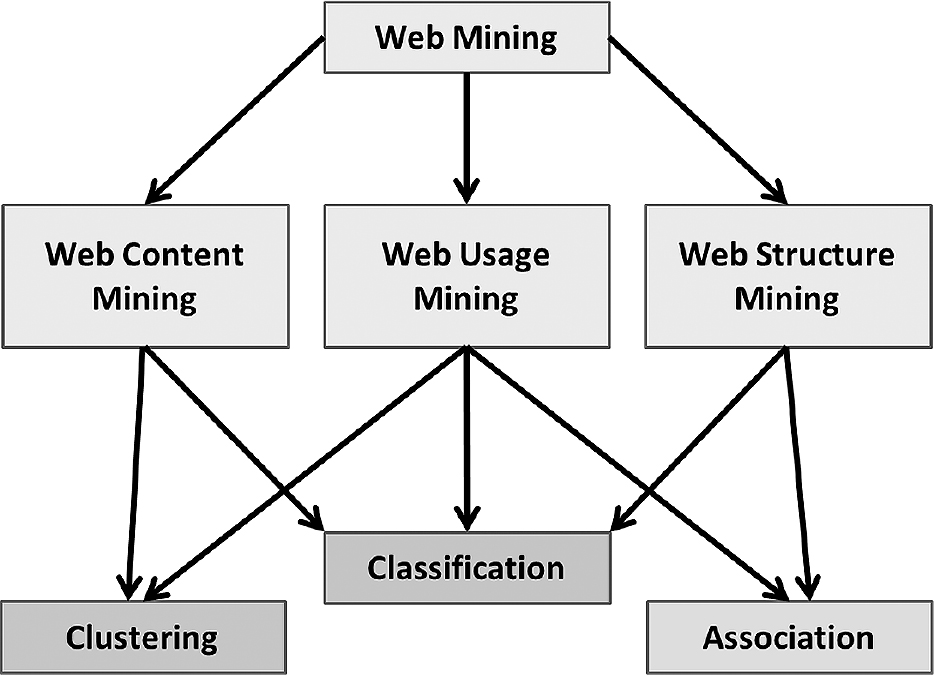
Note: Different forms of web mining can yield data on web usage, contents, and the structure of the Internet.
Web structure mining focuses on gathering and analyzing data on the connections (e.g., links) among webpages. This can help understand the technical properties of portions of the web, and often, other information can be inferred from this structure, which is literally shaped like a web in many cases. For example, one can choose a specific website and then assess other websites to see how many times they link to that particular site. A large number of links relative to other websites may suggest greater popularity. Observations such as these are used in a variety of tasks, such as ranking hits for search engine results.
...
- Criminal and Ethical Facets
- Economic Facets
- Adware
- Agriculture and the Internet
- Alibaba
- Amazon
- Back Offices, Call Centers, and the Internet
- Bitcoin
- Blockchain
- Broadband Internet Affordability
- Crowdfunding
- Cryptocurrencies
- e-Commerce: Business-to-Business
- e-Commerce: Business-to-Consumer
- e-Commerce: Business-to-Government
- e-Tailing
- eBay
- Economic Development and the Internet
- Energy Use and the Internet
- Fiber Optics and the Internet
- Internet Advertising
- Internet Banking
- Internet Recruiting
- Internet Taxation
- Location-Based Services
- Manufacturing and the Internet
- MercadoLibre
- PayPal
- Rural Areas and the Internet
- Sharing Economy and the Internet
- Smart Cities
- Smart Energy Systems
- Smart Grids
- Telework
- Tourism and the Internet
- Transportation and the Internet
- Virtual Teams
- Webinars
- Internet History and Governance
- Declaration of the Independence of Cyberspace
- ARPANET
- BITNET
- Cyclades
- Deep Packet Inspection
- Electronic Frontier Foundation
- Gopher
- Internet Architecture Board
- Internet Assigned Numbers Authority
- Internet Corporation for Assigned Names and Numbers
- Internet Engineering Task Force
- Internet Governance
- Internet Origins and History
- Internet Society
- Internet Standards
- NSFNET
- Usenet
- WELL, The
- World Wide Web
- World Wide Web Consortium
- Political and Legal Facets
- Anonymous
- Biometrics
- Clicktivism
- Cyberespionage
- Cybersecurity
- Cyberwarfare
- Distributed Denial-of-Service Attack
- e-Government
- Elections and the Internet
- Electronic Signatures
- Geoblocking
- Great Firewall
- Internet Activism
- Internet Censorship
- Internet Law
- Internet Surveillance
- m-Government
- Military Internet
- National Security Agency Surveillance
- Net Neutrality
- Right to Be Forgotten
- Right to Internet Access
- Slacktivism
- Social Movements and the Internet
- Stuxnet
- WikiLeaks
- Social, Behavioral, and Psychological Facets
- Augmented Reality
- Baidu
- Blind People and the Internet
- Blogs
- Chat Rooms
- Children, Adolescents, and the Internet
- Citizen Science
- Crowdsourcing
- Cybercafés
- Cyberoptimism and Cyberpessimism
- Cyberwellness
- Diasporas and the Internet
- Digital Divides, Disability and
- Digital Divides, Ethnicity and
- Digital Divides, Gender and
- Digital Divides, Geography of
- Digital Divides, Global
- Digital Divides, Language and
- Digital Earth
- Digital Humanities
- Digital Natives
- e-Health
- Education and the Internet: Colleges and Universities
- Education and the Internet: Elementary and Secondary Schools
- Elderly People and the Internet
- Electronic Literature
- Emojis and Emoticons
- Ethnographic Research and the Internet
- Google Earth
- Health Care and the Internet
- Internet Addiction
- Internet Dating
- Internet Gambling
- Internet Gaming
- Internet Mapping
- Internet Memes
- Internet Movie Database
- Internet Nonusers
- Internet Pornography
- Internet Privacy
- Internet Slang
- Internet Telephony
- iPhones
- Journalism and the Internet
- Libraries and the Internet
- Massive Open Online Courses
- Microblogs
- Mobile Internet
- Municipal Broadband
- Music and the Internet
- Myspace
- Neogeography
- Netflix
- Netiquette
- Netizen
- One Laptop per Child
- Online Social Networks
- Photo Sharing Applications
- Podcasting
- Project Loon
- Religion and the Internet
- Sexting
- Skype
- Smartphone Apps
- Smartphones
- Social Media
- Sports and the Internet
- Telecenters
- Telemedicine
- Television and the Internet
- Tencent
- Texting
- Tor
- Video Games and the Internet
- Virtual Reality
- Wearable Technologies
- Web 2.0
- Wi-Fi
- Wikipedia
- Yahoo
- YouTube
- Technical Facets
- AI Safety
- Algorithmic Selection on the Internet
- Broadband Internet
- CAPTCHA
- Cloud Computing
- Cookies
- Cyberinfrastructure
- Cyberspace
- Cybersquatting
- Deep Web
- Digital Steganography
- Digital Watermarking
- Domain Name
- Domain Name System
- Electronic Mailing Lists
- Ethernet
- File Sharing
- File Transfer Protocol
- Firewalls
- Freenet
- Geoweb
- Hashtag
- Hyperlink
- Hypertext Markup Language
- Hypertext Transfer Protocol
- Internet Backbone Networks
- Internet Connectivity
- Internet Data Centers
- Internet GIS
- Internet of Things
- Internet Routing
- Internet Service Providers
- IP Addresses
- Local Area Networks
- Packet Switching
- Peer-to-Peer Networks
- Satellite Internet
- Search Engine
- Semantic Web
- TCP/IP
- Traceroute
- Uniform Resource Locator
- Virtual Private Networks
- Volunteered Geographic Information
- Web Browsers
- Web Design
- Web GIS
- Web Mining
- Web Programming
- Webometrics
- Website and Webpage
- Wide Area Networks
- Loading...
Get a 30 day FREE TRIAL
-
 Watch videos from a variety of sources bringing classroom topics to life
 -
Read modern, diverse business cases
-
Explore hundreds of books and reference titles

Read next

More like this
Sage Recommends
We found other relevant content for you on other Sage platforms.
Have you created a personal profile? Login or create a profile so that you can save clips, playlists and searches