
Entry
Reader's guide
Entries A-Z
Subject index
Cloud Computing
Cloud computing has been defined in multiple ways in both academia and industry, but it can be defined most simply as a model of service delivery and access where dynamically scalable and virtualized resources (i.e., virtual versions of servers, storage, databases, networks, applications, and services) are provided as a service over the Internet. This entry further elaborates cloud computing, then discusses its advantages, evolution, and deployment models and services.
Cloud computing (also referred to simply as “the cloud”) allows access to the Internet’s infrastructure (e.g., Amazon Elastic Compute Cloud [EC2]), platforms (e.g., Google App Engine), and software (e.g., Salesforce), which are provided by cloud providers (e.g., Amazon, Google, Microsoft), third-party service providers, and service and application providers at low cost in an on-demand fashion at any time, from anywhere. It offers on-demand resources from a pool of virtualized resources to tackle elasticity and scalability for large-scale computational tasks.
Cloud computing has become mature and pervasive and is widely recognized as essential in addressing the needs of businesses in emerging areas such as artificial intelligence, machine learning, analytics, and orchestration. Some widely used cloud-based applications and services are Apple’s iCloud, Apple’s Siri, YouTube, Dropbox, Facebook, Twitter, Gmail, and Office 365, just to name a few. Figure 1 shows an overview of cloud computing.
Figure 1 Overview of Cloud Computing: Characteristics, Challenges, Service Delivery, and Deployment Models
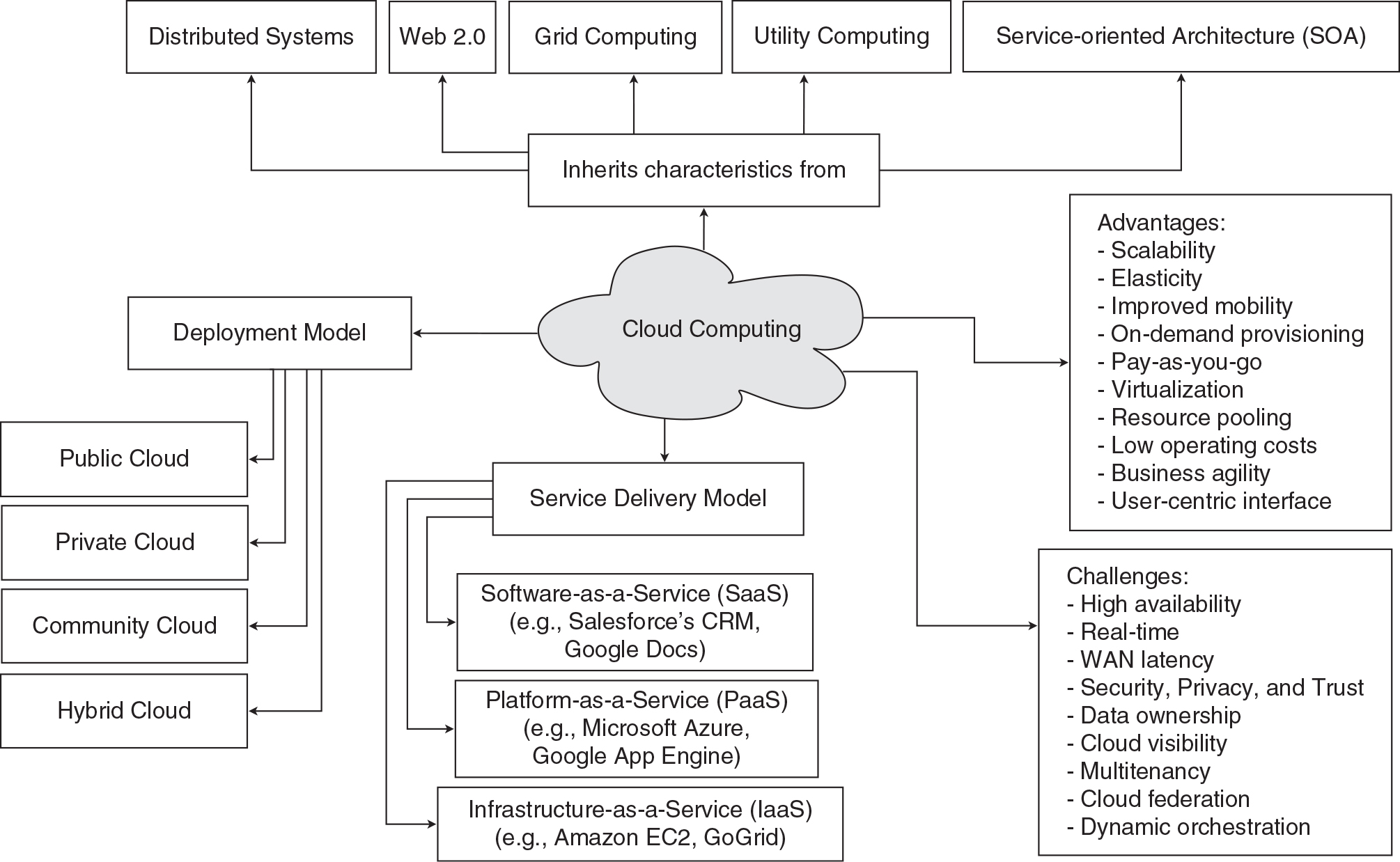
From a technological point of view, not only has cloud computing become an integral part of the most highly impactful technologies such as mobile Internet, automation of knowledge, Internet of Things, and big data, but it also has been identified as the next-generation computing infrastructure. From an economic point of view, clouds offer tremendous benefits. For instance, McKinsey Global Institute reported in 2013 that the total economic impact of cloud technology could be $1.7 trillion to $6.2 trillion annually in 2025 and the proliferation and sophistication of cloud services could become a major driving force in making entrepreneurship more feasible.
Advantages of Cloud Computing
The key advantages of cloud computing are summarized as follows:
- Dynamic provisioning/de-provisioning: Clouds provide dynamic, on-demand provisioning of resources. They create a virtual machine (VM) instance whenever end users need it and terminate it whenever they do not.
- Elasticity: Elasticity allows dynamic scaling—that is, provisioning and de-provisioning of computing resources based on actual demand. Elasticity in cloud infrastructure enables the hypervisor to create VMs or containers with the resources to meet real-time demand. The hypervisor is also known as a VM monitor, which is a thin layer of software that creates and runs multiple VMs as well as manages the operation of a virtualized environment on the top of a real host node. Some popular hypervisors include Xen, Kernel-based VM, Quick Emulator, and Oracle VM VirtualBox.
- Scalability: Scalability is a desirable property of any system, network, or process that indicates either its ability to handle an increased workload or its potential to be enlarged in order to accommodate that growth. There are two types of scalability: (1) vertical scalability and (2) horizontal scalability. Vertical scalability (scaling up) is accomplished by adding more resources (e.g., more memory or additional central processing units, or moving an application to a bigger VM) to a single node in a system. Horizontal scalability (scaling out), on the other hand, is the ability to increase capacity by adding multiple nodes (VMs) to a system and dividing the workload among them.
- Multitenancy: Multitenancy is the ability to share resources and costs to support a variety of applications and many end users.
- Pay per use: Cloud computing offers a pay-per-use billing model, by which it reduces the cost and complexity of owning computing and network infrastructures.
- Ease of integration: In cloud computing environments, multiple services from different third parties can be integrated easily. In addition, open application programming interfaces allow telecommunications operators to create the services needed to compete with content and application providers such as Dropbox, Apple, Facebook, Google, and Netflix since the service provider delivers one or multiple services (e.g., cloud services, communications, media content, social networks) over the Internet. Besides the aforementioned advantages, cloud computing poses many challenges, including large and variable wide area network (WAN) latency, real-time response, reliability and high availability, privacy and security, and regulation and compliance, among others.
Evolution of Cloud Computing
The overarching concept of cloud computing is rooted in the 1960s. Cloud computing implements utility computing, an idea discussed by John McCarthy (known as the father of artificial intelligence) in 1961. In utility computing, computing is viewed as a public utility just like the telephone system. Each customer needs to pay only for the capacity that he or she uses.
...
- Criminal and Ethical Facets
- Economic Facets
- Adware
- Agriculture and the Internet
- Alibaba
- Amazon
- Back Offices, Call Centers, and the Internet
- Bitcoin
- Blockchain
- Broadband Internet Affordability
- Crowdfunding
- Cryptocurrencies
- e-Commerce: Business-to-Business
- e-Commerce: Business-to-Consumer
- e-Commerce: Business-to-Government
- e-Tailing
- eBay
- Economic Development and the Internet
- Energy Use and the Internet
- Fiber Optics and the Internet
- Internet Advertising
- Internet Banking
- Internet Recruiting
- Internet Taxation
- Location-Based Services
- Manufacturing and the Internet
- MercadoLibre
- PayPal
- Rural Areas and the Internet
- Sharing Economy and the Internet
- Smart Cities
- Smart Energy Systems
- Smart Grids
- Telework
- Tourism and the Internet
- Transportation and the Internet
- Virtual Teams
- Webinars
- Internet History and Governance
- Declaration of the Independence of Cyberspace
- ARPANET
- BITNET
- Cyclades
- Deep Packet Inspection
- Electronic Frontier Foundation
- Gopher
- Internet Architecture Board
- Internet Assigned Numbers Authority
- Internet Corporation for Assigned Names and Numbers
- Internet Engineering Task Force
- Internet Governance
- Internet Origins and History
- Internet Society
- Internet Standards
- NSFNET
- Usenet
- WELL, The
- World Wide Web
- World Wide Web Consortium
- Political and Legal Facets
- Anonymous
- Biometrics
- Clicktivism
- Cyberespionage
- Cybersecurity
- Cyberwarfare
- Distributed Denial-of-Service Attack
- e-Government
- Elections and the Internet
- Electronic Signatures
- Geoblocking
- Great Firewall
- Internet Activism
- Internet Censorship
- Internet Law
- Internet Surveillance
- m-Government
- Military Internet
- National Security Agency Surveillance
- Net Neutrality
- Right to Be Forgotten
- Right to Internet Access
- Slacktivism
- Social Movements and the Internet
- Stuxnet
- WikiLeaks
- Social, Behavioral, and Psychological Facets
- Augmented Reality
- Baidu
- Blind People and the Internet
- Blogs
- Chat Rooms
- Children, Adolescents, and the Internet
- Citizen Science
- Crowdsourcing
- Cybercafés
- Cyberoptimism and Cyberpessimism
- Cyberwellness
- Diasporas and the Internet
- Digital Divides, Disability and
- Digital Divides, Ethnicity and
- Digital Divides, Gender and
- Digital Divides, Geography of
- Digital Divides, Global
- Digital Divides, Language and
- Digital Earth
- Digital Humanities
- Digital Natives
- e-Health
- Education and the Internet: Colleges and Universities
- Education and the Internet: Elementary and Secondary Schools
- Elderly People and the Internet
- Electronic Literature
- Emojis and Emoticons
- Ethnographic Research and the Internet
- Google Earth
- Health Care and the Internet
- Internet Addiction
- Internet Dating
- Internet Gambling
- Internet Gaming
- Internet Mapping
- Internet Memes
- Internet Movie Database
- Internet Nonusers
- Internet Pornography
- Internet Privacy
- Internet Slang
- Internet Telephony
- iPhones
- Journalism and the Internet
- Libraries and the Internet
- Massive Open Online Courses
- Microblogs
- Mobile Internet
- Municipal Broadband
- Music and the Internet
- Myspace
- Neogeography
- Netflix
- Netiquette
- Netizen
- One Laptop per Child
- Online Social Networks
- Photo Sharing Applications
- Podcasting
- Project Loon
- Religion and the Internet
- Sexting
- Skype
- Smartphone Apps
- Smartphones
- Social Media
- Sports and the Internet
- Telecenters
- Telemedicine
- Television and the Internet
- Tencent
- Texting
- Tor
- Video Games and the Internet
- Virtual Reality
- Wearable Technologies
- Web 2.0
- Wi-Fi
- Wikipedia
- Yahoo
- YouTube
- Technical Facets
- AI Safety
- Algorithmic Selection on the Internet
- Broadband Internet
- CAPTCHA
- Cloud Computing
- Cookies
- Cyberinfrastructure
- Cyberspace
- Cybersquatting
- Deep Web
- Digital Steganography
- Digital Watermarking
- Domain Name
- Domain Name System
- Electronic Mailing Lists
- Ethernet
- File Sharing
- File Transfer Protocol
- Firewalls
- Freenet
- Geoweb
- Hashtag
- Hyperlink
- Hypertext Markup Language
- Hypertext Transfer Protocol
- Internet Backbone Networks
- Internet Connectivity
- Internet Data Centers
- Internet GIS
- Internet of Things
- Internet Routing
- Internet Service Providers
- IP Addresses
- Local Area Networks
- Packet Switching
- Peer-to-Peer Networks
- Satellite Internet
- Search Engine
- Semantic Web
- TCP/IP
- Traceroute
- Uniform Resource Locator
- Virtual Private Networks
- Volunteered Geographic Information
- Web Browsers
- Web Design
- Web GIS
- Web Mining
- Web Programming
- Webometrics
- Website and Webpage
- Wide Area Networks
- Loading...
Get a 30 day FREE TRIAL
-
 Watch videos from a variety of sources bringing classroom topics to life
 -
Read modern, diverse business cases
-
Explore hundreds of books and reference titles

Read next

More like this
Sage Recommends
We found other relevant content for you on other Sage platforms.
Have you created a personal profile? Login or create a profile so that you can save clips, playlists and searches