
Entry
Reader's guide
Entries A-Z
Subject index
Zebrafish Models to Study Stem Cells
Stem cells arise before the birth of an organism. During embryonic development, stem cells acquire the abilities to generate replica copies (self-renewal) and produce more specialized cell types (differentiation). Understanding how stem cells form inside organisms could provide scientists with better tools to manipulate stem cells in a dish, which would greatly enhance stem cell utility in regenerative medicine. Although nature can faithfully generate stem cells in vivo, scientists have been unable to crack this code. Model organisms, such as the zebrafish, can provide a window into the earliest events in a stem cell’s birth. Additionally, unlike mammals, zebrafish maintain the ability to completely regenerate most organs as adults, thus allowing a dissection of the necessary signals to facilitate tissue regeneration in higher vertebrates.
Zebrafish as a Model Organism
Zebrafish are small tropical freshwater fish often utilized in biomedical research with many advantages for such use. For example, embryos are fertilized ex vivo and grow outside the mother, allowing easy visualization of development. Additionally, development occurs rapidly, taking only days to transition from fertilized egg to free-swimming larva. Moreover, hundreds of embryos can be produced from a single pair of adult zebra-fish. This attribute, combined with their small size, allows large numbers of zebrafish to be produced and housed in a small space, making large-scale projects more practical and affordable. In addition to physical attributes, zebrafish are a great tool for biomedical research as they share a great deal of genetic similarity to humans. Combined, these characteristics make zebrafish an ideal vertebrate model for discovery of new regulators of stem cells.
Large-Scale Screening in Zebrafish
Zebrafish are attractive models for performing large-scale screening projects to identify novel factors controlling stem cells. Two main types of screens are performed in zebrafish: genetic and chemical. Genetic screens work by introducing hundreds to thousands of random mutations into DNA. If the mutation is recessive and disrupts the function of the gene product, when a zebrafish carries two mutant copies of the gene, it displays abnormal traits. For example, a forward genetic screen was performed to identify genes essential for hematopoietic stem cell (HSC) formation. Mutants lack HSCs and all differentiated blood cells. The screen uncovered roles for ribosomal components, splicing machinery, and epigenetic modifiers in HSC emergence. Defects in all of these processes were later linked to a variety of human blood disorders, such as bone marrow failure syndromes and malignancies thought to initiate from aberrant stem cells.
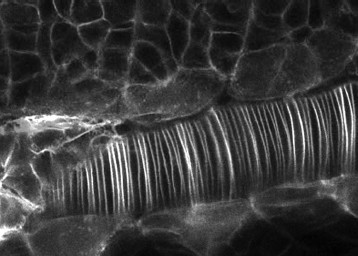
Studies of zebrafish embryonic development may help determine the underlying cause of common neural tube defects–such as spina bifida–which occur in about 1 in 1,000 newborn children. These “see through” embryos allow all internal development to be cl early observed from the outside. (National Institute of General Medical Sciences/Alexander Schler)
In addition to genetic screens, zebrafish are amenable to drug screens. For these screens, developing zebrafish are exposed to a library of chemicals and then assessed for defects. The compounds used in screening often affect known pathways; thus similar to genetic screens, chemical screens can provide insight into which factors are essential for stem cell development. Moreover, many available chemical libraries consist of FDA-approved drugs, thus small molecules identified in zebrafish screens have a high potential to move quickly into the clinic. For example, a zebrafish chemical screen published in 2007 identified an essential role for the prostaglandin E2 (PGE2) pathway in HSC formation and was later shown to expand mammalian HSCs ex vivo. A clinical trial is already under way to test PGE2-mediated expansion of HSCs for human cord blood transplantation.
...
- Adipose: Cell Types Composing the Tissue
- Adipose: Current Research on Isolation or Production of Therapeutic Cells
- Adipose: Development and Regeneration Potential
- Adipose: Existing or Potential Regenerative Medicine Strategies
- Adipose: Major Pathologies
- Adipose: Stem and Progenitor Cells in Adults
- Adipose: Tissue Function
- Adult Stem Cells: Overview
- Bladder: Cell Types Composing the Tissue
- Bladder: Current Research on Isolation or Production of Therapeutic Cells
- Bladder: Development and Regeneration Potential
- Bladder: Existing or Potential Regenerative Medicine Strategies
- Bladder: Major Pathologies
- Bladder: Stem and Progenitor Cells in Adults
- Blood Adult Stem Cell: Current Research on Isolation or Production of Therapeutic Cells
- Blood Adult Stem Cell: Development and Regeneration Potential
- Blood Adult Stem Cell: Existing or Potential Regenerative Medicine Strategies
- Blood Adult Stem Cell: Major Pathologies
- Blood Adult Stem Cell: Stem and Progenitor Cells in Adults
- Bone: Cell Types Composing the Tissue
- Bone: Current Research on Isolation or Production of Therapeutic Cells
- Bone: Development and Regeneration Potential
- Bone: Existing or Potential Regenerative Medicine Strategies
- Bone: Major Pathologies
- Bone: Stem and Progenitor Cells in Adults
- Breast: Cell Types Composing the Tissue
- Breast: Current Research on Isolation or Production of Therapeutic Cells
- Breast: Development and Regeneration Potential
- Breast: Existing or Potential Regenerative Medicine Strategies
- Breast: Major Pathologies
- Breast: Stem and Progenitor Cells in Adults
- Cartilage, Tendons, and Ligaments: Cell Types Composing the Tissue
- Cartilage, Tendons, and Ligaments: Current Research on Isolation or Production of Therapeutic Cells
- Cartilage, Tendons, and Ligaments: Development and Regeneration Potential
- Cartilage, Tendons, and Ligaments: Existing or Potential Regenerative Medicine Strategies
- Cartilage, Tendons, and Ligaments: Major Pathologies
- Cartilage, Tendons, and Ligaments: Stem and Progenitor Cells in Adults
- Dental: Current Research on Isolation or Production of Therapeutic Cells
- Dental: Development and Regeneration Potential
- Dental: Existing or Potential Regenerative Medicine Strategies
- Dental: Major Pathologies
- Dental: Stem and Progenitor Cells in Adults
- Eyes: Cell Types Composing the Tissue
- Eyes: Current Research on Isolation or Production of Therapeutic Cells
- Eyes: Development and Regeneration Potential
- Eyes: Existing or Potential Regenerative Medicine Strategies
- Eyes: Major Pathologies
- Eyes: Stem and Progenitor Cells in Adults
- Eyes: Tissue Function
- Gonads, Female: Cell Types Composing the Tissue
- Gonads, Female: Current Research on Isolation or Production of Therapeutic Cells
- Gonads, Female: Development and Regeneration Potential
- Gonads, Female: Major Pathologies
- Gonads, Female: Stem and Progenitor Cells in Adults
- Gonads, Male: Cell Types Composing the Tissue
- Gonads, Male: Current Research on Isolation or Production of Therapeutic Cells
- Gonads, Male: Development and Regeneration Potential
- Gonads, Male: Existing or Potential Regenerative Medicine Strategies
- Gonads, Male: Major Pathologies
- Gonads, Male: Stem and Progenitor Cells in Adults
- Graft Failure: Graft-Versus-Host Disease
- Gut: Current Research on Isolation or Production of Therapeutic Cells
- Gut: Development and Regeneration Potential
- Gut: Existing or Potential Regenerative Medicine Strategies
- Gut: Major Pathologies
- Gut: Stem and Progenitor Cells in Adults
- Heart: Cell Types Composing the Tissue
- Heart: Current Research on Isolation or Production of Therapeutic Cells
- Heart: Development and Regeneration Potential
- Heart: Existing or Potential Regenerative Medicine Strategies
- Heart: Major Pathologies
- Heart: Stem and Progenitor Cells in Adults
- Heart: Tissue Function
- Kidney: Cell Types Composing the Tissue
- Kidney: Current Research on Isolation or Production of Therapeutic Cells
- Kidney: Development and Regeneration Potential
- Kidney: Existing or Potential Regenerative Medicine Strategies
- Kidney: Major Pathologies
- Kidney: Stem and Progenitor Cells in Adults
- Liver: Cell Types Composing the Tissue
- Liver: Current Research on Isolation or Production of Therapeutic Cells
- Liver: Development and Regeneration Potential
- Liver: Existing or Potential Regenerative Medicine Strategies
- Liver: Major Pathologies
- Liver: Stem and Progenitor Cells in Adults
- Liver: Tissue Function
- Lung: Cell Types Composing the Tissue
- Lung: Current Research on Isolation or Production of Therapeutic Cells
- Lung: Development and Regeneration Potential
- Lung: Existing or Potential Regenerative Medicine Strategies
- Lung: Major Pathologies
- Lung: Stem and Progenitor Cells in Adults
- Lung: Tissue Function
- Mesenchymal: Cell Types Composing the Tissue
- Mesenchymal: Current Research on Isolation or Production of Therapeutic Cells
- Mesenchymal: Development and Regeneration Potential
- Mesenchymal: Existing or Potential Regenerative Medicine Strategies
- Mesenchymal: Major Pathologies
- Mesenchymal: Stem and Progenitor Cells in Adults
- Muscle: Cell Types Composing the Tissue
- Muscle: Current Research on Isolation or Production of Therapeutic Cells
- Muscle: Development and Regeneration Potential
- Muscle: Existing or Potential Regenerative Medicine Strategies
- Muscle: Major Pathologies
- Muscle: Stem and Progenitor Cells in Adults
- Neural: Cell Types Composing the Tissue
- Neural: Current Research on Isolation or Production of Therapeutic Cells
- Neural: Development and Regeneration Potential
- Neural: Existing or Potential Regenerative Medicine Strategies
- Neural: Major Pathologies
- Neural: Stem and Progenitor Cells in Adults
- Pancreas: Cell Types Composing the Tissue
- Pancreas: Current Research on Isolation or Production of Therapeutic Cells
- Pancreas: Development and Regeneration Potential
- Pancreas: Existing or Potential Regenerative Medicine Strategies
- Pancreas: Major Pathologies
- Pancreas: Stem and Progenitor Cells in Adults
- Pancreas: Tissue Function
- Skin: Cell Types Composing the Tissue
- Skin: Current Research on Isolation or Production of Therapeutic Cells
- Skin: Development and Regeneration Potential
- Skin: Existing or Potential Regenerative Medicine Strategies
- Skin: Major Pathologies
- Skin: Stem and Progenitor Cells in Adults
- Skin: Tissue Function
- Sweat Gland: Cell Types Composing the Tissue
- Sweat Gland: Current Research on Isolation or Production of Therapeutic Cells
- Sweat Gland: Development and Regeneration Potential
- Sweat Gland: Existing or Potential Regenerative Medicine Strategies
- Sweat Gland: Major Pathologies
- Sweat Gland: Stem and Progenitor Cells in Adults
- Vascular Stem Cell
- C. elegans Models to Study Stem Cells
- Drosophila Models to Study Stem Cells
- Mouse Models to Study Stem Cells
- Rat Models to Study Stem Cells
- Xenopus Models to Study Stem Cells
- Zebrafish Models to Study Stem Cells
- Brain Cancer
- Breast Cancer
- Cancer Stem Cells: Overview
- Colon Cancer
- Head and Neck Cancer
- Leukemia and Lymphoma Cancer Stem Cells
- Liver Cancer
- Lung Cancer
- Melanoma: Stem Cells
- Pancreatic Cancer
- Skin Cancer
- Clinical Trials, U.S.: AIDS-Related Conditions
- Clinical Trials, U.S.: Amyotrophic Lateral Sclerosis
- Clinical Trials, U.S.: Batten Disease
- Clinical Trials, U.S.: Blood Deficiencies
- Clinical Trials, U.S.: Crohn’s Disease
- Clinical Trials, U.S.: Diabetes
- Clinical Trials, U.S.: Eye Conditions
- Clinical Trials, U.S.: Graft Failure, Graft-Versus-Host Disease
- Clinical Trials, U.S.: Heart Disease
- Clinical Trials, U.S.: Hematological Cancers
- Clinical Trials, U.S.: Immunologic/Histiocytic Disorders
- Clinical Trials, U.S.: Kidney Disease
- Clinical Trials, U.S.: Multiple Sclerosis
- Clinical Trials, U.S.: Parkinson’s Disease
- Clinical Trials, U.S.: Peripheral Vascular Disease
- Clinical Trials, U.S.: Skin Transplants
- Clinical Trials, U.S.: Solid Tumors
- Clinical Trials, U.S.: Spinal Cord Injury
- Clinical Trials, U.S.: Stroke
- Clinical Trials, U.S.: Traumatic Brain Injury
- Clinical Trials Outside the United States
- Clinical Trials Outside the United States: Amyotrophic Lateral Sclerosis
- Clinical Trials Outside the United States: Cerebral Palsy
- Clinical Trials Outside the United States: Spinal Cord Injury
- Clinical Trials Outside the United States: Stroke
- Animal Cloning
- Reproductive and Therapeutic Cloning
- Australia
- Belgium
- Brazil
- China
- Denmark
- France
- Germany
- India
- Iran
- Italy
- Japan
- Korea
- Netherlands
- Norway
- Saudi Arabia
- Singapore
- Spain
- Sweden
- Switzerland
- Taiwan
- United Kingdom
- United States
- Chimera Formation, Ethics of
- Clinical Trials, Ethics of
- Clinical Trials (Adult Cells), Ethics of
- Cloning, Ethics of
- Egg Donation, Ethics of
- Genome Sequencing, Ethics of
- Germ Cell Modifications (Gene Therapy), Ethics of
- In Vitro Production of Germ Cells, Ethics of
- Moral Status of Embryos
- Unapproved Therapy, Ethics of
- Tissue Engineering (Scaffold)
- Tissue Printing
- Aastrom Biosciences, Inc.
- Advanced Cell Technology
- Athersys
- Beike Biotechnology
- California Stem Cell, Inc.
- Cellerant Therapeutics
- Cryo-Cell International
- Cryo-Save
- Cytori Therapeutics, Inc.
- ES Cell International
- Fate Therapeutics
- Geron Corporation
- International Stem Cell Corporation
- Lentigen Corporation
- NeoStem, Inc.
- Neuralstem, Inc.
- New Biotech: Overview
- Parcell Laboratories
- Pathfinder Cell Therapy
- Stem Cell Companies: Overview
- Stemagen
- Stematix
- TiGenix/Cellerix
- ViaCyte, Inc.
- Albert Einstein College of Medicine
- Autonomous University of Barcelona
- Autonomous University of Madrid
- Baylor University
- Boston Children’s Hospital
- California Institute for Regenerative Medicine
- Case Western Reserve University/Cleveland Clinic
- Columbia University
- Coriell Institute for Medical Research
- Duke University
- Genetics Policy Institute
- Harvard University
- Hebrew University of Jerusalem
- Howard Hughes Medical Institute
- Indiana University
- Johns Hopkins University
- Karolinska Institute
- Kyoto University
- Massachusetts General Hospital
- Massachusetts Institute of Technology
- Max Planck Society
- Mayo Clinic
- McMaster University
- Mount Sinai School of Medicine
- National Academy of Sciences
- Northwestern University
- Oregon Health & Science University
- Ottawa Hospital Research Institute
- Pasteur Institute
- Peking University
- Princeton University
- Reeve-Irvine Research Center
- Robarts Research Institute
- Rockefeller University
- Rutgers University
- Sanford-Burnham Medical Research Institute
- Scripps Research Institute
- Sloan Kettering Institute
- Stanford University
- Stowers Institute for Medical Research
- University of Bonn
- University of British Columbia
- University of California, Berkeley
- University of California, Davis
- University of California, Los Angeles
- University of California, San Diego
- University of California, San Francisco
- University of Cambridge
- University of Connecticut
- University of Heidelberg
- University of Melbourne
- University of Miami
- University of Michigan
- University of Milan
- University of Minnesota
- University of North Carolina at Chapel Hill
- University of Oxford
- University of Pittsburgh
- University of Southern California
- University of Strasbourg
- University of Texas Health Science Center at Houston
- University of Tokyo
- University of Toronto
- University of Washington/Fred Hutchinson Cancer Research Center
- University of Wisconsin–Madison
- University Pierre et Marie Curie, Paris
- Vanderbilt of University
- Wake Forest University
- Weill Cornell Medical College
- Weizmann Institute of Science
- Whitehead Institute for Biomedical Research
- Yale University
- Bioreactors
- Xenotransplantation
- Gene Patents
- International Society for Stem Cell Research Guidelines
- Pluripotent Stem Cell Patents
- Bone Marrow Transplants
- Direct Reprogramming of Adult Cells Into Other Cell Types
- Endothelial Cell Isolation
- Fluorescence-Activated Cell Sorting
- Genome Sequencing
- Human ES Cell Isolation
- In Vitro Fertilization
- In Vitro Stem Cell Study Assays
- In Vivo Stem Cell Study Assays
- Lineage Tracing
- Mouse ES Cell Isolation
- MRI Tracking
- Non-Human Primate Embryonic Stem Cells
- Nuclear Transfer, Altered
- Nuclear Transfer, Somatic Cell
- Parthogenesis
- Preimplantation Genetic Diagnosis
- Profiling Study Methods
- Stem Cell Epigenetic: Chromatin Modification
- Stem Cell Epigenetic: DNA Methylation
- Stem Cell Epigenetic: DNA Replication
- Stem Cell Expression Profiling
- Stem Cell Genetic Modification Study Method
- Stem Cell Markers
- Stem Cell Purification
- Tissue Culture Study Methods
- Viral Vectors: Adeonvirus
- Viral Vectors: Lentivirus
- Amniotic Fluid Cells
- Cord Blood Stem Cells
- Fetal Stem Cells
- Mesenchymal Stem Cells
- American Association for the Advancement of Science
- California Institute for Regenerative Medicine
- Canada: Stem Cell Network
- Christopher & Dana Reeve Foundation, The
- Danish Stem Cell Research
- EuroStemCell
- Howard Hughes Medical Institute
- International Society for Stem Cell Research
- International Stem Cell Forum
- Japan Human Cell Society
- Lasker Foundation
- Medical Research Council (UK)
- Michael J. Fox Foundation
- National Institutes of Health
- National Science Foundation
- National Stem Cell Bank
- New York Stem Cell Foundation
- Parkinson’s Disease Foundation
- Scotland: Stem Cell Research and Regenerative Medicine
- Stem Cell Genome Anatomy Projects
- Stem Cell Network North Rhine Westphalia
- Swiss Stem Cells Network
- UK National Stem Cell Network
- WiCell
- Alvarez-Buylla, Arturo
- Anversa, Piero
- Charo, Alta
- Frenette, Paul
- Fuchs, Elaine
- Goldman, Steven A.
- Hochedlinger, Konrad
- Langer, Robert
- Losordo, Douglas
- Martino, Gianvito
- McCulloch, Ernest
- Orkin, Stuart
- Pera, Martin
- Rafii, Shahin
- Rao, Mahendra
- Reynolds, Brent A., and Samuel Weiss
- Scadden, David
- Snyder, Evan
- Steindler, Dennis
- Studer, Lorenz
- Thomson, James
- Till, James
- van der Kooy, Derek
- Vescovi, Angelo
- Weissman, Irving
- Yamanaka, Shinya
- Embryonic Stem Cells, Methods to Produce
- iPS, Methods to Produce
- iPS Tissue Sources
- iPSC From Animal Cells
- Pluripotency Network
- Pluripotent Stem Cells, Embryonic
- Pluripotent Stem Cells, Epi
- Pluripotent Stem Cells, Germ
- Pluripotent Stem Cells, Teratoma
- Advocacy
- Congress: Votes and Amendments
- Do No Harm: The Coalition of Americans for Research Ethics
- National Right to Life Committee
- President’s Council on Bioethics
- Special Interest/Lobby Groups
- Stem Cells: Bush Ruling
- Buddhism
- Catholicism
- Christianity
- Judaism
- Muslim
- Alzheimer’s Disease
- Animal Cloning
- Autism
- Cord Blood Banking
- Cosmetic Surgery
- Drug Testing and Drug Development in Cell Culture
- Endothelial Blood Vessels
- ESC and iPSC Banking
- Fertility Treatment Creation of Germ Cells From Adult Cells
- Food From Stem Cells
- Gene Therapy: Hemoglobinopathies
- Graft Failure: Graft-Versus-Host Disease
- Hearing Disease
- Heart Disease
- Hematopoietic Transplantation: Cancer
- Hematopoietic Transplantation: Gene Therapy
- Immune Disorders
- In Utero Treatment
- Kidney Disease
- Lung Disease
- Pancreatic Islet Transplant
- Parkinson’s Disease
- Radiation Injury Treatment
- Retinal Stem Cells
- Schizophrenia
- Skin Graft
- Spinal Cord Injury
- Stem Cell Banking
- Transfusion Product: NK Cells
- Transfusion Product: Platelets
- Transfusion Product: Red Blood Cells
- Wound Repair
- Self-Renewal and Differentiation
- Stem Cell Aging
- Stem Cell Differentiation/Self-Organization
- Stem Cell DNA Repair
- Stem Cell Ground State
- Stem Cell Histocompatibility
- Stem Cell Niche
- Stem Cell Plasticity
- Stem Cell Potency
- Tissue Regeneration: Animals and Plants
- Tissue Regeneration: Humans
- Transit Amplifying Cells
- Alabama
- Alaska
- Arizona
- Arkansas
- California
- Colorado
- Connecticut
- Delaware
- Florida
- Georgia
- Hawai’i
- Idaho
- Illinois
- Indiana
- Iowa
- Kansas
- Kentucky
- Louisiana
- Maine
- Maryland
- Massachusetts
- Michigan
- Minnesota
- Mississippi
- Missouri
- Montana
- Nebraska
- Nevada
- New Hampshire
- New Jersey
- New Mexico
- New York
- North Carolina
- North Dakota
- Ohio
- Oklahoma
- Oregon
- Pennsylvania
- Rhode Island
- South Carolina
- South Dakota
- Tennessee
- Texas
- Utah
- Vermont
- Virginia
- Washington
- West Virginia
- Wisconsin
- Wyoming
- Loading...
Get a 30 day FREE TRIAL
-
 Watch videos from a variety of sources bringing classroom topics to life
 -
Read modern, diverse business cases
-
Explore hundreds of books and reference titles

Read next

More like this
Sage Recommends
We found other relevant content for you on other Sage platforms.
Have you created a personal profile? Login or create a profile so that you can save clips, playlists and searches