
Entry
Reader's guide
Entries A-Z
Subject index
Stem Cell Potency
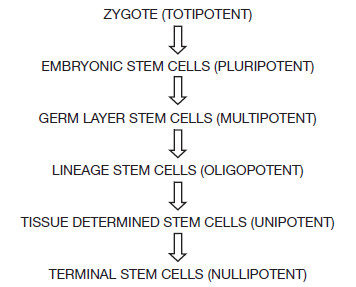
Stem cells are undifferentiated biological cells found in multicellular organisms that can divide and differentiate into various specialized cell types. This ability to differentiate into various cell types is called cell potency. The word potency itself comes from the Latin word potens, which means having power. As it relates to stem cells, potency specifies the differentiation power or potential of a cell. Therefore, the more cell types a cell can differentiate into then the stronger its potency. Potency is an important characteristic of stem cells and this property is being studied for application in stem cell-based therapies. Stem cell potency varies from totipotency to unipotency.
The various grades are as follows
- Totipotency
- Pluripotency
- Multipotency
- Oligopotency
- Unipotency
Potency decreases along the line of development, which means the zygote is the totipotent cell from where life begins.
Totipotency
The word toti comes from the Latin totus, meaning entirely. Totipotency is the ability of a single cell to differentiate into all types of differentiated cells in an organism. Totipotent cells have two basic characteristics:
- They have the ability to become any cell type in a fully developed human.
- They can divide in unlimited numbers without losing their totipotency.
Totipotent stem cells can differentiate into any type of specialized cell, both embryonic (embryonic stem cells are derived from embryos that develop from eggs that have been fertilized) and extra embryonic (cells that support the embryo) and so have the highest differentiation potential. An example of totipotent cells is the zygote and the cells produced from its first few divisions. Each totipotent stem cell can give rise to a complete organism. A totipotent zygotic cell is formed by the union of an egg and a sperm. This cell now has the potential to give rise to virtually all human cells. The zygote divides and gives rise to more and more totipotent cells. After approximately four days, these cells begin to specialize into pluripotent cells. These pluripotent cells have decreased differentiation potential.
Pluripotency
Pluripotent stem cells are descendants of totipotent cells and have the ability to differentiate into nearly all cell types. They can differentiate and form cells from all three germ layers (cell layers found in early embryo): ectoderm, mesoderm, and endoderm.
The difference between totipotent and pluripotent stem cells is slight, but significant. Pluripotent cells are similar to totipotent cells in that they can give rise to any and all human cells. The difference is that they are not capable of giving rise to an entire organism. On day four of development, the embryo forms two layers: one becomes the placenta (a temporary organ that joins the mother and fetus, permitting oxygen and nutrients to transfer from the mother to the fetus and the release of waste products from the fetus) and the other becomes the baby. The cells that will become the baby can give rise to any human tissue type, but alone these cannot give rise to the entire organism.
Pluripotent stem cells are true stem cells and are being studied for their enormous research and therapeutic potential. There are various types of pluripotent cells.
- Induced pluripotent cells (iPS cells): Induced pluripotent stem cells are generated directly from adult cells. These are actually reprogrammed cells with pluripotent capacity. The technology was first pioneered in 2006 in Japan, where they introduced four specific genes in an adult cell to convert it into a pluripotent cell; these were called induced pluripotent cells or iPS cells. These iPS cells can be made patient specific and may be used in creating transplants without the risk of immune rejection.
True embryonic stem cells (ES cells): These are cells derived from the inner cell mass of the blastocyst (the blastocyst is an early developmental stage of the embryo). Embryonic stem cells give rise to derivatives of all three basic germ layers (endoderm, ectoderm, and mesoderm). When given appropriate stimulation, they can develop into any specialized adult cell. ES cells therefore have immense potential to develop therapeutic cells and tissues.
...
- Adipose: Cell Types Composing the Tissue
- Adipose: Current Research on Isolation or Production of Therapeutic Cells
- Adipose: Development and Regeneration Potential
- Adipose: Existing or Potential Regenerative Medicine Strategies
- Adipose: Major Pathologies
- Adipose: Stem and Progenitor Cells in Adults
- Adipose: Tissue Function
- Adult Stem Cells: Overview
- Bladder: Cell Types Composing the Tissue
- Bladder: Current Research on Isolation or Production of Therapeutic Cells
- Bladder: Development and Regeneration Potential
- Bladder: Existing or Potential Regenerative Medicine Strategies
- Bladder: Major Pathologies
- Bladder: Stem and Progenitor Cells in Adults
- Blood Adult Stem Cell: Current Research on Isolation or Production of Therapeutic Cells
- Blood Adult Stem Cell: Development and Regeneration Potential
- Blood Adult Stem Cell: Existing or Potential Regenerative Medicine Strategies
- Blood Adult Stem Cell: Major Pathologies
- Blood Adult Stem Cell: Stem and Progenitor Cells in Adults
- Bone: Cell Types Composing the Tissue
- Bone: Current Research on Isolation or Production of Therapeutic Cells
- Bone: Development and Regeneration Potential
- Bone: Existing or Potential Regenerative Medicine Strategies
- Bone: Major Pathologies
- Bone: Stem and Progenitor Cells in Adults
- Breast: Cell Types Composing the Tissue
- Breast: Current Research on Isolation or Production of Therapeutic Cells
- Breast: Development and Regeneration Potential
- Breast: Existing or Potential Regenerative Medicine Strategies
- Breast: Major Pathologies
- Breast: Stem and Progenitor Cells in Adults
- Cartilage, Tendons, and Ligaments: Cell Types Composing the Tissue
- Cartilage, Tendons, and Ligaments: Current Research on Isolation or Production of Therapeutic Cells
- Cartilage, Tendons, and Ligaments: Development and Regeneration Potential
- Cartilage, Tendons, and Ligaments: Existing or Potential Regenerative Medicine Strategies
- Cartilage, Tendons, and Ligaments: Major Pathologies
- Cartilage, Tendons, and Ligaments: Stem and Progenitor Cells in Adults
- Dental: Current Research on Isolation or Production of Therapeutic Cells
- Dental: Development and Regeneration Potential
- Dental: Existing or Potential Regenerative Medicine Strategies
- Dental: Major Pathologies
- Dental: Stem and Progenitor Cells in Adults
- Eyes: Cell Types Composing the Tissue
- Eyes: Current Research on Isolation or Production of Therapeutic Cells
- Eyes: Development and Regeneration Potential
- Eyes: Existing or Potential Regenerative Medicine Strategies
- Eyes: Major Pathologies
- Eyes: Stem and Progenitor Cells in Adults
- Eyes: Tissue Function
- Gonads, Female: Cell Types Composing the Tissue
- Gonads, Female: Current Research on Isolation or Production of Therapeutic Cells
- Gonads, Female: Development and Regeneration Potential
- Gonads, Female: Major Pathologies
- Gonads, Female: Stem and Progenitor Cells in Adults
- Gonads, Male: Cell Types Composing the Tissue
- Gonads, Male: Current Research on Isolation or Production of Therapeutic Cells
- Gonads, Male: Development and Regeneration Potential
- Gonads, Male: Existing or Potential Regenerative Medicine Strategies
- Gonads, Male: Major Pathologies
- Gonads, Male: Stem and Progenitor Cells in Adults
- Graft Failure: Graft-Versus-Host Disease
- Gut: Current Research on Isolation or Production of Therapeutic Cells
- Gut: Development and Regeneration Potential
- Gut: Existing or Potential Regenerative Medicine Strategies
- Gut: Major Pathologies
- Gut: Stem and Progenitor Cells in Adults
- Heart: Cell Types Composing the Tissue
- Heart: Current Research on Isolation or Production of Therapeutic Cells
- Heart: Development and Regeneration Potential
- Heart: Existing or Potential Regenerative Medicine Strategies
- Heart: Major Pathologies
- Heart: Stem and Progenitor Cells in Adults
- Heart: Tissue Function
- Kidney: Cell Types Composing the Tissue
- Kidney: Current Research on Isolation or Production of Therapeutic Cells
- Kidney: Development and Regeneration Potential
- Kidney: Existing or Potential Regenerative Medicine Strategies
- Kidney: Major Pathologies
- Kidney: Stem and Progenitor Cells in Adults
- Liver: Cell Types Composing the Tissue
- Liver: Current Research on Isolation or Production of Therapeutic Cells
- Liver: Development and Regeneration Potential
- Liver: Existing or Potential Regenerative Medicine Strategies
- Liver: Major Pathologies
- Liver: Stem and Progenitor Cells in Adults
- Liver: Tissue Function
- Lung: Cell Types Composing the Tissue
- Lung: Current Research on Isolation or Production of Therapeutic Cells
- Lung: Development and Regeneration Potential
- Lung: Existing or Potential Regenerative Medicine Strategies
- Lung: Major Pathologies
- Lung: Stem and Progenitor Cells in Adults
- Lung: Tissue Function
- Mesenchymal: Cell Types Composing the Tissue
- Mesenchymal: Current Research on Isolation or Production of Therapeutic Cells
- Mesenchymal: Development and Regeneration Potential
- Mesenchymal: Existing or Potential Regenerative Medicine Strategies
- Mesenchymal: Major Pathologies
- Mesenchymal: Stem and Progenitor Cells in Adults
- Muscle: Cell Types Composing the Tissue
- Muscle: Current Research on Isolation or Production of Therapeutic Cells
- Muscle: Development and Regeneration Potential
- Muscle: Existing or Potential Regenerative Medicine Strategies
- Muscle: Major Pathologies
- Muscle: Stem and Progenitor Cells in Adults
- Neural: Cell Types Composing the Tissue
- Neural: Current Research on Isolation or Production of Therapeutic Cells
- Neural: Development and Regeneration Potential
- Neural: Existing or Potential Regenerative Medicine Strategies
- Neural: Major Pathologies
- Neural: Stem and Progenitor Cells in Adults
- Pancreas: Cell Types Composing the Tissue
- Pancreas: Current Research on Isolation or Production of Therapeutic Cells
- Pancreas: Development and Regeneration Potential
- Pancreas: Existing or Potential Regenerative Medicine Strategies
- Pancreas: Major Pathologies
- Pancreas: Stem and Progenitor Cells in Adults
- Pancreas: Tissue Function
- Skin: Cell Types Composing the Tissue
- Skin: Current Research on Isolation or Production of Therapeutic Cells
- Skin: Development and Regeneration Potential
- Skin: Existing or Potential Regenerative Medicine Strategies
- Skin: Major Pathologies
- Skin: Stem and Progenitor Cells in Adults
- Skin: Tissue Function
- Sweat Gland: Cell Types Composing the Tissue
- Sweat Gland: Current Research on Isolation or Production of Therapeutic Cells
- Sweat Gland: Development and Regeneration Potential
- Sweat Gland: Existing or Potential Regenerative Medicine Strategies
- Sweat Gland: Major Pathologies
- Sweat Gland: Stem and Progenitor Cells in Adults
- Vascular Stem Cell
- C. elegans Models to Study Stem Cells
- Drosophila Models to Study Stem Cells
- Mouse Models to Study Stem Cells
- Rat Models to Study Stem Cells
- Xenopus Models to Study Stem Cells
- Zebrafish Models to Study Stem Cells
- Brain Cancer
- Breast Cancer
- Cancer Stem Cells: Overview
- Colon Cancer
- Head and Neck Cancer
- Leukemia and Lymphoma Cancer Stem Cells
- Liver Cancer
- Lung Cancer
- Melanoma: Stem Cells
- Pancreatic Cancer
- Skin Cancer
- Clinical Trials, U.S.: AIDS-Related Conditions
- Clinical Trials, U.S.: Amyotrophic Lateral Sclerosis
- Clinical Trials, U.S.: Batten Disease
- Clinical Trials, U.S.: Blood Deficiencies
- Clinical Trials, U.S.: Crohn’s Disease
- Clinical Trials, U.S.: Diabetes
- Clinical Trials, U.S.: Eye Conditions
- Clinical Trials, U.S.: Graft Failure, Graft-Versus-Host Disease
- Clinical Trials, U.S.: Heart Disease
- Clinical Trials, U.S.: Hematological Cancers
- Clinical Trials, U.S.: Immunologic/Histiocytic Disorders
- Clinical Trials, U.S.: Kidney Disease
- Clinical Trials, U.S.: Multiple Sclerosis
- Clinical Trials, U.S.: Parkinson’s Disease
- Clinical Trials, U.S.: Peripheral Vascular Disease
- Clinical Trials, U.S.: Skin Transplants
- Clinical Trials, U.S.: Solid Tumors
- Clinical Trials, U.S.: Spinal Cord Injury
- Clinical Trials, U.S.: Stroke
- Clinical Trials, U.S.: Traumatic Brain Injury
- Clinical Trials Outside the United States
- Clinical Trials Outside the United States: Amyotrophic Lateral Sclerosis
- Clinical Trials Outside the United States: Cerebral Palsy
- Clinical Trials Outside the United States: Spinal Cord Injury
- Clinical Trials Outside the United States: Stroke
- Animal Cloning
- Reproductive and Therapeutic Cloning
- Australia
- Belgium
- Brazil
- China
- Denmark
- France
- Germany
- India
- Iran
- Italy
- Japan
- Korea
- Netherlands
- Norway
- Saudi Arabia
- Singapore
- Spain
- Sweden
- Switzerland
- Taiwan
- United Kingdom
- United States
- Chimera Formation, Ethics of
- Clinical Trials, Ethics of
- Clinical Trials (Adult Cells), Ethics of
- Cloning, Ethics of
- Egg Donation, Ethics of
- Genome Sequencing, Ethics of
- Germ Cell Modifications (Gene Therapy), Ethics of
- In Vitro Production of Germ Cells, Ethics of
- Moral Status of Embryos
- Unapproved Therapy, Ethics of
- Tissue Engineering (Scaffold)
- Tissue Printing
- Aastrom Biosciences, Inc.
- Advanced Cell Technology
- Athersys
- Beike Biotechnology
- California Stem Cell, Inc.
- Cellerant Therapeutics
- Cryo-Cell International
- Cryo-Save
- Cytori Therapeutics, Inc.
- ES Cell International
- Fate Therapeutics
- Geron Corporation
- International Stem Cell Corporation
- Lentigen Corporation
- NeoStem, Inc.
- Neuralstem, Inc.
- New Biotech: Overview
- Parcell Laboratories
- Pathfinder Cell Therapy
- Stem Cell Companies: Overview
- Stemagen
- Stematix
- TiGenix/Cellerix
- ViaCyte, Inc.
- Albert Einstein College of Medicine
- Autonomous University of Barcelona
- Autonomous University of Madrid
- Baylor University
- Boston Children’s Hospital
- California Institute for Regenerative Medicine
- Case Western Reserve University/Cleveland Clinic
- Columbia University
- Coriell Institute for Medical Research
- Duke University
- Genetics Policy Institute
- Harvard University
- Hebrew University of Jerusalem
- Howard Hughes Medical Institute
- Indiana University
- Johns Hopkins University
- Karolinska Institute
- Kyoto University
- Massachusetts General Hospital
- Massachusetts Institute of Technology
- Max Planck Society
- Mayo Clinic
- McMaster University
- Mount Sinai School of Medicine
- National Academy of Sciences
- Northwestern University
- Oregon Health & Science University
- Ottawa Hospital Research Institute
- Pasteur Institute
- Peking University
- Princeton University
- Reeve-Irvine Research Center
- Robarts Research Institute
- Rockefeller University
- Rutgers University
- Sanford-Burnham Medical Research Institute
- Scripps Research Institute
- Sloan Kettering Institute
- Stanford University
- Stowers Institute for Medical Research
- University of Bonn
- University of British Columbia
- University of California, Berkeley
- University of California, Davis
- University of California, Los Angeles
- University of California, San Diego
- University of California, San Francisco
- University of Cambridge
- University of Connecticut
- University of Heidelberg
- University of Melbourne
- University of Miami
- University of Michigan
- University of Milan
- University of Minnesota
- University of North Carolina at Chapel Hill
- University of Oxford
- University of Pittsburgh
- University of Southern California
- University of Strasbourg
- University of Texas Health Science Center at Houston
- University of Tokyo
- University of Toronto
- University of Washington/Fred Hutchinson Cancer Research Center
- University of Wisconsin–Madison
- University Pierre et Marie Curie, Paris
- Vanderbilt of University
- Wake Forest University
- Weill Cornell Medical College
- Weizmann Institute of Science
- Whitehead Institute for Biomedical Research
- Yale University
- Bioreactors
- Xenotransplantation
- Gene Patents
- International Society for Stem Cell Research Guidelines
- Pluripotent Stem Cell Patents
- Bone Marrow Transplants
- Direct Reprogramming of Adult Cells Into Other Cell Types
- Endothelial Cell Isolation
- Fluorescence-Activated Cell Sorting
- Genome Sequencing
- Human ES Cell Isolation
- In Vitro Fertilization
- In Vitro Stem Cell Study Assays
- In Vivo Stem Cell Study Assays
- Lineage Tracing
- Mouse ES Cell Isolation
- MRI Tracking
- Non-Human Primate Embryonic Stem Cells
- Nuclear Transfer, Altered
- Nuclear Transfer, Somatic Cell
- Parthogenesis
- Preimplantation Genetic Diagnosis
- Profiling Study Methods
- Stem Cell Epigenetic: Chromatin Modification
- Stem Cell Epigenetic: DNA Methylation
- Stem Cell Epigenetic: DNA Replication
- Stem Cell Expression Profiling
- Stem Cell Genetic Modification Study Method
- Stem Cell Markers
- Stem Cell Purification
- Tissue Culture Study Methods
- Viral Vectors: Adeonvirus
- Viral Vectors: Lentivirus
- Amniotic Fluid Cells
- Cord Blood Stem Cells
- Fetal Stem Cells
- Mesenchymal Stem Cells
- American Association for the Advancement of Science
- California Institute for Regenerative Medicine
- Canada: Stem Cell Network
- Christopher & Dana Reeve Foundation, The
- Danish Stem Cell Research
- EuroStemCell
- Howard Hughes Medical Institute
- International Society for Stem Cell Research
- International Stem Cell Forum
- Japan Human Cell Society
- Lasker Foundation
- Medical Research Council (UK)
- Michael J. Fox Foundation
- National Institutes of Health
- National Science Foundation
- National Stem Cell Bank
- New York Stem Cell Foundation
- Parkinson’s Disease Foundation
- Scotland: Stem Cell Research and Regenerative Medicine
- Stem Cell Genome Anatomy Projects
- Stem Cell Network North Rhine Westphalia
- Swiss Stem Cells Network
- UK National Stem Cell Network
- WiCell
- Alvarez-Buylla, Arturo
- Anversa, Piero
- Charo, Alta
- Frenette, Paul
- Fuchs, Elaine
- Goldman, Steven A.
- Hochedlinger, Konrad
- Langer, Robert
- Losordo, Douglas
- Martino, Gianvito
- McCulloch, Ernest
- Orkin, Stuart
- Pera, Martin
- Rafii, Shahin
- Rao, Mahendra
- Reynolds, Brent A., and Samuel Weiss
- Scadden, David
- Snyder, Evan
- Steindler, Dennis
- Studer, Lorenz
- Thomson, James
- Till, James
- van der Kooy, Derek
- Vescovi, Angelo
- Weissman, Irving
- Yamanaka, Shinya
- Embryonic Stem Cells, Methods to Produce
- iPS, Methods to Produce
- iPS Tissue Sources
- iPSC From Animal Cells
- Pluripotency Network
- Pluripotent Stem Cells, Embryonic
- Pluripotent Stem Cells, Epi
- Pluripotent Stem Cells, Germ
- Pluripotent Stem Cells, Teratoma
- Advocacy
- Congress: Votes and Amendments
- Do No Harm: The Coalition of Americans for Research Ethics
- National Right to Life Committee
- President’s Council on Bioethics
- Special Interest/Lobby Groups
- Stem Cells: Bush Ruling
- Buddhism
- Catholicism
- Christianity
- Judaism
- Muslim
- Alzheimer’s Disease
- Animal Cloning
- Autism
- Cord Blood Banking
- Cosmetic Surgery
- Drug Testing and Drug Development in Cell Culture
- Endothelial Blood Vessels
- ESC and iPSC Banking
- Fertility Treatment Creation of Germ Cells From Adult Cells
- Food From Stem Cells
- Gene Therapy: Hemoglobinopathies
- Graft Failure: Graft-Versus-Host Disease
- Hearing Disease
- Heart Disease
- Hematopoietic Transplantation: Cancer
- Hematopoietic Transplantation: Gene Therapy
- Immune Disorders
- In Utero Treatment
- Kidney Disease
- Lung Disease
- Pancreatic Islet Transplant
- Parkinson’s Disease
- Radiation Injury Treatment
- Retinal Stem Cells
- Schizophrenia
- Skin Graft
- Spinal Cord Injury
- Stem Cell Banking
- Transfusion Product: NK Cells
- Transfusion Product: Platelets
- Transfusion Product: Red Blood Cells
- Wound Repair
- Self-Renewal and Differentiation
- Stem Cell Aging
- Stem Cell Differentiation/Self-Organization
- Stem Cell DNA Repair
- Stem Cell Ground State
- Stem Cell Histocompatibility
- Stem Cell Niche
- Stem Cell Plasticity
- Stem Cell Potency
- Tissue Regeneration: Animals and Plants
- Tissue Regeneration: Humans
- Transit Amplifying Cells
- Alabama
- Alaska
- Arizona
- Arkansas
- California
- Colorado
- Connecticut
- Delaware
- Florida
- Georgia
- Hawai’i
- Idaho
- Illinois
- Indiana
- Iowa
- Kansas
- Kentucky
- Louisiana
- Maine
- Maryland
- Massachusetts
- Michigan
- Minnesota
- Mississippi
- Missouri
- Montana
- Nebraska
- Nevada
- New Hampshire
- New Jersey
- New Mexico
- New York
- North Carolina
- North Dakota
- Ohio
- Oklahoma
- Oregon
- Pennsylvania
- Rhode Island
- South Carolina
- South Dakota
- Tennessee
- Texas
- Utah
- Vermont
- Virginia
- Washington
- West Virginia
- Wisconsin
- Wyoming
- Loading...
Get a 30 day FREE TRIAL
-
 Watch videos from a variety of sources bringing classroom topics to life
 -
Read modern, diverse business cases
-
Explore hundreds of books and reference titles

Read next

More like this
Sage Recommends
We found other relevant content for you on other Sage platforms.
Have you created a personal profile? Login or create a profile so that you can save clips, playlists and searches