
Entry
Reader's guide
Entries A-Z
Subject index
Bernoulli Effect
This entry describes the Bernoulli effect, named after the 18th-century Swiss mathematician and physicist Daniel Bernoulli, which is the force that keeps aeroplanes in the air and allows sailing boats to tack against the wind. Its relevance to speech is that it is implicated in the trilling actions of the vocal folds in voicing and of the lips and tongue in trill sounds such as [b, r, r].
Figure 1 Bernoulli Effect and the Voicing Cycle
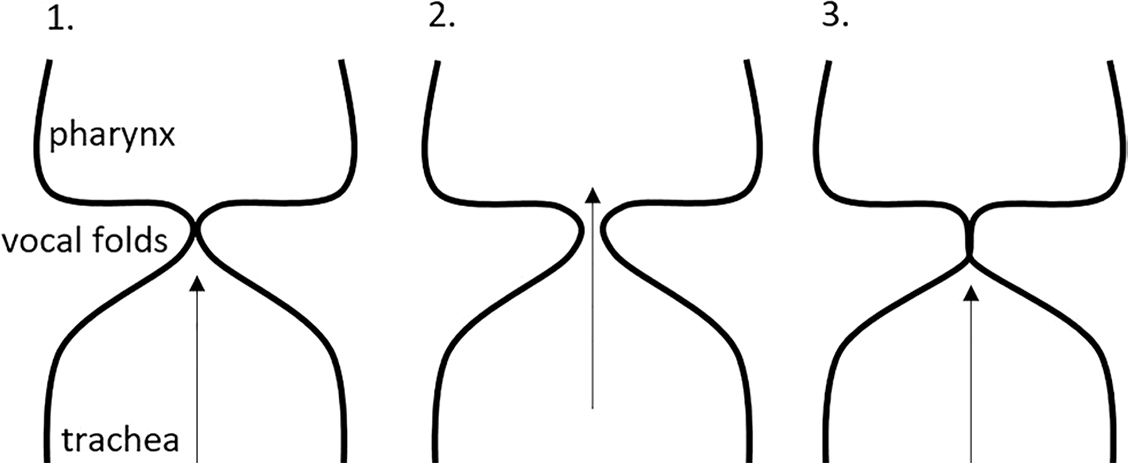
The basis of the effect is that the pressure of a flowing fluid (gas or liquid) decreases at right angles to the direction of flow in proportion as the velocity of flow increases. Surfaces adjacent to the flow tend to get sucked into it (see Figure 1). In the case of an aeroplane wing, the wing is shaped so that air flows faster over the top than underneath. The air pressure above the wing then decreases in relation to the pressure below it, resulting in an upward suction.
Bernoulli Effect and Voicing
To understand how the Bernoulli effect contributes to vocal fold vibration, it is necessary to consider how air from the lungs flows through the glottis into the supraglottal vocal tract. The glottal aperture during voicing is approximately 10 to 12 mm long, reaching a maximum width during normal voicing of about 2.5 mm. The depth of the gap bordered by the edges of the folds is 4 to 5 mm. The internal diameter of the trachea is around 20 to 25 mm, and the lower pharynx, about 22 to 29 mm. The trachea-glottis-pharynx configuration is thus a tube that narrows and then widens out again (see Figure 1).
The narrow section, the glottis, functions as a Venturi tube (named after an Italian physicist, Giovanni Battista Venturi) in that the flow of air has to speed up to get through without causing the flow in the trachea to slow down. This increase in velocity brings with it the Bernoulli effect: As the air accelerates through the glottis, the pressure it exerts on the vertical edges of the vocal folds decreases, causing a suction effect that brings the folds together. The glottis remains closed only momentarily because the air coming up the trachea pushes the folds apart again and, once again, accelerates through the gap—and the cycle continues.
The opening and closing actions of the vocal folds are aided by the elasticity of the muscle fibers composing the vocal folds. When they are pushed apart by the subglottal pressure, starting at the lower edges, they are waiting for an opportunity to spring back together again. The opportunity comes when the air accelerates past their surfaces, which also happens first at the lower edges. The speed with which they are pushed apart is slower than the speed with which they snap together again; the snapping together produces the acoustic energy of voicing and excites the air in the supraglottal chambers to create resonances that are then shaped by the articulators into vowels and voiced consonants.
The complete process by which voicing is produced is known as “aerodynamic-myoelastic action.” The term aerodynamic refers to the movement of air, and myoelastic refers to the muscle elasticity (“myo” is from the Greek word for muscle). The Bernoulli effect is a key part of this action and is brought into play by the Venturi tube properties of the glottis. The action continues for as long as the vocal folds are held in position by the laryngeal adductor muscles and there is sufficient air being pumped from the lungs.
...
- Anatomy and Physiology
- Acoustic Reflex
- Anatomy of the Hearing Mechanism and Central Audiology Nervous System
- Anatomy of the Human Articulators
- Anatomy of the Human Larynx
- Anatomy of the Human Neurological System
- Aspiration: Swallowing
- Auditory Brainstem Response
- Binaural Hearing
- Laryngopharyngeal Reflux (LPR)
- Late Auditory Evoked Potentials
- Paradoxical Vocal Cord Dysfunction (PVCD)
- Pathophysiology of Stroke
- Pathophysiology of Traumatic Brain Injury
- Physiological Basis for Voice
- Physiological Basis of Hearing
- Physiological Basis of Swallowing
- Plasticity of the Brain
- Regional Cerebral Blood Flow (rCBF)
- Reinnervation of the Larynx
- Sound Localization and Auditory Spatial Perception
- Vestibular System
- Vocal Production System: Evolution
- Voice Production: Physics
- Assessment Issues
- Academic Impact of Communication Disorders
- Advocacy
- Allocation of Resources
- Ambulatory Phonation Monitoring
- Anchored Assessment
- Aphasia Assessment
- Articulation (Phonetic) Assessment
- Baselines
- Bias
- Brain Imaging
- Causation
- Ceiling Effect in Testing
- Cepstral Analysis of Voice
- Classification Systems
- Cognitive Processes and Operations
- Communicative Competence
- Compensatory Adaptation and Strategies
- Comprehension
- Context
- Conversation
- Conversation Analysis
- Cultural and Linguistic Informants
- Descriptive Assessment
- Diagnosis of Communication Disorders
- Diagnostic and Statistical Manual of Mental Disorders (DSM)
- Diagnostic Audiological Assessment
- Diagnostic Reasoning
- Dialects and Dialectology
- Discourse Analysis
- Dynamic Assessment
- Educational Audiology
- Epidemiology of Communication Disorders
- Etiology
- Eye-Tracking Technology
- Fiberoptic Endoscopic Evaluation of Swallowing (FEES)
- Forensic Speech–Language Pathology
- Frequency Response
- Functional Assessment
- Functional Communication Skills
- Gatekeeping
- Geriatric Audiology
- Hearing Screening
- Hearing Tests
- Incidence of Communication Disorders
- Individual Differences
- Instrumental Analysis of Speech
- Instrumental Assessment of Voice Disorders
- Intelligibility
- International Classification of Functioning, Disability and Health
- Interviewing
- Labeling of Communication Disorders
- Language Assessment
- Language Difference
- Language Sampling
- Linguistic Profiles
- Listening Effort
- Mean Length of Utterance (MLU)
- Miscue Analysis
- Multidimensional Scoring
- Nasalance and Nasometry
- Observation
- Operationalism
- Pediatric Audiological Assessment
- Phonetic Transcription
- Phonological Processes
- Play
- Poverty and Language
- Prescriptive and Descriptive Approaches
- Prevalence of Communication Disorders
- Prognosis
- Prompts
- Proxemics
- Readability
- Reading Fluency
- Referral Issues
- Reliability
- Residual Speech Sound Errors
- Resilience
- Response to Intervention (RtI)
- Sampling Rate
- Screening for Speech and Language Disorders
- Self-Assessment of Speech Disorders
- Self-Assessment, Audiology
- Skills Versus Strategies
- Sound Spectography
- Speech Audiometry
- Speech Intelligibility Index (SII)
- Speech Mechanism Examination
- Speech Sampling
- Standardized Testing
- Statistics: Descriptive
- Statistics: Inferential
- Stimulability
- Swallowing Assessment
- Systemic Functional Linguistics
- Teratogens
- Test–Retest Approach
- Threshold
- Transcranial Stimulation
- Type Versus Token
- Ultrasonography
- Validity
- Vestibular Assessment
- Videofluoroscopic Swallow Study
- Vocal Quality: Perceptual Evaluation
- Cognitive Aspects of Communication
- Abstraction
- Allocation of Resources
- Attention
- Attention Deficit Hyperactivity Disorder (ADHD)
- Autism Spectrum Disorder
- Categorical Perception
- Cognition
- Cognitive Behavioral Therapy
- Cognitive Development
- Cognitive Impairment
- Cognitive Linguistics
- Cognitive Neuropsychological Approach to Intervention
- Cognitive Processes and Operations
- Cognitivism
- Comprehension
- Dementia
- Dichotic Listening
- Distributed Cognition
- Executive Function and Communication
- Intellectual Disability
- Intelligence
- Listening Effort
- Memory
- Memory Disorders
- Memory Impairments in Aphasia
- Metacognitive
- Modularity
- Perception
- Priming
- Schemata
- Scripts
- Skills Versus Strategies
- Theory of Mind
- Traumatic Brain Injury
- Communication Modalities
- Affect
- American Sign Language
- Amusia
- Augmentative and Alternative Communication (AAC)
- Australian Sign Language (Auslan)
- British Sign Language (BSL)
- Captioning
- Comprehension
- Connected Speech
- Conversation
- Cued Speech and Language
- Fingerspelling
- Gaze
- Key Word Signing Systems
- Kinesics
- Modality
- Multimodal Communication
- Nonverbal Communication
- Oral Language
- Proxemics
- Semiotics
- Signed Languages
- Speechreading
- Writing Systems
- Development/Acquisition
- Adaptation Theory
- Attention
- Auditory Development
- Babbling
- Behaviorism
- Chronological Age
- Cognitive Development
- Constructivism
- Critical Period for Language Acquisition
- Delayed Language Development
- Delayed Phonological Development
- Early Literacy Development
- Emergentism
- Foundations for Language Learning in the Neonatal and Early Infant Period
- Genetics
- Grammatical Development
- Imitative Response
- Intentionality
- Joint Attention
- Language Acquisition
- Late Talkers
- Mapping Hypothesis
- Mean Length of Utterance (MLU)
- Motherese
- Naming
- Nativism
- Otitis Media
- Phonological Development
- Play
- Pragmatic Development
- Resilience
- Second-Language Acquisition
- Semantic Development
- Social Development
- Socialization
- Speech Sound Development and Disorders in Multilinguals
- Speech, Language, and Learning Difficulties Associated With Prenatal Drug Exposure
- Statistical Learning
- Theories of Language Acquisition
- Theory of Mind
- Usage-Based Approach to Language Acquisition
- Zone of Proximal Development
- Diversity
- Accent Modification
- African American English
- Australian Aboriginal Languages
- Bias
- Bilingual Aphasia
- Bilingual Children With Specific Language Impairment
- Bilingual Education
- Bilingualism
- Code Switching and Mixing
- Crosslinguistic Manifestations of Disordered Speech and Language
- Cultural and Linguistic Informants
- Culture
- Deaf Culture
- Dialects and Dialectology
- Diglossia
- Diversity
- Indigenous Languages
- Indigenous Languages of Central and South America
- Indigenous Languages of North America
- Indigenous Languages of the Pacific
- Intercultural Communication
- International Adoption: Impact on Speech and Language Abilities
- Language Difference
- Language Register
- Multilingualism
- Multilingualism and Speech Sound Disorders
- Pidgin and Creole Languages
- Poverty and Language
- Relevance Theory
- Second-Language Acquisition
- Signed Languages
- Sociolinguistics
- Sociolinguistics of Sign Languages
- Stigma
- Stylistics
- Tone Languages and Communication Disorders
- Translation
- Varieties of English
- Etiologies
- Age-Related Hearing Loss
- Alzheimer’s Disease
- Amyotrophic Lateral Sclerosis
- Arthritis: Laryngeal Involvement
- Auditory Neuropathy Spectrum Disorder
- Blindness, Impact on Communication
- Cancer of the Head and Neck
- Cerebral Palsy
- Chronic Cough
- Cleft Lip and Palate: Speech Effects
- Concussion
- Craniofacial Anomalies
- Dementia
- Down Syndrome
- Fetal Alcohol Spectrum Disorder
- Functional Communication Skills
- Functionalism
- Genetics
- Genetics and Stuttering
- Genetics of Hearing Loss
- Hydrocephalus
- Infectious Diseases and Communication Disorders
- Intellectual Disability
- Irritable Larynx Syndrome
- Laryngeal Disorders: Benign Vocal Fold Pathologies
- Laryngectomy
- Laryngopharyngeal Reflux (LPR)
- Learned Helplessness
- Muscle Tension Dysphonia (MTD)
- Myasthenia Gravis
- Noise-Induced Hearing Loss and Its Prevention
- Occupation-Related Dysphonia
- Otitis Media
- Ototoxicity
- Parkinson’s Disease
- Post-Polio Syndrome (PPS)
- Psychiatric Disorders With Communication Disorders
- Psychogenic Voice Disorders
- Psychological Stress and Speech Disorders
- Radiation Therapy and Communication Disorders
- Seizure Disorders
- Sleep: Effects on Language Learning
- Speech, Language, and Learning Difficulties Associated With Prenatal Drug Exposure
- Stroke
- Stuttering, Cause of
- Tardive Dyskinesia
- Teratogens
- Tongue Thrust
- Tourette Syndrome
- Trauma to Speech and Hearing Mechanisms
- Traumatic Brain Injury
- Velocardiofacial Syndrome (VCFS)
- Williams Syndrome
- Fluency and Fluency Disorders
- Altered Auditory Feedback and Stuttering
- Attitudes in Stuttering
- Circumlocution and Avoidance in Stuttering
- Cluttering
- Covert Stuttering
- Delayed Auditory Feedback
- Fluency and Disfluency, Typical
- Fluency and Fluency Disorders
- Intensive Stuttering Programs
- Neurogenic Stuttering
- Paralinguistic and Prosodic Impact on Stuttering
- PostTreatment Relapse in Stuttering
- Quality of Life and Stuttering
- Relaxation Therapy
- Stuttering and Adolescence
- Stuttering and Emotional Reactions
- Stuttering and Language Complexity
- Stuttering Treatment
- Stuttering, Cause of
- Stuttering, Effects of
- Stuttering, Motor Control in
- Stuttering, Motor Control in Stuttering
- Stuttering, Response to
- Temperament, Anxiety, and Stuttering
- Gerontology and Communication Disorders
- Hearing and Hearing Disorders
- Acclimatization to Hearing Aids
- Acoustic Admittance
- Acoustic Ecology
- Acoustic Reflex
- Acoustics
- Age-Related Hearing Loss
- Air and Bone Conduction
- Amplitude Compression
- Amplitude Envelope
- Amusia
- Anatomy of the Hearing Mechanism and Central Audiology Nervous System
- Assistive Listening Devices
- Audiology
- Audiovisual Integration
- Auditory Brainstem Implant
- Auditory Brainstem Response
- Auditory Development
- Auditory Neuropathy Spectrum Disorder
- Auditory Processing
- Auditory Processing Disorder
- Auditory Scene Analysis
- Auditory Steady-State Response
- Auditory Training
- Background Noise
- Binaural Hearing
- Captioning
- Classroom Acoustics
- Cochlear Hearing loss
- Cochlear Implant (Re)habilitation
- Cochlear Implants
- Conductive Hearing Loss and Its Treatment
- Decibel
- Diagnostic Audiological Assessment
- Dichotic Listening
- Digital Signal Processing
- Distortion
- Dual Sensory Impairment (DSI)
- Earphones and Other Transducers
- Educational Audiology
- Electrocochleography (ECochG)
- Electronsytagmography (ENG) and Videonystagmograhy (VNG)
- Frequency Compression and Transposition
- Frequency Resolution
- Frequency Response
- Functional Hearing Loss
- Genetics of Hearing Loss
- Geriatric Audiology
- Hard of Hearing
- Hearing Accessibility
- Hearing Aid Earmold
- Hearing Aid Fitting
- Hearing Aids
- Hearing Assistive Technology
- Hearing Disability and Disorders
- Hearing Screening
- Hearing Tests
- Hyperacusis
- Late Auditory Evoked Potentials
- Listening Effort
- Loudness
- Ménière’s Disease
- Masking
- Noise-Induced Hearing Loss and Its Prevention
- Otitis Media
- Otoacoustic Emissions (OAEs)
- Ototoxicity
- Pediatric Audiological Assessment
- Pediatric Audiological Rehabilitation
- Pharmacological Interventions in Hearing Disorders
- Physiological Basis of Hearing
- Pitch
- Prevention of Hearing Disorders
- Psychoacoustics
- Pure-Tone Audiometry
- Rehabilitative Audiology
- Retrocochlear Hearing Loss
- Room Acoustics
- Saturation Sound Pressure Level (SSPL)
- Self-Assessment, Audiology
- Signal Detection Theory
- Sound Localization and Auditory Spatial Perception
- Speech Audiometry
- Speech Intelligibility Index (SII)
- Speech Tracking
- Speechreading
- Temporal Fine Structure
- Temporal Processing
- Threshold
- Tinnitus
- Vestibular Assessment
- Vestibular Disorders
- Vestibular Rehabilitation
- Vestibular System
- Vocoding Techniques
- Word Deafness
- Intervention and Therapeutic Issues
- Accent Modification
- Acclimatization to Hearing Aids
- Accountability in Therapy for Communication Disorders
- Advocacy
- Allocation of Resources
- Altered Auditory Feedback and Stuttering
- Aphasia Intervention
- Articulation Therapy (Phonetic Intervention)
- Auditory Training
- Augmentative and Alternative Communication (AAC)
- Baselines
- Behaviorism
- Bibliotherapy
- Biofeedback
- Book Clubs, Communication-Adapted
- Breathing Exercises
- Bullying and Teasing
- Captioning
- Caseload
- Clinician
- Coaching
- Cochlear Implant (Re)habilitation
- Cognitive Behavioral Therapy
- Cognitive Neuropsychological Approach to Intervention
- Cognitive Processes and Operations
- Cognitivism
- Collaboration in Speech–Language Therapy
- Communication Partner Training
- Compensatory Adaptation and Strategies
- Compensatory Strategies: Swallowing
- Comprehension
- Computer-Aided Rehabilitation
- Conductive Hearing Loss and Its Treatment
- Constructivism
- Context
- Cooperative Learning
- Counseling in Speech–Language Pathology
- Cued Speech and Language
- Discharge From Therapy
- Educational Audiology
- Efficacy and Effectiveness in Treatment Studies
- Ethics in Communication Disorders Service Delivery
- Evidence-Based Practice
- Feedback in Therapy
- Functionalism
- Geriatric Audiology
- Group Therapy
- Hearing Accessibility
- Hearing Aid Fitting
- Hearing Assistive Technology
- Inclusion Models in Special Education
- Individual Differences
- Intelligibility Enhancement
- Intensive Stuttering Programs
- Journaling
- Key Word Signing System
- Language Difference
- Language Therapy and Intervention
- Manual Circumlaryngeal Techniques in Voice Disorders
- Mediation in Therapy
- Medical Management of Voice Disorders
- Modified Diet
- Motivation
- Outcome Measurement
- Pediatric Audiological Rehabilitation
- Person-Centered Care
- Pharmacological Interventions in Hearing Disorders
- Pharmacological Interventions in Speech and Language Disorders
- Phonological Treatment
- Placebo Effect
- Plasticity of Brain
- Play Therapy
- Positive Psychology and Wellness
- Preschool Language Intervention
- Prevention of Speech and Language Disorders
- Priming
- Prompts
- Prosthetics for Structural Deficits
- Recovery From Aphasia
- Rehabilitation
- Rehabilitative Audiology
- Relaxation Therapy
- Response to Intervention (RtI)
- Revaluing Reading
- Self-Advocacy
- Self-Correction
- Self-Management
- Semi-occluded Vocal Tract Techniques
- Service Delivery Models
- Skills Versus Strategies
- Social Stories
- Speech Tracking
- Speechreading
- Spontaneous Recovery
- Stuttering Treatment
- Support Groups
- Swallowing Disorders: Prophylactic Therapy
- Swallowing Rehabilitation in Adults
- Telepractice
- Tissue Engineering
- Treatment Research
- Ultrasonography
- Ventilator-Assisted Speech Production
- Vestibular Rehabilitation
- Vocal Hygiene
- Voice Therapy
- Voice Therapy for the Professional Singer
- Yawn-Sigh Technique
- Zone of Proximal Development
- Language and Language Disorders
- Academic Impact of Communication Disorders
- Adolescent Language Disorders
- Attention Deficit Hyperactivity Disorder (ADHD)
- Autism Spectrum Disorders
- Bilingual Children With Specific Language Impairment
- Clinical Linguistics
- Delayed Language Development
- Descriptive Assessment
- Discourse Impairments
- Dynamic Assessment
- Echolalia
- Expressive and Receptive Language
- Formulaic Language
- Language
- Language Acquisition
- Language Assessment
- Language Delay
- Language Difference
- Language Disorders in Children
- Language Disorders of People With Hearing Impairment
- Language Sampling
- Language Therapy and Intervention
- Late Talkers
- Learning Disabilities
- Miscue Analysis
- Narratives
- Nonverbal Communication
- Oral Language
- Pragmatic Impairment
- Preschool Language Intervention
- Prevention of Speech and Language Disorders
- Readability
- Reading and Reading Disorders
- Reading Fluency
- Response to Intervention (RtI)
- Revaluing Reading
- Selective Mutism
- Semantic Disorders
- Speech Sampling
- Standardized Testing
- Statistical Learning
- Syntactic Disorders
- Tone Languages and Communication Disorders
- Writing and Writing Disorders
- Linguistics
- Abstraction
- Acoustic Phonetics
- Adjectives and Adverbs
- Adpositions and Conjunctions
- African American English
- Allophone
- American Sign Language
- Applied Linguistics
- Articulatory Phonetics
- Auditory Phonetics
- Australian Aboriginal Languages
- Australian Sign Language (Auslan)
- Babbling
- Bilingualism
- British Sign Language (BSL)
- Cascade Effect
- Causation
- Clauses and Phrases
- Clinical Linguistics
- Clinical Phonetics
- Clinical Phonology
- Code Switching and Mixing
- Cognitive Linguistics
- Cohesion and Coherence
- Communicative Competence
- Competence and Performance
- Comprehension
- Consonants
- Context
- Conversation
- Conversation Analysis
- Cooperative Principle
- Corpus Linguistics
- Critical Discourse Analysis
- Deixis
- Descriptive Linguistics
- Determiners
- Dialects and Dialectology
- Diglossia
- Discourse
- Discourse Analysis
- Emergence and Human Communication
- Expressive and Receptive Language
- Felicity Conditions
- Functionalism
- Generative Linguistics
- Grammatical Development
- Implicature
- Indigenous Languages
- Indigenous Languages of Central and South America
- Indigenous Languages of North America
- Indigenous Languages of the Pacific
- Information Structure
- Intentionality
- Intonation
- Key Word Signing Systems
- Language
- Language Acquisition
- Language Difference
- Language Families
- Language Register
- Language Sampling
- Languages of Africa
- Languages of Central, South, and West Asia: Urdu and Persian
- Languages of East Asia
- Languages of Europe
- Languages of Mainland South East Asia
- Languages of North Asia
- Languages of South Asia
- Languages of the Caucasus
- Languages of the Middle East and North Africa
- Languages of West and Central Asia: Turkic
- Lenition and Fortition
- Lexicon
- Linear Phonology
- Linguistic Profiles
- Linguistic Typology
- Linguistics
- Markedness
- Mean Length of Utterance (MLU)
- Meaning
- Metalinguistics
- Metaphonology
- Metaphor
- Modularity
- Morphology
- Motherese
- Multilingualism
- Naming
- Narratives
- Neurolinguistics
- Neurophonetics
- Neuropragmatics
- Nonlinear Phonology
- Nouns and Pronouns
- Optimality Theory
- Oral Language
- Origins of Language
- Phoneme
- Phonetic Transcription
- Phonetics
- Phonological Development
- Phonological Processes
- Phonology
- Pidgin and Creole Languages
- Pitch
- Pragmatic Development
- Pragmatics
- Prescription and Descriptive Approaches
- Priming
- Prosody
- Psycholinguistics
- Recursion
- Reference
- Relational Analysis
- Relevance Theory
- Rule-Governed Alternations
- Second-Language Acquisition
- Semantic Field
- Semantics
- Semiotics
- Sense
- Sociolinguistics
- Sonority
- Speech Act Theory
- Stylistics
- Syllable
- Syntax and Grammar
- Systemic Functional Linguistics
- Texts
- Universal Grammar
- Verbs
- Vocabulary
- Vowels
- Writing Systems
- Xenophone
- Neurogenics and Neurological Disorders
- Agnosia
- Alzheimer’s Disease
- Amusia
- Amyotrophic Lateral Sclerosis
- Anatomy of the Hearing Mechanism and Central Audiology Nervous System
- Anatomy of the Human Neurological System
- Anomia
- Aphasia
- Aphasia Assessment
- Aphasia Intervention
- Apraxia of Speech
- Auditory Neuropathy Spectrum Disorder
- Bilingual Aphasia
- Brain Imaging
- Cerebral Palsy
- Childhood Apraxia of Speech
- Communication Partner Training
- Compensatory Adaptation and Strategies
- Concussion
- Concussive Injury
- Coping Hypothesis
- Dementia
- Dysarthria
- Dysphonia
- Electroencephalography (EEG)
- Epilepsy
- Foreign Accent Syndrome
- Hemiplegia
- Hydrocephalus
- Jargon and Jargon Aphasia
- Memory Impairments in Aphasia
- Motor Speech Disorders
- Multidimensional Scoring
- Myasthenia Gravis
- Neuroconstructivism
- Neurogenic Communication Disorders
- Neurogenic Stuttering
- Neurolinguistics
- Paraphasia
- Parkinson’s Disease
- Pathophysiology of Stroke
- Pathophysiology of Traumatic Brain Injury
- Premorbid Level
- Primary Progressive Aphasia
- Prognosis
- Psychosocial Impact of Aphasia
- Quality of Life and Neurogenic Communication Disorders
- Recovery From Aphasia
- Regional Cerebral Blood Flow (rCBF)
- Right Hemisphere Cognitive-Communication Disorders
- Seizure Disorders
- Spontaneous Recovery
- Stereotypy
- Stroke
- Supported Conversation for Adults With Aphasia (SCA)
- Swallowing Disorders
- Tardive Dyskinesia
- Tourette Syndrome
- Transcranial Stimulation
- Traumatic Brain Injury
- Vestibular Disorders
- Physics of Hearing and Speech
- Acoustics
- Air and Bone Conduction
- Airflow Measurement
- Amplitude Compression
- Amplitude Envelope
- Bernoulli Effect
- Boyle’s Law
- Categorical Perception
- Decibel
- Digital Signal Processing
- Distortion
- Frequency Resolution
- Frequency Response
- Jitter and Shimmer
- Loudness
- Pitch
- Sampling Rate
- Temporal Fine Structure
- Timbre
- Voice Acoustics
- Voice Production: Physics
- Professional Matters
- Advocacy
- Bias
- Classification Systems
- Clinician
- Communicative Competence
- Cultural and Linguistic Informants
- Databases in Communication Disorders
- Diagnostic and Statistical Manual of Mental Disorders (DSM)
- Diversity
- Educational Audiology
- Efficacy and Effectiveness of Treatment Studies
- Emotional Impact of Communicative Disorders
- Enculturation Into the Profession
- Epidemiology of Communication Disorders
- Ethics in Communication Disorders Research
- Ethics in Communication Disorders Service Delivery
- Evidence-Based Practice
- Forensic Speech–Language Pathology
- Functional Communication Skills
- Gatekeeping
- Incidence of Communication Disorders
- Intercultural Communication
- International Classification of Functioning, Disability and Health
- Internet Resources
- Labeling of Communication Disorders
- Learned Helplessness
- Locus of Control
- Motivation
- Nonverbal Communication
- Outcome Measurement
- Person-Centered Care
- Placebo Effect
- Positive Psychology and Wellness
- Power Relations in Service Delivery
- Prevalence of Communication Disorders
- Prevention of Hearing Disorders
- Prevention of Speech and Language Disorders
- Professional Associations
- Prognosis
- Psychological Stress and Speech Disorders
- Psychosocial Issues Associated With Communication Disorders
- Referral Issues
- Reliability
- Research
- Self-Correction
- Self-Help Groups
- Skills Versus Strategies
- Socialization
- Special Education
- Speech–Language Pathology
- Stigma
- Support Groups
- Technology and Communication Disorders
- Telehealth
- Temporal Imperative
- Treatment Research
- Validity
- Vocal Hygiene
- Research
- Case Studies
- Conversation Analysis
- Ethics in Communication Disorders Research
- Ethnographic Approaches in Research
- Experimental Research
- Eye-Tracking Technology
- Focus Groups
- Grounded Theory
- Instrumental Analysis of Speech
- Interviewing
- Meta-Analysis
- Observation
- Phenomenology
- Placebo Effect
- Qualitative Research
- Quantitative Research
- Reliability
- Research
- Statistical Learning
- Statistics: Descriptive
- Statistics: Inferential
- Treatment Research
- Ultrasonography
- Validity
- Virtual Reality
- Service Delivery General Issues
- Accountability in Therapy for Communication Disorders
- Advocacy
- Baselines
- Biofeedback
- Bullying and Teasing
- Caseload
- Compensatory Adaptation and Strategies
- Computer-Aided Rehabilitation
- Context
- Cooperative Learning
- Counseling in Speech–Language Pathology
- Diagnosis of Communication Disorders
- Diagnostic Reasoning
- Discharge From Therapy
- Efficacy and Effectiveness of Treatment Studies
- Ethics in Communication Disorders Research
- Ethics in Communication Disorders Service Delivery
- Evidence-Based Practice
- Feedback in Therapy
- Geriatric Audiology
- Group Therapy
- Inclusion Models in Special Education
- Mediation in Therapy
- Premorbid Level
- Rehabilitation
- Response to Intervention (RtI)
- Screening for Speech and Language Disorders
- Self-Advocacy
- Self-Management
- Service Delivery Models
- Sleep: Effects on Language Learning
- Telepractice
- Speech Sound Disorders
- Accent Modification
- Acoustic Phonetics
- Airflow Measurement
- Anatomy of the Human Articulators
- Articulation (Phonetic) Assessment
- Articulation Therapy (Phonetic Intervention)
- Articulatory Phonetics
- Atypical Speech Sounds
- Auditory Phonetics
- Babbling
- Cascade Effect
- Categorical Perception
- Childhood Apraxia of Speech
- Cleft Lip and Palate: Speech Effects
- Clinical Phonetics
- Clinical Phonology
- Coarticulation
- Comprehensibility
- Connected Speech
- Consonant Clusters
- Consonants
- Covert Contrast
- Craniofacial Anomalies
- Delayed Phonological Development
- Dialects and Dialectology
- Glossectomy
- Instrumental Assessment of Speech Sound Disorders
- Intelligibility
- Intelligibility Enhancement
- Intonation
- Lenition and Fortition
- Linear Phonology
- Markedness
- Metaphonology
- Multilingualism and Speech Sound Disorders
- Neurophonetics
- Nonlinear Phonology
- Nonpulmonic Consonants
- Optimality Theory
- Orofacial Myofunctional Disorders
- Phoneme
- Phonetic Transcription
- Phonetics
- Phonological and Phonemic Awareness
- Phonological Development
- Phonological Disorders
- Phonological Processes
- Phonological Treatment
- Phonology
- Prompts
- Prosodic Disorders
- Prosody
- Pulmonic Ingressive Speech
- Residual Speech Sound Errors
- Segmentation of Speech
- Self-Assessment of Speech Disorders
- Self-Correction
- Sonority
- Sound Spectrography
- Speech Mechanism Examination
- Speech Naturalness
- Speech Perception, Theories of
- Speech Production, Theories of
- Speech Sampling
- Speech Sound Development and Disorders in Multilinguals
- Speech Sound Disorders
- Speech Synthesis
- Stimulability
- Suprasegmental Aspects of Speech
- Syllable
- Tongue Thrust
- Ultrasonography
- Variable Speech Production
- Vocoding Techniques
- Vowels
- X-radiography
- Swallowing and Dysphagia
- Anatomy of the Human Larynx
- Aspiration: Swallowing
- Compensatory Strategies: Swallowing
- Endoscopy
- Fiberoptic Endoscopic Evaluation of Swallowing (FEES)
- Modified Diet
- Physiological Basis of Swallowing
- Radiation Therapy and Communication Disorders
- Swallowing Assessment
- Swallowing Disorders
- Swallowing Disorders: Prophylactic Therapy
- Swallowing Rehabilitation in Adults
- Thickened Liquids
- Videofluoroscopic Swallow Study
- Theoretical Formulations
- Adaptation Theory
- Behaviorism
- Cognitivism
- Connectionist Models
- Constructivism
- Cooperative Principle
- Critical Period for Language Acquisition
- Distributed Cognition
- Emergence and Human Communication
- Emergentism
- Functionalism
- Generative Linguistics
- Locus of Control
- Mapping Hypothesis
- Modularity
- Nativism
- Neuroconstructivism
- Optimality Theory
- Origins of Language
- Plasticity of the Brain
- Relevance Theory
- Scientific Realism
- Signal Detection Theory
- Speech Act Theory
- Speech Perception, Theories of
- Speech Production, Theories of
- Statistical Learning
- Theories of Language Acquisition
- Universal Grammar
- Zone of Proximal Development
- Voice and Resonance
- Alaryngeal Voice
- Ambulatory Phonation Monitoring
- Anatomy of the Human Larynx
- Arthritis: Laryngeal Involvement
- Biofeedback
- Breathing Exercises
- Cancer of the Head and Neck
- Cepstral Analysis of Voice
- Chronic Cough
- Cleft Lip and Palate: Speech Effects
- Craniofacial Anomalies
- Dysphonia
- Electroglottography (EGG)/ Electrolaryngography (ELG)
- Electrolarynx
- Electropalatography (EPG)
- Endoscopy
- Esophageal and Tracheoesophageal Speech
- Essential Vocal Tremor
- Frequency Response
- Instrumental Analysis of Speech
- Instrumental Assessment of Voice Disorders
- Irritable Larynx Syndrome
- Jitter and Shimmer
- Laryngeal Disorders: Benign Vocal Fold Pathologies
- Laryngectomy
- Laryngopharyngeal Reflux (LPR)
- Manual Circumlaryngeal Techniques in Voice Disorders
- Medical Management of Voice Disorders
- Motor Speech Disorders
- Muscle Tension Dysphonia (MTD)
- Nasalance and Nasometry
- Nasality
- Occupational-Related Dysphonia
- Orofacial Myofunctional Disorders
- Paradoxical Vocal Cord Dysfunction (PVCD)
- Physiological Basis for Voice
- Pitch
- Prosthetics for Structural Deficits
- Psychiatric Disorders With Communication Disorders
- Psychogenic Voice Disorders
- Psychological Stress and Speech Disorders
- Puberphonia
- Reinnervation of the Larynx
- Relaxation Therapy
- Resonance Disorders
- Semi-occluded Vocal Tract Techniques
- Singing and Performing Voice
- Sound Spectrography
- Speech Mechanism Examination
- Speech Synthesis
- Tissue Engineering
- Tracheostomy
- Transgender Voice and Communication
- Trauma to Speech and Hearing Mechanisms
- Ultrasonography
- Velocardiofacial Syndrome (VCFS)
- Ventilator-Assisted Speech Production
- Vocal Hygiene
- Vocal Production System: Evolution
- Vocal Quality: Perceptual Evaluation
- Vocalization
- Voice Acoustics
- Voice Disorders
- Voice Production: Physics
- Voice Quality
- Voice Therapy
- Voice Therapy for the Professional Singer
- Yawn–Sigh Technique
- Loading...
Get a 30 day FREE TRIAL
-
 Watch videos from a variety of sources bringing classroom topics to life
 -
Read modern, diverse business cases
-
Explore hundreds of books and reference titles

Read next

More like this
Sage Recommends
We found other relevant content for you on other Sage platforms.
Have you created a personal profile? Login or create a profile so that you can save clips, playlists and searches