
Entry
Reader's guide
Entries A-Z
Subject index
Wikis as a Collaboration Tool
The term wiki comes from the Hawaiian phrase wiki wiki, which means “quick,” “fast,” “speedy,” or “hurry.” Wiki originated from the work of Ward Cunningham, who created the first wiki called WikiWikiWeb in 1995. The best-known example of a wiki is Wikipedia, the world’s largest online encyclopedia constructed by users. Many other examples of wikis can be found in nearly every domain, including business, industry, and education. Wikis are a type of Web 2.0 technologies that enable people to share information, collaborate, and communicate with each other. Wikis are a type of social software that includes blogs, forums, podcasting, social networking, social bookmarking, Flickr, Facebook, and del.icio.us. More specifically, a wiki is a collection of webpages that are continuously edited collaboratively by multiple users. As such, wiki technology matches the evolution of the networked society that requires collaborative team skills. This entry discusses software for creating wikis, the use of wikis as a repository for shared information, the use of wikis in education, and the implications of wikis for teaching and learning.
Wiki Software Tools
There is a wide range of software tools for creating wikis. These are classified in two broad categories. The first one includes wiki services or wiki farms that are hosted by a service provider. The services may be free or fee-based. Examples of popular wiki farms are Wikispaces, Wikidot, and PBworks. The second category involves wiki tools that can be directly installed on one’s own server, such as PmWiki, TWiki, Tiki Wiki, and MediaWiki, which is one of the best known tools, originally for use on Wikipedia, with thousands of applications. The content of MediaWiki consists of articles with a title and a body that may include text, images, figures, or other media. A community of users edits articles collaboratively. MediaWiki has a number of basic components, such as tool bars, navigation, and user options, that help users edit articles, as shown in Figure 1.
Figure 1 A representation of an article with MediaWiki components
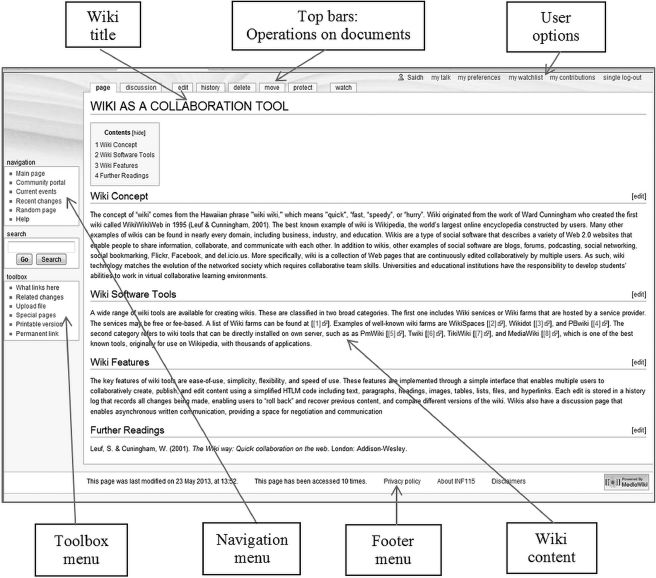
The key features of wiki software tools are ease of use, simplicity, flexibility, and speed of use. These features are implemented through a simple interface that enables multiple users to collaboratively create, edit, and publish content using a simplified HTML language, including text, paragraphs and headings, links, images, tables, lists, and files. Each edit is stored in a history log that records all changes being made, enabling users to “roll back” and recover previous content, and compare different versions of the wiki. Wikis also have a discussion page that enables asynchronous written communication, providing a space for negotiation and communication. In addition, wiki tools provide a number of technical functionalities that support the creation of wiki applications, such as technical support through developer and user documentation, user rights management and registration, tracking and restoring capabilities through the history log, browser and cross-platform compatibility, and installation procedures.
Wikis as Repository for Shared Information
Wikis as collaboration tools serve as a repository for shared information among online users in a variety of contexts. They provide an online space to create, edit, and store documents. Wikis include a wide range of applications from small-scale group projects with few pages to large applications with hundreds of pages. Well-known organizations such as IBM, Nokia, SUN Microsystems, Motorola Systems, and many other private companies and public institutions use wikis for project knowledge organization, document management, communication, and marketing. Wikis can be established as a private (or restricted) space, where individual users can participate, or public area, where anyone can be involved in information sharing. Wikis as collaboration tools facilitate collaborative writing and coauthoring. Alterations and changes are made directly in the text being written. Argumentations and critical reflections accompanying the revisions may be made in the discussion page. The main advantages of wikis as collaboration tools are as
...
- Adaptive Learning Systems
- Adaptive and Responsive Websites
- Adaptive Learning Software and Platforms
- Avatars and Agents in Virtual Systems
- Cloud-Based Adaptive Systems
- Data Mining and Recommendation Engines
- Design and Creation of Adaptive Educational Systems
- Dynamic Student Profiles
- Intelligent Tutoring Systems
- Learners and Instructional Control in Adaptive Systems
- Learning Analytics
- Learning Analytics for Programming Competencies
- Learning Analytics for Writing Competencies
- Personalized Learning and Instruction
- Student Modeling
- System and Learner Control in Adaptive Systems
- Technologies That Learn and Adapt to Users
- Adult Education and Workforce Development
- Diffusion of New Technologies in the Workplace
- Distance Learning for Degree Completion for Working Adults
- Distance Learning for Professional Development
- Education in Workplace Settings
- Information and Communication Technologies: Competencies in the 21st Century Workforce
- Information and Communication Technologies: Knowledge Management
- Information and Communication Technologies: Organizational Learning
- Learning in the Defense Sector With Simulated Systems
- Learning in the Health Sector With Simulated Systems
- Learning in the Manufacturing Sector With Simulated Systems
- Learning in the Marketing Sector With Simulated Systems
- Technology and Information Literacy
- Training Using Virtual Worlds
- Wearable Learning Environments
- Web 2.0/3.0 in the Workplace
- Agent Technologies
- Analysis of Educational Needs and Requirements
- Causal Influence Diagrams
- Cognitive Task Analysis
- Competency Models and Frameworks
- Critical Decision Method
- Knowledge and Skill Hierarchies
- Knowledge Elicitation
- Learning Analytics
- Learning Analytics for Programming Competencies
- Learning Analytics for Writing Competencies
- Skill Decomposition
- Structural Learning Theory
- Think Aloud Protocol Analysis
- Workflow Analysis
- Communication Technologies
- Asynchronous Tools and Technologies
- Blogs as a Communication Tool
- Collaborative Communication Tools and Technologies
- Cybersecurity
- Data Streaming
- Digital Identity
- Message Design for Digital Media
- Multimedia and Image Design
- Social Networking
- Socially Constructed Virtual Artifacts
- Synchronous Tools and Technologies
- Wikis as a Collaboration Tool
- Digital Literacy
- Assessing Literacy Skills in the 21st Century
- Digital Literacy and Adult Learners
- Digital Literacy and Critical Thinking
- Digital Literacy in Elementary and Secondary Education
- Digital Literacy in Higher Education
- Digital Literacy: Overview and Definition
- Information, Technology, and Media Literacies
- Measuring and Assessing Literacy Skills
- Media Literacies
- Methods for Teaching Digital Literacy Skills
- Technology and Information Literacy
- Twenty-First Century Technology Skills
- Verification and Validation of Digital Resources
- Visual Literacy Skills in Science, Technology, Engineering, and Mathematics Education
- Educational Technology Research
- Activity Theory
- Benefit-Cost Analysis
- Case Study Research in Educational Technology
- Cost Analysis in Assessments of Educational Technology
- Design and Development Research
- Design-Based Research
- Evaluation Research
- Experimental Research and Educational Technology
- Four-Component Instructional Design (4C/ID)
- Instructional Design Research
- Qualitative Research Tools for Educational Technology Research
- Research in Schools
- Emerging Tools and Technologies
- Evaluation, Assessment, and Testing
- Adaptive Testing
- Assessment of Attitudes and Predispositions
- Assessment of Problem Solving and Higher Order Thinking
- Automated Scoring of Essays
- Certification of Instructional Designers in Educational Technology
- Certification of Teachers in Educational Technology
- Criterion-Referenced Assessments
- Educational Data Mining
- Evaluation of Educational Technology Competencies
- Formative Assessment
- Item Response Theory
- Knowledge and Skill-Based Digital Badges
- Measuring and Assessing TPACK (Technological Pedagogical Content Knowledge)
- Natural Language Processing in Learning Environments
- Norm-Based Assessments
- Objectives-Based Assessments
- Performance Assessment
- Program Evaluation
- Stealth Assessment
- Summative Assessment
- Feedback and Measurement Tools and Technologies
- Data Sensing and Visualization Systems
- Diagnostic Feedback in Formal Educational Settings
- Diagnostic Feedback in Informal Educational Settings
- E-Portfolio Technologies
- E-Portfolios in Higher Education
- E-Portfolios in K–12 Education
- Learning Analytics
- Learning Analytics for Programming Competencies
- Learning Analytics for Writing Competencies
- Recommendation Engines
- Reflection and Preflection Prompts and Scaffolding
- Repair Theory
- Student Response Systems
- Game-Based Learning
- Alignment of Games and Learning Goals
- Assessment in Game-Based Learning
- Games and Transformational Play
- Games for Adult Learners
- Games in Business and Industry Settings
- Games in Elementary and Middle School Settings
- Games in High School Settings
- Games in Higher Education
- Games in Medical Training
- Games in Military Training
- Games to Promote Inquiry Learning
- Games: Impact on Interest and Motivation
- Games: Impact on Learning
- Gamification
- Management Flight Simulators
- Serious Games
- Video Games and Student Assessment
- History of Educational Technology
- Informal Learning
- Design of Engaging Informal Learning Places and Spaces
- Informal Learning Strategies
- Information and Communication Technologies for Informal Learning
- Integrating Informal Learning with Programs at the College/University Level
- Integrating Informal Learning with School Programs at the Secondary Level
- Learning in Museums
- Learning in Outdoor Settings
- Measuring Learning in Informal Contexts
- Seamless Learning
- Ubiquitous Learning
- Virtual Tours
- Information Tools and Technologies
- Cloud Computing
- Cloud-Based Adaptive Systems
- Collaborative Communication Tools and Technologies
- E-Book Standards
- Geographic Information Systems and Education
- Information and Communication Technologies for Formal Learning
- Information and Communication Technologies for Informal Learning
- Information and Communication Technologies in Developed Countries
- Information and Communication Technologies in Developing Countries
- Information and Communication Technologies in Multinational and Multicultural Contexts
- Information and Communication Technologies: Competencies in the 21st Century Workforce
- Information and Communication Technologies: Knowledge Management
- Information and Communication Technologies: Organizational Learning
- Mobile Tools and Technologies for Learning and Instruction
- Planning for Technology Upgrades and Improvements
- Podcasting for Learning and Information Sharing
- Radio Frequency Identification in Education
- Repositories for Learning and Instructional Apps
- Infrastructure Development
- Instructional Design
- Cognitive Apprenticeship
- Cognitive Flexibility Theory
- Cognitive Load Theory
- Component Display Theory
- Conditions of Learning: Gagné’s Nine Events of Instruction
- Curricula for Advanced Learning Technologies
- Four Component Instructional Design (4C/ID)
- Instructional Design Models
- Instructional Design Practice
- Instructional Design Research
- Instructional Designer Preparation
- Multimedia and Image Design
- Self-Regulated E-Learning Design Principles
- Technology-Facilitated Experiential Learning
- Instructional and Learning Strategies
- Anchored Instruction
- Case-Based Reasoning and Educational Technology
- Conditions of Learning
- Cultural Considerations in Technology-Enhanced Learning and Instruction
- Distributed Cognitions in Computer-Supported Collaborative Learning
- Elaboration Theory
- Embodied Learning Systems
- Engaged Learning
- Informal Learning Strategies
- Instructional Transaction Theory
- Mindtools
- Model-Based Approaches
- Multimedia and Image Design
- Problem- and Task-Centered Approaches
- Technology Support for Conceptual Change
- Technology-Enhanced Inquiry Learning
- Technology-Facilitated Experiential Learning
- Interactive and Immersive Multimedia
- 3D Immersive Environments
- Biofeedback Learning Environments
- Haptic Technologies to Support Learning
- Head-Mounted Displays in Learning and Instruction
- Holographic Imaging in Learning and Instruction
- New Visual World and Future Competencies
- Simulation-Based Learning
- Training Using Virtual Worlds
- Transmedia in Education
- Virtual Worlds
- Internet and Information Resources
- Cloud Computing
- Cloud-Based Adaptive Systems
- Creative Commons
- Desktop and Virtual Publishing
- Digital Archives
- Digital Curation
- Digital Storytelling
- Intellectual Property
- Internet of Things
- Internet: Impact and Potential for Learning and Instruction
- Metatagging of Learning Objects and Apps
- Online Mentoring
- Web Analytics
- Journals
- Mobile Technologies
- 3G and 4G Networks
- Apps for Use at the Elementary Level
- Apps for Use at the Secondary Level
- Apps for Use in Higher Education
- Integrated and Networked Mobile Devices for Learning and Instruction
- Learning and Instructional Apps
- Mobile Assistive Technologies
- Mobile Devices: Impact on Learning and Instruction
- Mobile Tools and Technologies for Learning and Instruction
- Radio Frequency Identification in Education
- Remote Sensing Technologies
- Tablet Devices in Education and Training
- Touch-Based and Gesture-Based Devices
- Wearable Learning Environments
- Open Access Resources
- Performance Technologies
- Psychological and Social Issues and Perspectives
- Accelerated Learning
- Affective Factors in Learning, Instruction, and Technology
- ARCS Model
- Behavioral Factors in Learning, Instruction, and Technology
- Cognition and Human Learning
- Cognitive Load Theory
- Constructivist Theory
- Cyberbullying
- Digital Divide
- Dual Coding Theory
- Educational Technology, Philosophical Perspectives on
- Experiential Learning
- Human-Computer Interaction
- Intersubjectivity and Educational Technology
- Motivation, Emotion Control, and Volition
- Neuroscience and Learning
- Situated Learning
- Vulnerability in Learning
- Simulation and Modeling Technologies
- Social Media
- Second Self
- Collaboration and Social Networking
- Integrating Social Media Into Learning and Instruction
- Measuring Contacts and Interactions in Social Networks
- New Visual World and Future Competencies
- Semantic Web
- Social Media and Networking
- Social Media in Elementary School Settings
- Social Media in Higher Education
- Social Media in Secondary School Settings
- Social Media in the Workplace
- Social Media, Identity in
- Social Network Analysis
- Social Networking
- Web 2.0 and Beyond
- Special Education
- Assistive Technology
- Assistive Technology for Persons With Autism Spectrum Disorder
- Gesture-Based Learning and Instructional Systems
- Technologies for Persons With Dyslexia
- Technologies for Persons With Hearing Impairments
- Technologies for Persons With Physical Disabilities
- Technologies for Persons With Visual Impairments
- Technologies for Students With Attention Deficit Disorder
- Technologies to Enhance Communication for Persons With Autism Spectrum Disorder
- Universal Design
- Universal Design for Learning
- Teaching and Learning With Technology
- Badges and Skill Certification
- Collaborative Learning and 21st-Century Skills
- Collaborative Learning With Technology
- Leadership in E-Learning
- Learning and Instructional Apps
- Learning by Modeling
- Learning Objects
- Massive Open Online Courses
- Measuring and Assessing TPACK (Technological Pedagogical Content Knowledge)
- Natural Language Processing in Learning Environments
- Pedagogical Knowledge
- Personal Learning Environments
- Seamless Learning
- Self-Regulated E-Learning Design Principles
- Technologies for Critical Thinking Development
- Technologies for Gifted Students
- Technologies in Arts Education
- Technologies in Humanities Education
- Technologies in Mathematics Education
- Technologies in Medical Education
- Technologies in Science Education
- Technologies Supporting Self-Regulated Learning
- Technologies to Support Engineering Education
- Technology Knowledge
- Technology, Pedagogy, and the Learning Society
- TPACK (Technological Pedagogical Content Knowledge)
- TPACK (Technological Pedagogical Content Knowledge): Implications for 21st-Century Teacher Education
- Twenty-First-Century Technology Skills
- Virtual Learning Environments
- Virtual Schools and Programs
- Virtual Teams
- Technology Diffusion and Integration
- Change Agency
- Diffusion of Distance Education
- Diffusion of New Technologies in the Workplace
- Disruptive Innovations
- Disruptive Technologies
- Early Adopters
- Emerging Educational Technologies
- Innovators and Risk Takers in Education
- Predicting Change and Adoption of Technology Innovations
- Systemic Change and Educational Technology
- Technology Integration
- Loading...
Get a 30 day FREE TRIAL
-
 Watch videos from a variety of sources bringing classroom topics to life
 -
Read modern, diverse business cases
-
Explore hundreds of books and reference titles

Read next

More like this
Sage Recommends
We found other relevant content for you on other Sage platforms.
Have you created a personal profile? Login or create a profile so that you can save clips, playlists and searches