
Entry
Reader's guide
Entries A-Z
Subject index
Sign Language: Two-Handed Fingerspelling
Fingerspelling is the manual representation of orthography, where different hand configurations are used to represent letters of the alphabet. It is an integral part of Deaf community and used to fill lexical gaps in a sign language. It is commonly used by signers to introduce spoken language words for which there is no sign equivalent; to spell proper nouns, person names, and place names; to represent abbreviations; to explain a new concept; for emphasis or clarification; and in teaching or learning sign language.
The use of fingerspelling varies from individual to individual depending on age, educational background, geographical region, knowledge of English, and personal preference. Older Deaf people use fingerspelling more than do younger signers. People in northern England and Scotland fingerspell more than those in southern England. Fingerspelling is also subject to change with time and place.
There are many different manual alphabets, most of which are one-handed and some of which are two-handed. American Sign Language (ASL), French Sign Language (LSF), and German Sign Language (DGS), among others, use a one-handed manual alphabet. Sign languages of the BANZSL (British, Australian, and New Zealand Sign Language) family, a term coined by Johnston and Schembri in 2002, employ a two-handed manual alphabet where each letter of the English alphabet is represented by configurations of the two hands (the only exception is the letter C, which is one-handed; see Figure 1). The earliest form of the BANZSL alphabet is derived from an alphabet published in the anonymous pamphlet Digita Lingua in 1698. This alphabet has been used in British Sign Language (BSL) and Auslan (Australian Sign Language) since the 19th century and in the New Zealand Sign Language since the 1970s. Sign languages used in the Indian subcontinent (India, Pakistan, and Nepal) also use a two-handed fingerspelling derived from the BANZSL alphabet. It is mostly used by urban and literate signers.
Figure 1 Two-Handed Fingerspelling of the BANZSL (British, Australian, and New Zealand Sign Language) Family
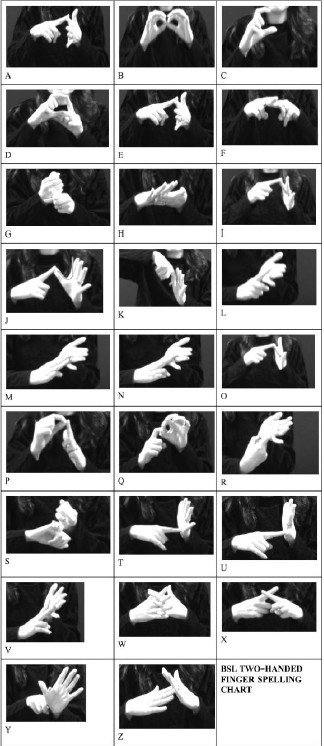
Source: Sharma, S. (2014). Handedness and cerebral lateralization: Looking at signing, fingerspelling and gesture skills in Deaf signers and signers with stroke in British Sign Language (BSL). Doctoral dissertation, University College London (UCL).
Figure 2 Two-Handed Fingerspelling in Turkish Sign Language (TİD)
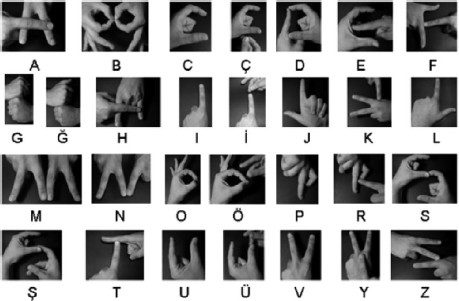
Source: Kubus, O. (2008). An analysis of Turkish Sign Language (TİD) phonology and morphology. Unpublished master’s thesis, Middle East Technical University.
Turkish Sign Language (TİD) is also a two-handed system but is slightly different from BANZSL and comprises 29 manual letter signs corresponding to the Turkish alphabet (see Figure 2).
Signs may be made with the left or right hand as the dominant hand. In fingerspelling, too, this consistency is maintained. In one-handed manual alphabets, only the dominant hand is used. Within two-handed manual alphabets such as the British one, letters can be formed asymmetrically or symmetrically; in asymmetric forms, the dominant hand is the active articulator with the nondominant hand serving as a location.
The two-handed alphabet is articulated in neutral signing space in front of the body, as opposed to the one-handed alphabet, which is articulated in a specific spot within the neutral space. In BSL, the vowels A, E, I, O, and U are formed by touching each of the fingertips starting from the thumb. The letter C is the only one-handed letter. The letters B, F, G, L, M, N, R, S, and W are visually motivated and correspond to the shape of the English letters. The two hands make the shape of the letters C, D, J, K, P, Q, T, V, X, and Y. Only two letters, H and J, have an additional movement to the handshape.
...
- Deaf Community
- Africa, Eastern: Deaf Community
- Africa, Middle: Deaf Community
- Africa, Southern: Deaf Community
- Africa, Western: Deaf Community
- Asia, Southeast: Deaf Community
- Asia, Southern: Deaf Community
- Asia, Western: Deaf Community
- Canada: Deaf Community
- Central America: Deaf Community
- Deaf International Development
- Japan: Deaf Community
- Puerto Rico: Deaf Community
- South America: Deaf Community
- United States: Deaf Community
- Deaf Community: Diversity
- Diversity: Disability and Deaf Studies
- Diversity: First Nation Peoples of North America
- Diversity: LGBTQI
- Diversity: Women
- Deaf Community: Health
- Aphasia and Brain Lesions
- Autism Spectrum
- Early Intervention and Newborn Screening
- Genetic Counseling
- Genetics and Heredity
- Genetics: Connexin 26 and Connexin 30
- Hearing Conditions and Auditory Disorders, Causes of
- Hearing Conditions, Screening and Assessment
- Mental Health
- Mental Health Services
- Social Hearing Handicap Index
- Speech-Language Pathology
- Substance Abuse
- Deaf Community: History
- Biblical Tradition, References to Deaf in
- Civil War, U.S.: Deaf History of and Participation in
- Deaf History: 1300-1800
- Deaf History: 1800-1880
- Deaf History: 1881-1920
- Deaf History: 1921-1980
- Deaf History: 1981 to Present
- Deaf History: Antiquity
- Deaf History: Caribbean
- Deaf History: Central America
- Deaf History: Eastern Asia
- Deaf History: Eastern Europe
- Deaf History: Middle Africa
- Deaf History: Northern Europe
- Deaf History: Oceania
- Deaf History: South America
- Deaf History: Southeast Asia
- Deaf History: Southern Africa
- Deaf History: Southern Asia
- Deaf History: Western Europe
- Religious Materials, Access to Translated
- Science, Deaf History of and Participation in
- Sports, Deaf History of
- War, Deaf History of and Participation in
- Women, Deaf: History of
- World War II, Deaf History of
- Deaf Community: Organizations
- Education: Professional Organizations
- Interpreting: Professional Organizations
- Medicine: Professional Organizations
- Telecommunications for the Deaf and Hard of Hearing, Inc., Formation of
- Deaf Community: Psychology and Sociology
- Bullying
- Child Welfare and Child Abuse
- Cochlear Implant: Deaf Community
- Crime and Delinquency
- Domestic Violence and Services
- Misdiagnosis of Deaf People
- Neuropsychology
- Oralism, Psychological Effects of
- Psychological Evaluations and Testing
- Psychology, Multicultural
- Social Work
- Socioemotional Development
- Sociology of Deaf People
- Deaf Community: Social Patterns
- Adoption
- Catholicism
- Christianity
- Demographics
- Genealogy, Deaf History of
- Genetics and Ancestry
- Islam
- Mentors and Role Models
- Missionaries
- Mormonism
- Parent Education
- Summer Programs
- Theology
- Volunteerism
- Deaf Culture: Art
- Actors
- Art and Literature, Deaf History of and Participation in
- Art Genres and Movements
- Artists
- Artists in Residency
- Arts, Performing
- Deaf Art
- Deaf Professionals in American Art Museums
- De’VIA Manifesto
- Digital Arts
- Magicians
- Music, Signed
- Rhythm Stories and Songs, Signed
- Theater, Adapted
- Theater, Original
- Deaf Culture: Literature
- Books
- Folklore
- Literature, Deaf Characters in
- Literature, Deaf Themes in
- Poetry
- Poetry, Signed
- Poetry, Signed: Themes of
- Sign Language Literature
- Writers
- Deaf Culture: Media
- Deaf Cinema
- Film: Deaf Characters
- Film: Documentaries
- Film: Silent, Indies, and Post-Talkies Era
- Media, Stereotype of Deaf People in
- Television: Cultural Deaf Programming
- Television: Mainstream Programming
- Deaf Education: Educational Programs
- Education Programs: K-12 Charter Schools
- Education Programs: K-12 Day Schools
- Education Programs: K-12 Mainstream Programs
- Education Programs: K-12 Oral Schools
- Education Programs: K-12 Residential Schools
- Education Settings, Placement in
- Education, Early Intervention in
- Education: Higher Education
- Education: Transition
- Deaf Education: History
- Deaf Education History: 1980 to Present
- Deaf Education History: Milan 1880
- Deaf Education History: Post-1880 to 1979
- Deaf Education History: Pre-1880
- Education, History of Total Communication in
- Hearing People in Deaf Education
- Residential Schools, History of
- Residential Schools, Segregation in
- Deaf Education: Philosophy
- Combined Method, Philosophy and Models of
- Oralism, Philosophy and Models of
- Sign Systems, Cued Speech
- Sign Systems, Methodical
- Special Education, Philosophy and Models of
- Teaching Profession, Philosophies of
- Deaf Education: Policy and Curriculum
- Academic Test Bias
- Assessment Accommodations and Testing Modifications
- Classroom, Signing in the
- Educational Assessment Measures
- Individualized Education Program and Least Restrictive Environment, Placement in
- Journals, Deaf Education
- Mainstreaming and Social Capital
- Teacher Training, Bilingual
- Teaching Profession, Preparation for
- Teaching Profession, Requirements of
- Deaf Studies
- Deaf Centrism and Deaf Centricity
- Deaf Crit
- Deaf Gain
- Deaf Studies
- Deaf Studies Programs
- Deaf Studies: Disability Studies Perspective and Controversy
- Deaf Theory
- deaf/Deaf: Origins and Usage
- DeafSpace
- Dysconscious Audism
- Geographies
- Journals, Deaf Studies
- Transnationalism
- Deaf Studies: Social Justice
- Audism
- Bioethics
- Deaf Dean Now Protest
- Deaf Drivers and Deaf Workers: Advocacy Work of the National Association for the Deaf
- Deaf President Now Protest
- Deaf Rights Activism, Global Protests
- Driving Restrictions Protests
- Equality Issues
- Eugenics
- Unity for Gallaudet Protest
- Employment
- Business Owners and Entrepreneurs
- Employment: Affirmative Action
- Employment: Career Opportunities and Choices
- Employment: Depression and the New Deal
- Employment: Government Assistance
- Employment: Labor Bureaus
- Employment: Oppression
- Employment: Peddling
- Employment: Rehabilitation Services Administration
- Employment: U.S. Works Progress Administration
- Identity
- Children of Deaf Adults
- Children, Deaf, of Deaf Parents
- Children, Deaf, of Hearing Parents
- Deaf Culture
- Deafhood
- Group Membership and Exclusion
- Identity Development
- Labeling
- Surdescence
- Language: Attitudes and Planning
- Bilingualism, Philosophy and Models of
- International Day of Sign Language
- Language Attitudes
- Language: Oralism Versus Manualism
- Linguicism
- Linguistic Genocide
- Literacy
- Manualism, Philosophy and Models of
- Sign Language, Endangered
- Sign Languages, Recognition of
- Signed Language Policy
- Signed Language Rights, Attitudes Toward
- Language: Interpreting
- Interpreter Training, University
- Interpreting
- Interpreting, Categories of
- Interpreting, History of
- Interpreting, Legal
- Interpreting, Medical
- Interpreting: Agencies
- Interpreting: Deaf Interpreter
- Interpreting: Tasks
- National Multicultural Interpreter Project
- Language: Linguistics
- Bilingualism
- Cognitive Processes
- Deaf Learners, Cognition of
- Language Acquisition and Development
- Language Assessment Tools
- Language Contact of Spoken and Signed Languages
- Linguistics: Etymology
- Linguistics: Generativism
- Linguistics: Gestures and Homesigns
- Linguistics: Morphology
- Linguistics: Nonmanual Markers
- Linguistics: Phonetics
- Linguistics: Phonology
- Linguistics: Pragmatics
- Linguistics: Semantics
- Linguistics: Spatial Grammar
- Linguistics: Structuralism
- Linguistics: Syntax
- Multilingualism
- Nativism
- Neurolinguistics and Cortex Imaging
- Psycholinguistics, Milestones in
- Psycholinguistics, Primary
- Psycholinguistics: Visual Processing
- Sign Language Research: 1980 to Present
- Sign Language Research: Pre-1980
- Signed Language Linguistics, History of
- Sociolinguistics: Black American Sign Language
- Sociolinguistics: Dialects, Regionalisms, and Ethnic Varieties
- Sociolinguistics: Registers
- Language: Sign Language
- American Sign Language and English Literacy, Interdependence of
- American Sign Language, Positive Psychological Effects of
- Baby Signs
- International Signs
- Languages, Natural
- Sign Language as Academic Language
- Sign Language Teaching, Curriculum Models of
- Sign Language Teaching, Foreign Language Requirements for
- Sign Language Teaching, History of
- Sign Language Teaching, Training for
- Sign Language, Hawaiian
- Sign Language, Indigenous
- Sign Language: Africa
- Sign Language: Arabic Fingerspelling
- Sign Language: Caribbean
- Sign Language: Central America
- Sign Language: Eastern Europe
- Sign Language: Japan
- Sign Language: JSL Fingerspelling
- Sign Language: Name Signs
- Sign Language: One-Handed Fingerspelling
- Sign Language: Pacific Region
- Sign Language: Scandinavia
- Sign Language: South America
- Sign Language: Southern Asia
- Sign Language: Southern Europe
- Sign Language: Tactile
- Sign Language: Two-Handed Fingerspelling
- Sign Language: United Kingdom and Ireland
- Sign Language: Western Asia
- Sign Writing
- Signed Language Literacy, Definition of
- Signed Language Pathology
- Signing Communities
- Law and Public Policy
- Americans with Disabilities Act
- Architectural Barriers Act of 1968
- Camenisch v. University of Texas
- Commission on the Education of the Deaf
- Communications Act: Section 255
- Community Television of Southern California v. Gottfried
- Costner v. United States
- Department of Education, U.S.
- Eckstein v. Kirby
- Education Laws, Federal: Impact on Education of the Deaf
- Education of the Deaf Act of 1986
- Flail v. Bolger
- Hendrick Hudson Board of Education v. Rowley
- Human Fertilisation and Embryology Act of 2008
- Jackson v. Indiana
- Jones v. Illinois Department of Rehabilitation Services
- Legislation, Disability
- Legislation, Interpreter
- Legislation, Proposed: Assembly Bill 2072
- Legislation, Proposed: House Bill 1367
- Legislation, United States
- Legislators
- Linguistic and Human Rights Ratifications, European Union
- Linguistic and Human Rights, Constitutional Recognitions of
- Linguistic Minority Law, International
- People of Illinois v. Lang
- Public Policy Issues
- Pyles v. Kamka
- Schornstein v. New Jersey Division of Vocational Rehabilitation Services
- Southeastern Community College v. Davis
- Strathie v. Department of Transportation
- Telecommunications Act of 1996
- UN Convention on Genocide
- UN Convention on the Rights of Persons with Disabilities
- UN Convention on the Rights of the Child
- UN Declaration on the Rights of Persons Belonging to National or Ethnic, Religious and Linguistic Minorities
- UNESCO Education Position Paper (2003)
- Technology
- Avatar Technology
- Captioning
- Captioning Technology, Media
- FAX Technology
- Hearing Aids
- Hearing Mechanisms, Internal
- Inventors
- Social Media
- Technology, Assistive
- Technology, Tactile
- Technology, Wireless
- Teletypewriter (TTY)
- Loading...
Get a 30 day FREE TRIAL
-
 Watch videos from a variety of sources bringing classroom topics to life
 -
Read modern, diverse business cases
-
Explore hundreds of books and reference titles

Read next

More like this
Sage Recommends
We found other relevant content for you on other Sage platforms.
Have you created a personal profile? Login or create a profile so that you can save clips, playlists and searches