
Entry
Entries A-Z
Great Depression
The Great Depression, which lasted from 1929 until the early 1940s, was both the worst economic crisis in U.S. history and a major turning point in the development of the presidency. It brought down one president, Herbert C. Hoover, and provided another, Franklin D. Roosevelt, with an opportunity to display the greatness of leadership that elevated him to the first rank among presidents. By the time the Great Depression was over, the presidency, along with much of the nation, had been profoundly transformed.
Hoover had the bad luck to be president when the economic boom of the 1920s reached its catastrophic conclusion in the great stock market crash of 1929. First described by economists as a temporary interruption in good times, the crash led to a wave of business and bank failures, joblessness, and a crisis of political leadership. But Hoover, who had once proclaimed that the end of poverty was near, did not know how to cope with the crisis. Holding the conventional belief in the need for government economy and a balanced budget, he was unwilling to take the steps needed to aid the economy or even to show people that the government cared about their suffering. His popularity plunged, and he was defeated by Roosevelt in a landslide election in 1932.
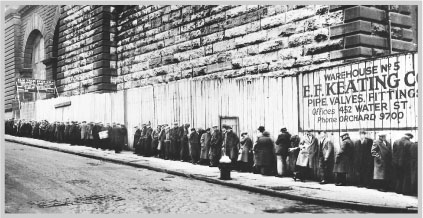
Breadlines became symbolic of the Great Depression. Shown here are people queued up in New York, beside the Brooklyn Bridge Library of Congress
Roosevelt actually had campaigned on a platform of government economy and a balanced budget. Once in office, however, he proved himself a master pragmatist, willing to consider almost any idea if it had a chance of helping the economy and restoring people’s confidence in the future.
Roosevelt’s first months in the White House were perhaps the most crucial. Taking office at a time when the financial system seemed on the verge of complete collapse, he moved quickly to stabilize the banking system and spoke directly to Americans with a message of reassurance. Within a few weeks he had worked a remarkable and enduring change in the spirit of the nation, banishing the despair and political paralysis of the Hoover years and replacing them with an ebullient national mood and a refashioned presidency. Almost overnight the presidency was transformed from a passive entity to the vivid focal point of national attention.

During a session of Congress known as the First Hundred Days, Roosevelt also pushed through a series of bills aimed at dealing with the national emergency. In the years that followed, his New Deal program brought about massive economic and social changes, such as the Social Security program for the elderly and federal aid for the unemployed, disabled, and poor children. His program sought to help individuals and to counter the economic and social problems of the depression by, for example, helping workers to form unions to resist the relentless economic pressures on them.
Yet despite the government’s efforts, the depression continued throughout the 1930s. When, after modest improvements, the economy began to turn down again in 1937, Roosevelt also brought about an important change in the government’s economic philosophy. Drawing on the work of the British economist John Maynard Keynes, who advocated government spending to counter unemployment, Roosevelt and his advisers began using deficit spending as a way of stimulating the economy. The new approach to economic management, which in one form or another has guided federal budget policies ever since, helped bring about a reduction in unemployment. The Great Depression itself did not fully end, however, until the United States began massive military spending after its entry into World War II.
...
Get a 30 day FREE TRIAL
-
 Watch videos from a variety of sources bringing classroom topics to life
 -
Read modern, diverse business cases
-
Explore hundreds of books and reference titles

Read next

More like this
Sage Recommends
We found other relevant content for you on other Sage platforms.
Have you created a personal profile? Login or create a profile so that you can save clips, playlists and searches