
Entry
Entries A-Z
Calhoun, John C.
John Caldwell Calhoun (1782–1850) served as vice president under John Quincy Adams and Andrew Jackson from 1825 to 1832. Calhoun was an important player in many of the greatest political controversies of his era. He also was the first vice president to resign and the only incumbent vice president to run for reelection on a ticket opposing the president he had just served.
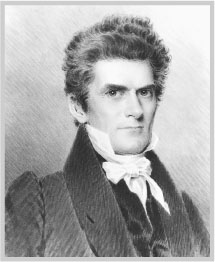
John C. Calhoun. National Portrait Gallery, Smithsonian Institution
Calhoun was born into a family of wealthy South Carolina planters. He graduated from Yale University in 1804 and passed the South Carolina bar in 1807. The next year he won a seat in the state legislature, and in 1811 he was elected to the U.S. House of Representatives as a Jeffersonian Democratic-Republican.
During the War of 1812 Calhoun was a leader of the War Hawks, a group of expansionist members of Congress who had helped push the United States toward war with Britain. He served three terms in the House and chaired the Foreign Relations Committee. In 1817 President James Monroe appointed Calhoun secretary of war, a post that he held throughout Monroe’s presidency.
In 1824 Calhoun maneuvered for the vice presidency, an office he hoped would lead to the presidency. He courted the two main candidates, Andrew Jackson and John Quincy Adams, and received the support of both men for his vice-presidential candidacy. Calhoun became vice president when Adams was elected president by the House of Representatives, since neither Adams nor Jackson had received a majority of electoral votes.
Relations between Calhoun and Adams quickly became strained. Calhoun shared few political goals with Adams, and as vice president Calhoun worked to foil many of the president’s programs. By 1828 Calhoun’s break with Adams was complete. The vice president threw his support behind Democratic presidential candidate Andrew Jackson, who in turn backed Calhoun’s nomination for a second vice-presidential term. The Jackson-Calhoun ticket easily defeated Adams and Richard Rush.
Like Adams, Jackson soon became dissatisfied with his vice president. The split between the two men was first opened in early 1829 by the refusal of Calhoun’s wife to accept the wife of Secretary of War John H. Eaton into Washington society. This was a small matter, however, compared with Calhoun’s increasingly radical opinions on states’ rights. During his early career Calhoun had been known as a nationalist. He had not only called for war with the British in 1812 but also supported the national bank, internal improvements, and a high tariff that many of his fellow southerners opposed. By 1827, however, Calhoun had begun to believe that the southern states needed protection from high tariffs and from the growing antislavery movement in the North. He wrote anonymously in support of nullification, a concept that allowed a state to nullify a federal law within its borders. Jackson rejected nullification as unconstitutional.
On April 13, 1830, at a Jefferson Day dinner, Jackson resolved to find out whether his vice president’s first loyalties were to his country or to his state. The president stared directly at Calhoun as he delivered the toast: “Our Union—it must be preserved.” When the vice president replied, “The Union, next to our liberties, most dear,” he finally committed himself to South Carolina and the South.
...
Get a 30 day FREE TRIAL
-
 Watch videos from a variety of sources bringing classroom topics to life
 -
Read modern, diverse business cases
-
Explore hundreds of books and reference titles

Read next

More like this
Sage Recommends
We found other relevant content for you on other Sage platforms.
Have you created a personal profile? Login or create a profile so that you can save clips, playlists and searches