
Entry
Entries A-Z
Adams, John
John Adams (1735–1826) was the second president of the United States and a leading patriot during the American Revolution. He also served as the first vice president of the United States, under George Washington. Adams’s single term as president saw the intensification of partisan politics and the rise of the rival Democratic-Republican Party, which would dominate American government during the early nineteenth century.
Adams was born on October 30, 1735, in Braintree (now Quincy), Massachusetts. His parents were well-established farmers whose ancestors had immigrated to Massachusetts from England a century before his birth. Adams enrolled in Harvard University in 1751, intending to become a Congregational minister. However, before he graduated in 1755 he had decided on a career in either law or medicine. After briefly teaching school in Worcester, Adams began studying law. By 1758 he had been admitted to the Massachusetts bar and was practicing law in Braintree.
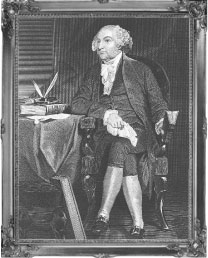

William Winstanley, Adams National Historic Site
Adams soon became recognized throughout Massachusetts as an outspoken advocate of colonial causes. He wrote Braintree’s protest against the British Stamp Act of 1765 and published a series of anonymous letters in the Boston Gazette in which he said that the rights of English citizens were derived solely from God, not from the British monarchy or Parliament. In 1770 Adams demonstrated his commitment to due process of the law when he defended the British soldiers on trial for the murder of colonial citizens at the Boston Massacre. His reputation withstood the unpopularity of his action, and the following year he was elected by a large margin to the Massachusetts legislature.
In 1774 Adams became a delegate to the First Continental Congress. He was an early and influential advocate of separation from Britain and was appointed to the committee assigned to draft a declaration of independence. Adams retired from Congress in November 1777. Within a month, however, Congress appointed him to the American commission in France. He set sail to join Benjamin Franklin and Arthur Lee in Paris on February 13, 1778, but a treaty of alliance had already been concluded by the time he arrived. Adams returned to America in the summer of 1779. Upon his arrival he was elected as a delegate to the Massachusetts constitutional convention. He wrote the first draft of the new state constitution, which the convention adopted with only minor changes. He returned to Europe in 1780 and spent the next eight years in various diplomatic posts, including minister to Holland and minister to Great Britain. He signed the armistice ending war with the British in 1783 and negotiated several loans and commercial treaties with the European powers.
After returning to Boston in 1789, Adams was elected vice president in the first presidential election. Adams dutifully presided over the Senate in accordance with the Constitution. Because the original Senate had only twenty-two members, the vice president was often in a position to break tie votes as prescribed by the Constitution. During Adams’s two terms he had twenty-nine opportunities to decide issues with his tie-breaking vote, more than any later vice president. However, he was seldom consulted by Washington on important issues and complained that the vice presidency was an insignificant and mechanical job. Nevertheless, Adams’s relations with Washington remained cordial.
...
Get a 30 day FREE TRIAL
-
 Watch videos from a variety of sources bringing classroom topics to life
 -
Read modern, diverse business cases
-
Explore hundreds of books and reference titles

Read next

More like this
Sage Recommends
We found other relevant content for you on other Sage platforms.
Have you created a personal profile? Login or create a profile so that you can save clips, playlists and searches