
Entry
Reader's guide
Entries A-Z
Subject index
Ulster Freedom Fighters
The Ulster Freedom Fighters (UFF) was a Northern Irish Loyalist paramilitary group that claimed responsibility for dozens of assassinations believed to have been carried out by members of the Ulster Defense Association (UDA) before it disbanded in 2007.
In Northern Ireland, beginning in the late 1960s, a bloody conflict was waged between the province's Roman Catholics (also called Republicans or Nationalists), who wanted Northern Ireland to become a part of the Republic of Ireland, and its Protestants (also called Loyalists or Unionists), who wanted it to remain part of Great Britain. Armed paramilitary groups sprung up in both communities. One such Loyalist group, the Ulster Defense Association, began a campaign of sectarian assassinations in the spring of 1972, killing Catholics at random in reprisal for attacks by the Irish Republican Army (IRA). By the end of the year, more than 80 people had been killed.
The Northern Irish police and British government were initially reluctant to acknowledge the murders as politically motivated sectarian attacks. They did not want to give the IRA a propaganda victory, and they feared provoking a Protestant backlash that could destroy the delicate peace negotiations then under way. For its part, the UDA could not claim responsibility for the attacks without the organization being declared illegal and having many of its members arrested.
At a meeting in May 1973, UDA leaders decided that a shadow organization called the Ulster Freedom Fighters would be created within the UDA. The UDA could continue its attacks, but the UFF would claim responsibility. The UFF would also streamline the UDA's terrorist operations. The UDA was structured like the British Army; the UFF, in contrast, would be composed of small, hard-to-penetrate cells of four or five individuals. The most reliable members of the Belfast death squads that had committed the previous murders were chosen as UFF commanders. On June 26, 1973, a man claiming to be “Captain Black” of the UFF called a Belfast newspaper and claimed responsibility for the murder of the Catholic politician Paddy Wilson and his companion, marking the first public use of the UFF name.
Mural in Kilcooley, a housing estate situated in Bangor, County Down, Northern Ireland.
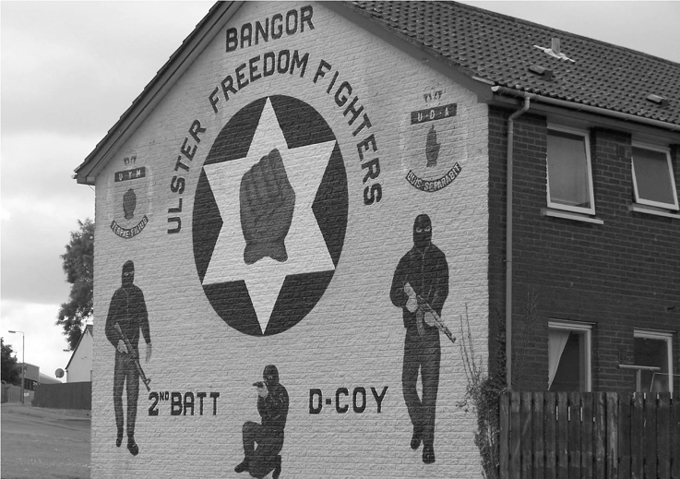
The UFF was banned as a terrorist organization in November 1973, while the UDA remained legal until 1992. Despite the banning, the UFF claimed responsibility for or was implicated in hundreds of deaths over the next 25 years. The UFF was also involved in the assassinations and attempted assassinations of several prominent Republican activists, including the murder of the lawyer Pat Finucane in 1989, and the attempted murders of Bernadette Devlin McAliskey in 1981 and Gerry Adams, the leader of Sinn Fein (the IRA's political arm) in 1984. The UFF was also implicated in a 1989 scandal that involved members of Northern Ireland's security forces who had passed on secret police intelligence about Republicans to Loyalist paramilitaries for use in planning assassinations.
In January 1998, the UFF and the UDA declared a cease-fire in compliance with the Good Friday Agreement. A series of attacks beginning in 1998 by groups calling themselves the Red Hand Defenders and the Orange Volunteers are believed to have been carried out by former UDA/UFF members. On October 12, 2001, the British government declared that it no longer considered the UDA and the UFF to be honoring the cease-fire, although the group itself had not announced the cease-fire to be at an end. In 2007, shortly after an official statement released by the UDA renouncing violence, the group was ordered to stand down, and along with its parent group, the UFF began disarming in 2009.
...
- Counterterrorism
- 9/11 Commission
- Airport Security
- Bureau of Alcohol, Tobacco, Firearms and Explosives
- Central Intelligence Agency
- Counterterrorism
- Criminal Prosecution of Terrorists
- Decommissioning in Northern Ireland
- Department of Justice, U.S.
- Federal Bureau of Investigation
- Force 17
- Force Protection Conditions
- Foreign Intelligence Surveillance Act
- Forensic Science and Terrorism
- Grenzschutzgruppe 9
- Guantánamo Bay
- Homeland Security
- Intelligence Gathering
- International Relations and Terrorism
- Interrogation Techniques
- Law and Terrorism
- Mossad
- National Security Agency
- National Security Council
- Operation Eagle Claw
- Patriot Act
- Rehabilitation of Terrorists
- Rendition, Extraordinary
- Rewards for Justice
- Sayeret Matkal
- Special Air Service Regiment
- Special Operations Wing
- Torture Debate
- United Nations
- Culture and Ideology of Terrorism
- Anarchism
- Christian Identity
- Ethnic Cleansing
- Fatwa
- Gender-Based Terrorism
- Homegrown Jihadi Movement
- Media and Terrorism
- New Terrorism, The
- Patriot Movement
- Popular Culture, Terrorism in
- Posse Comitatus
- Religious and Spiritual Perspectives on Terrorism
- Stockholm Syndrome
- Taliban Code of Conduct
- Training of Terrorists
- Turner Diaries, The
- White Supremacy Movement
- Women Terrorists
- Economics, Politics, and the Law
- 9/11 Commission
- Bureau of Alcohol, Tobacco, Firearms and Explosives
- Central Intelligence Agency
- Counterterrorism
- Criminal Prosecution of Terrorists
- Department of Justice, U.S.
- Economics and Terrorism
- Federal Bureau of Investigation
- Financing Terrorism
- Foreign Intelligence Surveillance Act
- Homeland Security
- Insurance and Terrorism
- International Relations and Terrorism
- Law and Terrorism
- National Security Agency
- National Security Council
- Patriot Act
- Rendition, Extraordinary
- Torture Debate
- United Nations
- Groups
- Abu Nidal Organization
- Abu Sayyaf Group
- Aden-Abyan Islamic Army
- al Aqsa Martyrs Brigades
- al Asifa
- al Jihad
- al Muhajiroun
- al Qaeda
- al Qaeda in Iraq
- al Qaeda in the Islamic Maghreb
- al Shabab
- Alex Boncayao Brigade
- Animal Liberation Front
- Ansar al Islam
- Armed Islamic Front
- Armed Islamic Group
- Armenian Secret Army for the Liberation of Armenia
- Army of God
- Aryan Nations
- Aryan Republican Army
- Aum Shinrikyo
- Baader-Meinhof Gang
- Basque Fatherland and Liberty
- Black Panther Party
- Black September
- Chukaku-ha
- Communist Party of Nepal (Maoists)
- Continuity Irish Republican Army
- Covenant, the Sword and the Arm of the Lord, The
- Democratic Front for the Liberation of Palestine
- Democratic Front for the Liberation of Rwanda
- Earth First!
- Earth Liberation Front
- East Turkestan Islamic Movement
- El Rukns
- Evan Mecham Eco-Terrorist International Conspiracy
- FALN
- Farabundo Martí National Liberation Front
- FARC
- Fatah
- First of October Antifascist Resistance Group
- Force 17
- Gama'a al Islamiyya
- German Red Army Faction
- Great Eastern Islamic Raiders’ Front
- Grey Wolves
- Hamas
- Hanafi Muslim Movement
- Harakat ul-Mujahideen
- Hezbollah
- Hizb-ul-Mujahideen
- Irgun Zvai Leumi
- Irish National Liberation Army
- Irish Republican Army
- Islamic Army for the Liberation of Holy Places
- Islamic Movement of Uzbekistan
- Jaish-e-Mohammed
- Jamaat ul Fuqra
- Japanese Red Army
- Jewish Terrorist Groups in the United States
- Justice Department
- Kahane Chai
- Kosovo Liberation Army
- Ku Klux Klan
- Kurdistan Workers’ Party
- Lashkar-e-Taiba
- Lautaro Youth Movement
- Liberation Tigers of Tamil Eelam
- Lord's Resistance Army
- Loyalist Volunteer Force
- Macheteros
- Manuel Rodriquez Patriotic Front
- May 19 Communist Organization
- Morazanist Patriotic Front
- Moro Islamic Liberation Front
- Mujahideen-e-Khalq Organization
- National Liberation Army–Bolivia
- National Liberation Army–Colombia
- National Liberation Front of Corsica
- New People's Army
- Orange Volunteers
- Order, The
- Ordine Nuovo
- Palestine Islamic Jihad
- Palestine Liberation Front–Abu Abbas Faction
- Palestine Liberation Organization
- People Against Gangsterism and Drugs
- People's Revolutionary Army
- Popular Front for the Liberation of Palestine
- Popular Front for the Liberation of Palestine–General Command
- Popular Liberation Army
- Puerto Rican Nationalist Terrorism
- Real Irish Republican Army
- Red Brigades
- Red Hand Defenders
- Revolutionary Organization 17 November
- Revolutionary People's Liberation Party/Front
- Revolutionary United Front
- Shining Path
- Stern Gang
- Symbionese Liberation Army
- Taliban
- Tehrik-i-Taliban Pakistan
- Tupac Amaru Revolutionary Movement
- Tupac Katari Guerrilla Army
- Tupamaros
- Turkish Hezbollah
- Ulster Defense Association
- Ulster Freedom Fighters
- Ulster Volunteer Force
- United Self-Defense Forces of Colombia
- Vigorous Burmese Student Warriors
- Weatherman
- White Patriot Party
- Zetas, Los
- Individuals
- Abbas, Muhammad “Abu”
- Abdel Rahman, Omar
- Abdullah, Abdullah Ahmed
- Adel, Saif al
- Ali, Ahmed Mohamed Hamed
- Anderson, Terry A.
- Arocena, Eduardo
- Asahara, Shoko
- Atef, Muhammad
- Atta, Mohamed
- Atwa, Ali
- Atwah, Muhsin Musa Matwalli
- Awda, Abd al Aziz
- Awlaki, Anwar al
- Ayyash, Yahya
- Baader, Andreas
- Bakunin, Mikhail
- Banna, Sabri al
- Bashir, Abu Bakar
- Berenson, Lori
- bin Laden, Osama
- Boudin, Katherine
- Buckley, William
- Chesimard, Joanne
- Cicippio, Joseph
- Copeland, David
- Coronado, Rodney
- Dohrn, Bernardine
- Dozier, James Lee
- Elbaneh, Jaber A.
- Ellerman, Josh
- Ellison, James
- Fadhil, Mustafa Mohamed
- Fadlallah, Sheikh Mohammad Hussein
- Gadahn, Adam Yahiye
- Ghailani, Ahmed Khalfan
- Goldstein, Baruch
- Griffin, Michael Frederick
- Guevara, Ernesto (Che)
- Habash, George
- Hage, Wadih el
- Hawatmeh, Nayef
- Hearst, Patty
- Hill, Paul Jennings
- Hoorie, Ali Saed bin Ali el
- Hussein, Saddam
- Izz al Din, Hassan
- Jibril, Ahmed
- Kahane, Meir
- Kansi, Mir Aimal
- Khaled, Leila
- Kikumura, Yu
- Kilburn, Peter
- Kropotkin, Peter
- Liby, Anas al
- Lindh, John Walker
- Marighella, Carlos
- Marzook, Mousa Mohammed Abu
- Masri, Abu Ayyub al
- Mathews, Robert Jay
- McVeigh, Timothy James
- Meinhof, Ulrike
- Metesky, George
- Miller, Frazier Glenn
- Mohamed, Khalfan Khamis
- Mohammed, Fazul Abdullah
- Mohammed, Khalid Shaikh
- Moussaoui, Zacarias
- Msalam, Fahid Mohammed Ally
- Mughassil, Ahmad Ibrahim al
- Mugniyah, Imad Fayez
- Nasrallah, Sheikh Hassan
- Nasser, Abdelkarim Hussein Mohamed al
- Nichols, Terry Lynn
- Nosair, El Sayyid
- Ocalan, Abdullah
- Odeh, Mohammed Saddiq
- Owhali, Mohamed Rashed al
- Padilla, José
- Pearl, Daniel
- Qaddafi, Muammar el
- Rajneesh, Bhagwan Shree
- Reid, Richard
- Ressam, Ahmed
- Reynoso, Abimael Guzmán
- Rudolph, Eric
- Sánchez, Ilich Ramírez
- San Diego, Daniel Andreas
- Scutari, Richard
- Shallah, Ramadan Abdullah
- Shigenobu, Fusako
- Snell, Richard Wayne
- Steen, Alann
- Sutherland, Thomas
- Swedan, Sheikh Ahmed Salim
- Waite, Terry
- Yacoub, Ibrahim Salih Mohammed al
- Yasin, Abdul Rahman
- Younis, Fawaz
- Yousef, Ramzi Ahmed
- Zarqawi, Abu Musab al
- Zawahiri, Ayman al
- Zubaydah, Abu
- Types and Methods of Terrorism
- Agricultural Terrorism
- Anthrax
- Anti-Abortion Terrorism
- Asymmetrical Warfare
- Biological Terrorism
- Bombings and Bomb Scares
- Chemical Terrorism
- Cyberterrorism
- Death Squads
- Ecoterrorism
- Ethnic Cleansing
- Freelance Terrorism
- Hijacking
- Homegrown Jihadi Movement
- Hostage Taking
- Kneecapping
- Leaderless Resistance
- Lone-Wolf Terrorism
- Lynching
- Narcoterrorism
- Nuclear Terrorism
- State Terrorism
- State-Sponsored Terrorism
- Suicide Terrorism
- Weapons of Mass Destruction
- Regional Categories
- Africa: Eastern, Central, and Southern
- Africa: Northern
- Americas: Central and South America
- Farabundo Martí National Liberation Front
- FARC
- Lautaro Youth Movement
- Manuel Rodriquez Patriotic Front
- Morazanist Patriotic Front
- Movement of the Revolutionary Left
- National Liberation Army–Bolivia
- National Liberation Army–Colombia
- People's Revolutionary Army
- Popular Liberation Army
- Shining Path
- Tupac Amaru Revolutionary Movement
- Tupac Katari Guerrilla Army
- Tupamaros
- United Self-Defense Forces of Colombia
- Americas: North America
- 9/11 Commission
- Animal Liberation Front
- Anti-Abortion Terrorism
- Army of God
- Aryan Nations
- Aryan Republican Army
- Black Panther Party
- Branch Davidian Compound Siege
- Brooklyn Bridge Shooting
- Centennial Park Bombing
- Covenant, the Sword and the Arm of the Lord, The
- Earth First!
- Earth Liberation Front
- El Rukns
- Empire State Building Shooting
- Evan Mecham Eco-Terrorist International Conspiracy
- FALN
- Fort Smith, Arkansas, Trial
- Fraunces Tavern Bombing
- Grand Central Station Bombing
- Hanafi Muslim Movement
- Homegrown Jihadi Movement
- Jewish Terrorist Groups in the United States
- Ku Klux Klan
- LaGuardia Airport Bombing
- Macheteros
- May 19 Communist Organization
- Oklahoma City Bombing
- Order, The
- Puerto Rican Nationalist Terrorism
- September 11 Attacks
- Sixteenth Street Baptist Church Bombing
- Statue of Liberty Bombing
- Subway Suicide Bombing Plot
- Symbionese Liberation Army
- TWA Flight 355 Hijacking
- Wall Street Bombing
- Weatherman
- White Patriot Party
- World Trade Center Bombing (1993)
- Y2K Plot
- Zetas, Los
- Asia: East and Southeast
- Asia: South and Central
- Afghan Arabs
- Afghanistan War
- Air India Flight 182 Bombing
- Eastern Turkestan Islamic Movement
- Harakat ul-Mujahideen
- Hizb-ul-Mujahideen
- Islamic Movement of Uzbekistan
- Jaish-e-Mohammed
- Jamaat ul Fuqra
- Kurdistan Workers’ Party
- Lashkar-e-Taiba
- Mumbai Attack, 2008
- Pan Am Flight 73 Hijacking
- Popular Front for the Liberation of Palestine
- Popular Front for the Liberation of Palestine–General Command
- Sikh Terrorism
- Taliban
- Tehrik-i-Taliban Pakistan
- Turkish Hezbollah
- Europe
- Animal Liberation Front
- Armenian Secret Army for the Liberation of Armenia
- Basque Fatherland and Liberty
- Basque Separatists
- Birmingham Pub Bombing
- Bloody Sunday
- Canary Wharf Bombing
- Chechen Terrorism
- Continuity Irish Republican Army
- Decommissioning in Northern Ireland
- Earth Liberation Front
- First of October Antifascist Resistance Group
- German Red Army Faction
- Great Eastern Islamic Raiders’ Front
- Grey Wolves
- Homegrown Jihadi Movement
- Irish National Liberation Army
- Irish Republican Army
- Islamic Army for the Liberation of Holy Places
- Justice Department
- Kosovo Liberation Army
- La Belle Discotheque Bombing
- London Underground Bombings
- Loyalist Volunteer Force
- Madrid Bombings
- Munich Olympics Massacre
- National Liberation Front of Corsica
- Omagh Bombing
- Orange Volunteers
- Ordine Nuovo
- Pan Am Flight 103 Bombing
- Real Irish Republican Army
- Red Brigades
- Red Hand Defenders
- Revolutionary Organization 17 November
- Revolutionary People's Liberation Party/Front
- Ulster Defense Association
- Ulster Freedom Fighters
- Ulster Volunteer Force
- USO Club Bombing
- Middle East: Arabian Peninsula and Persian Gulf States
- Middle East: The Levant
- Achille Lauro Hijacking
- al Aqsa Martyrs Brigades
- al Asifa
- Black September
- Democratic Front for the Liberation of Palestine
- Fatah
- Force 17
- Hamas
- Hezbollah
- Intifada
- Irgun Zvai Leumi
- Kahane Chai
- King David Hotel Bombing
- Mossad
- Palestine Islamic Jihad
- Palestine Liberation Front–Abu Abbas Faction
- Palestine Liberation Organization
- Popular Front for the Liberation of Palestine
- Popular Front for the Liberation of Palestine–General Command
- Sayeret Matkal
- Stern Gang
- TWA Flight 840 Hijacking
- U.S. Embassy Bombing, Beirut
- U.S. Marine Barracks Bombing, Beirut
- Wrath of God
- Loading...
Get a 30 day FREE TRIAL
-
 Watch videos from a variety of sources bringing classroom topics to life
 -
Read modern, diverse business cases
-
Explore hundreds of books and reference titles

Read next

More like this
Sage Recommends
We found other relevant content for you on other Sage platforms.
Have you created a personal profile? Login or create a profile so that you can save clips, playlists and searches