
Entry
Reader's guide
Entries A-Z
Subject index
Al-Nasser, Abdelkarim Hussein Mohamed (?–)
On June 21, 2001, Abdelkarim al-Nasser was indicted in the United States for his role in coordinating the 1996 bombing of the Khobar Towers, a high-rise U.S. military barracks in Dhahran, Saudi Arabia. The FBI lists al-Nasser as one of its “most wanted terrorists.”
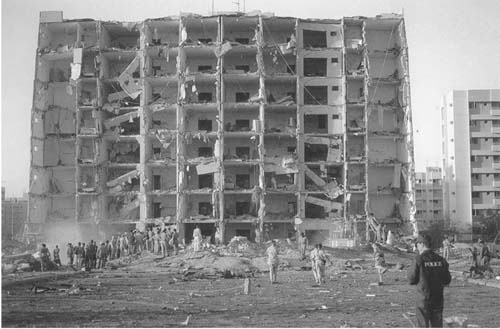
Khobar Towers after the June 25, 1996, bombing of the U.S. high-rise barracks that killed 19 soldiers. Abdelkarim al-Nasser was indicted in June 2001 for his role in coordinating the bombing.
The indictment asserts that al-Nasser, who was born in Al Ihsa, Saudi Arabia, was the head of Saudi Hezbollah in the 1990s. That group is largely made up of young Shiite Muslim men who are loyal to Iran, not the Saudi government. Saudi Hezbollah, also called Hezbollah al-Hijaz, is outlawed in Saudi Arabia, thus Al-Nasser often met other organization leaders in Lebanon, Syria, or Iran.
Saudi Hezbollah operatives frequently gathered at the Sayyeda Zeinab shrine in Damascus, Syria, an important religious site for Shiite Muslims. The site was also a prime recruiting place for Saudi Hezbollah; its operatives often approached men on religious pilgrimages.
According to the indictment, al-Nasser's military operations chief, Ahmad Ibrahim al-Mughassil, planned and carried out much of the attack on the Khobar Towers in an attempt to force the U.S. military from Saudi Arabia. Weeks before the attack, al-Nasser led a meeting at the Sayyeda Zeinab shrine to discuss the final plans for the truck bomb assault. On the evening of June 25, 1996, al-Mughassil and fellow Saudi Hezbollah member Ali Saed bin Ali el-Hoorie drove a truck carrying more than 5,000 pounds of explosives to the Khobar Towers; they parked the truck and quickly drove off in a waiting getaway car. Minutes later, the truck exploded, killing 19 U.S. service members and wounding another 500 people.
Eleven of the 14 men charged with the bombing are in Saudi custody. Saudi Arabia has challenged U.S. jurisdiction because the attack was on Saudi soil and was committed largely by Saudi citizens. The Saudi government has declared that it will not extradite these men.
Three other men indicted in the Khobar case, Ahmad al-Mughassil, Ali el-Hoorie, and Ibrahim Salih Mohammed al-Yacoub are also on the FBI's “most wanted” list. The U.S. State Department is offering an award of up to $25 million for information leading directly to the arrest or indictment of al-Nasser.
Further Reading
- Abu Nidal Organization
- Agricultural Terrorist Activities
- Al Fatah
- Al Qaeda
- United States v. Usama Bin Laden et al. Indictment
- United States v. Zacarias Moussaoui Indictment
- Abullah, Abdullah Ahmed
- Aden-Abyan Islamic Army
- Al Qaeda
- Al-'Owhali, Mohamed Rashed
- Al-Adel, Saif
- Al-Liby, Anas
- Al-Mughassil, Ahmad Ibrahim
- Al-Nasser, Abdelkarim Hussein Mohamed
- Al-Yacoub, Ibrahim Salih Mohammed
- Al-Zawahiri, Ayman
- Ali, Ahmed Mohamed Hamed
- Atef, Muhammad
- Atta, Mohamed
- Atwah, Muhsin Musa Matwalli
- Bin Laden, Osama
- East African Embassy Bombings
- El-Hage, Wadih
- Fadhil, Mustafa Mohamed
- Fatwa
- Financing Terrorism
- Ghailani, Ahmed Khalfan
- Jihad
- Militant Islam
- Mohamed, Khalfan Khamis
- Mohammed, Fazul Abdullah
- Mohammed, Khalid Shaikh
- Moussaoui, Zacarias
- Msalam, Fahid Mohammed Ally
- Odeh, Mohamed Sadeek
- Reid, Richard
- September 11 Attacks
- Swedan, Sheikah Ahmed Salim
- Taliban
- Transnational Terrorism
- U.S.S. Cole Bombing
- War on Terrorism
- Yousef, Ramzi Ahmed
- Zubaydah, Abu
- Animal Rights Terrorist Activities
- Antiabortion Terrorist Activities
- Biological Terrorist Activities
- Bombings
- 15 May Organization
- Air India Flight 182 Bombing
- Birmingham Pub Bombings
- Bombings and Bomb Scares
- Canary Wharf Bombing
- Centennial Park Bombing
- Copeland, David
- East African Embassy Bombings
- FALN
- Fraunces Tavern Bombing
- Grand Central Station Bombing
- Khobar Towers Bombing
- King David Hotel Bombing
- La Belle Discotheque Bombing
- La Guardia Airport Bombing
- Metesky, George
- Oklahoma City Bombing
- Omagh Bombing
- Pan Am Flight 103 Bombing
- Puerto Rican Nationalist Terrorism
- Revolutionary People's Struggle
- Riyadh Saudi Arabia Bombing
- Sixteenth Street Baptist Church Bombing
- Statue of Liberty Bombing
- Subway Suicide Bombing Plot
- Tripoli and Benghazi Bombing
- U.S. Embassy Bombing, Beirut
- U.S. Marine Barracks Bombing, Beirut
- U.S.O. Club Bombing
- U.S.S. Cole Bombing
- Unabomber
- Wall Street Bombing
- World Trade Center Bombing (1993)
- Chemical Terrorist Activities
- Embassy Bombing in Beirut, Lebanon, April 1983
- Embassy Bombings in Dar Es Salaam, Tanzania, and Nairobi, Kenya, August 1998
- Environmental Terrorist Activities
- Government Responses to Terrorism
- United States v. Usama bin Laden et al. Indictment (United States)
- United States v. Zacarias Moussaoui Indictment (United States)
- Bureau of Alcohol, Tobacco and Firearms (United States)
- Central Intelligence Agency (United States)
- Counterterrorism
- Delta Force (United States)
- Department of Justice, U.S. (United States)
- Federal Bureau of Investigation (United States)
- Federal Emergency Management Agency (United States)
- FPCON Levels (United States)
- Grenzschutzgruppe 9 (Germany)
- Homeland Security, Office of (United States)
- Mossad (Israel)
- National Security Agency (United States)
- National Security Council (United States)
- Operation Eagle Claw (United States)
- Patriot Act (United States)
- Rewards for Justice (United States)
- Sayeret Matkal (Israel)
- SEAL Team Six (United States)
- Special Air Service Regiment (Great Britain and Australia)
- Special Operations Wing (United States)
- United Nations
- War on Terrorism (United States)
- Wrath of God (Israel)
- Hamas
- Hezbollah
- Hijackings
- Achille Lauro Hijacking
- Abu Nidal Organization
- Hezbollah
- Hijacking
- Palestine Liberation Front–Abu Abbas Faction
- Palestine Liberation Organization
- Pan Am Flight 73 Hijacking
- Popular Front for the Liberation of Palestine
- Stockholm Syndrome
- TWA Flight 355 Hijacking
- TWA Flight 840 Hijacking
- TWA Flight 847 Hijacking
- Hostage Taking/Kidnappings
- Jihad: Concept of Jihad
- Groups
- Khobar Towers Bombing in Dhahran, Saudi Arabia, June 1996
- Lebanon Hostage Crisis
- Marine Barracks Bombing in Beirut, Lebanon, October 1983
- Members of Terrorist Groups, Freelance Terrorists, and Terrorist Supporters
- Abbas, Muhammed “Abu”
- Al-'Owhali, Mohamed Rashed
- Al-Adel, Saif
- Al-Banna, Sabri
- Al-Liby, Anas
- Al-Mughassil, Ahmad Ibrahim
- Al-Nasser, Abdelkarim Hussein Mohamed
- Al-Yacoub, Ibrahim Salih Mohammed
- Al-Zawahiri, Ayman
- Ali, Ahmed Mohamed Hamed
- Arafat, Yasir
- Arocena, Eduardo
- Asahara, Shoko
- Atef, Muhammad
- Atta, Mohamed
- Atwa, Ali
- Atwah Muhsin Musa Matwalli
- Ayyash, Yahya
- Baader, Andreas
- Berenson, Lori
- Bin Laden, Osama
- Boudin, Katherine
- Chesimard, Joanne
- Copeland, David
- Coronado, Rodney
- Dohrn, Bernardine
- El-Hage, Wadih
- El-Hoorie, Ali Saed bin Ali
- Ellerman, Josh
- Ellison, James
- Fadhil, Mustafa Mohamed
- Fadlallah, Sheikh Muhammad Hussein
- Ghailani, Ahmed Khalfan
- Goldstein, Baruch
- Griffin, Michael
- Guevara, Ernesto (Che)
- Guzmán, Abimael
- Habash, George
- Hawetmeh, Najib
- Hearst, Patty
- Hill, Paul
- Hussein, Saddam
- Izz-al-Din, Hasan
- Jibril, Ahmed
- Kahane, Meir
- Kasi, Mir Aimal
- Khaled, Leila
- Kikumura, Yu
- Marighella, Carlos
- Marzook, Musa (Mousa) Mohammed Abu
- Mathews, Robert Jay
- McVeigh, Timothy
- Meinhof, Ulrike
- Metesky, George
- Miller, Frazier Glenn
- Mohamed, Khalfan Khamis
- Mohammed, Fazul Abdullah
- Mohammed, Khalid Shaikh
- Moussaoui, Zacarias
- Msalam, Fahid Mohammed Ally
- Mughniyah, Imad Fayez
- Nasrallah, Sheik Hassan
- Nichols, Terry Lynn
- Nosair, El Sayyid
- Ocalan, Abdullah
- Odeh, Mohamed Sadeek
- Qaddafi, Muammar el-
- Rahman, Omar Abdel
- Rajneesh, Bhagwan Shree
- Reid, Richard
- Ressam, Ahmed
- Rudolph, Eric
- Sánchez, Ilich Ramírez (Carlos the Jackal)
- Scutari, Richard
- Shallah, Ramadan Abdullah
- Shigenobu, Fusako
- Snell, Richard Wayne
- Swedan, Sheikah Ahmed Salim
- Unabomber
- Yasin, Abdul Rahman
- Younis, Fawaz
- Yousef, Ramzi Ahmed
- Zubaydah, Abu
- Methods Used by Terrorists
- Nationalistic and Religious Terrorist Groups
- Central America
- East Asia and Southeast Asia
- Europe
- Baader-Meinhof Gang (West Germany)
- Basque Fatherland and Liberty (Basque region of Spain)
- Basque Separatists (Basque region of Spain)
- First of October Antifascist Resistance Group (Spain)
- German Red Army Faction (Germany)
- Islamic Army for the Liberation of Holy Places
- Kosovo Liberation Army (Kosovo)
- National Liberation Front of Corsica (Corsica)
- Ordine Nuovo (Italy)
- Red Brigades (Brigades Rosse) (Italy)
- Revolutionary Organization 17 November (Greece)
- Revolutionary People's Struggle (Greece)
- Middle East, Central Asia, and South Asia
- 15 May Organization (Palestine, Iraq)
- Abu Nidal Organization (Iraq, Syria, Libya)
- Aden Abyan Islamic Army (Yemen)
- Al 'Asifa (Palestine)
- Al Aqsa Martyrs Brigades (Palestine)
- Al Fatah (Palestine)
- Al Qaeda (Afghanistan, Saudi Arabia, other Middle Eastern countries; North and South America; Europe; Philippines)
- Armenian Secret Army for the Liberation of Armenia (Turkey)
- Democratic Front for the Liberation of Palestine (Palestine)
- Force 17 (Palestine)
- Great Eastern Islamic Raiders' Front (Turkey)
- Grey Wolves (Turkey)
- Hamas (Palestine)
- Harakat ul-Mujahidin (India-Pakistan)
- Hezbollah (Lebanon)
- Hizb-ul-Mujahideen (India-Pakistan)
- Irgun Zvai Leumi (Israel)
- Islamic Movement of Uzbekistan (Uzbekistan)
- Jaish-e-Mohammed (Pakistan)
- Kahane Chai (Israel)
- Kurdistan Workers Party (Turkey)
- Lashkar-e-Tayyiba (India-Pakistan)
- Liberation Tigers of Tamil Eelam (Sri Lanka)
- Mujahedin-e-Khalq Organization (Iran)
- Mujahideen (Afghanistan)
- Palestine Liberation Front–Abu Abbas Faction (Lebanon, Tunisia, Iraq)
- Palestine Liberation Organization (Palestine)
- Palestinian Islamic Jihad (Palestine, Syria)
- Popular Front for the Liberation of Palestine (Palestine)
- Popular Front for the Liberation of Palestine–General Command (Palestine)
- Revolutionary People's Liberation Front (Turkey)
- Sikh Terrorism (India)
- Stern Gang (Israel)
- Taliban (Afghanistan)
- Turkish Hezbollah (Turkey)
- Wrath of God (Israel)
- North America and West Indies
- Black Panther Party (United States)
- El Rukns (United States)
- FALN (Puerto Rico, United States)
- Hanafi Muslim Movement (United States)
- Jamaat ul-Fuqra (United States, Kashmir, Pakistan)
- Jewish Terrorist Groups in the United States (United States)
- Macheteros (Puerto Rico)
- May 19 Communist Organization (United States)
- Omega 7 (Cuba)
- Puerto Rican Nationalist Terrorism (Puerto Rico)
- Symbionese Liberation Army (United States)
- United Freedom Front (United States)
- Weatherman (United States)
- South America
- Lautaro Youth Movement (Chile)
- Manuel Rodriquez Patriotic Front (Chile)
- Movement of the Revolutionary Left (Chile)
- National Liberation Army (Bolivia)
- National Liberation Army (Colombia)
- People's Liberation Army (Colombia)
- Revolutionary Armed Forces of Colombia (Colombia)
- Shining Path (Peru)
- Tupac Amaru Revolutionary Movement (Peru)
- Tupac Katari Guerrilla Army (Bolivia)
- United Self-Defense Forces of Colombia (Colombia)
- United Kingdom
- Al Muhajiroun (United Kingdom)
- Continuity Irish Republican Army (Northern Ireland)
- Irish National Liberation Army (Northern Ireland)
- Irish Republican Army (Northern Ireland)
- Loyalist Volunteer Force (Northern Ireland)
- Orange Volunteers (Northern Ireland)
- Real Irish Republican Army (Northern Ireland)
- Red Hand Defenders (Northern Ireland)
- Ulster Defense Association (Northern Ireland)
- Ulster Freedom Fighters (Northern Ireland)
- Ulster Volunteer Force (Northern Ireland)
- Oklahoma City Federal Building Bombing, April 1995
- Palestine Liberation Front–Abu Abbas Faction
- Right-Wing Militia Movements
- September 11, 2001, Attacks
- Terrorism and the Media
- Theoretical Perspectives on Terrorism
- Anarchism
- April 19
- Asymmetrical Warfare
- Bakunin, Michael
- Fatwa
- Financing Terrorism
- Freedom Fighters
- Freelance Terrorism
- Jihad
- Kropotkin, Peter
- Leaderless Resistance
- Militant Islam
- Persian Gulf War
- State Terrorism
- State-Sponsored Terrorism
- Stockholm Syndrome
- Suicide Bombers
- Terrorism, Definition and History of
- Transnational Terrorism
- United Nations
- War on Terrorism
- White Supremacist Terrorist Activities in the United States
- The Turner Diaries
- Aryan Nations
- Aryan Republican Army
- Covenant, the Sword, and the Arm of the Lord
- Ellison, James
- Fort Smith, Arkansas, Trial
- Ku Klux Klan
- Mathews, Robert Jay
- Miller, Frazier Glenn
- Scutari, Richard
- Sixteenth Street Baptist Church Bombing
- Skinheads
- Snell, Richard Wayne
- The Order
- White Patriot Party
- White Supremacy
- World Trade Center Bombing, February 1993
- Loading...
Get a 30 day FREE TRIAL
-
 Watch videos from a variety of sources bringing classroom topics to life
 -
Read modern, diverse business cases
-
Explore hundreds of books and reference titles

Read next

More like this
Sage Recommends
We found other relevant content for you on other Sage platforms.
Have you created a personal profile? Login or create a profile so that you can save clips, playlists and searches