
Entry
Reader's guide
Entries A-Z
Subject index
Main Effect
A main effect is a statistical term associated with experimental designs and their analysis. In the analysis of variance statistical test, which often is used to analyze data gathered via an experimental design, a main effect is the statistically significant difference between levels of an independent variable (e.g. mode of data collection) on a dependent variable (e.g. respondents' mean amount of missing data), ignoring the influence of other factors. To better understand the statistical concept of a main effect, it is helpful to understand a few key terms and experimental conditions under which a main effect may be found.
When conducting research, it is not uncommon to use a factorial analysis of variance to determine how two or more categorical independent variables (called factors in analysis of variance) affect a continuous dependent variable. Each factor in a factorial analysis of variance contains two or more categories or levels of that factor that are manipulated to determine how the factor influences the dependent variable.
For example, a survey researcher investigating item nonresponse may want to know how the two factors survey type (containing the levels “paper-and-pencil survey” vs. “computer-assisted survey”) and mode of administration (containing the levels “interviewer-administered” vs. “self-administered”) separately and together influence the dependent variable percentage of item nonresponse. A sample of respondents is randomly assigned to one of the four conditions in the experiment: (1) paper-and-pencil interviewer-administered, (2) paper-and-pencil self-administered, (3) computer-assisted interviewer-administered, and (4) computer-assisted self-administered. A factorial analysis of variance can be used to investigate the main effects of the two factors (survey type and mode of administration) on the amount of item nonresponse.
In such a factorial analysis of variance, a main effect is a statistically significant difference between the levels of one factor on the dependent variable regardless of the influence of any other factor. In this survey research example, a main effect for the factor “mode of administration” would occur if self-administration resulted in a statistically significant difference in the average amount of item nonresponse when compared to interviewer administration, regardless of any influence that the factor “survey type” (paper-and-pencil vs. computer-assisted) might have on item nonresponse. Ignoring the influence of all other factors on the dependent variable when determining a main effect is referred to as collapsing across levels of the other factor. The illustrations in Figures 1 and 2 help visualize this process.
Figure 1 illustrates a main effect for mode of administration. The two parallel lines on the graph show a difference in the amount of item nonresponse between self-administered surveys and interviewer-administered surveys. Mentally collapsing across the factor survey type, one can see that self-administration resulted in more item nonresponse ( s) than interviewer administration (i). There is no main effect for survey type because each level of that factor contains identical amounts of item nonresponse (p and c).
Figure 1 A main effect for mode of administration
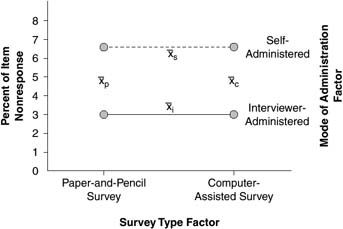
Figure 2 Main effects for survey type and mode of administration
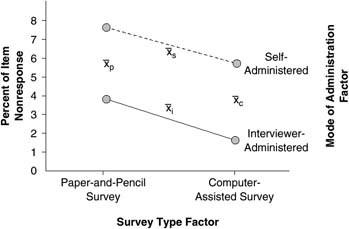
Figure 2 shows a slightly more complex relationship, with main effects for both survey type and mode of administration. The main effect for the factor survey type shows that paper-and-pencil surveys have a greater amount of item nonresponse (p) when collapsed across mode of administration than the amount of item nonresponse in computer-assisted surveys (c). The main effect for the factor mode of administration shows that self-administration results in more item nonresponse (s) than interviewer administration (i) when collapsed across levels of survey type.
...
- Ethical Issues in Survey Research
- Anonymity
- Beneficence
- Cell Suppression
- Certificate of Confidentiality
- Common Rule
- Confidentiality
- Consent Form
- Debriefing
- Deception
- Disclosure
- Disclosure Limitation
- Ethical Principles
- Falsification
- Informed Consent
- Institutional Review Board (IRB)
- Minimal Risk
- Perturbation Methods
- Privacy
- Protection of Human Subjects
- Respondent Debriefing
- Survey Ethics
- Voluntary Participation
- Measurement - Interviewer
- Measurement - Mode
- Measurement - Questionnaire
- Aided Recall
- Aided Recognition
- Attitude Measurement
- Attitude Strength
- Attitudes
- Aural Communication
- Balanced Question
- Behavioral Question
- Bipolar Scale
- Bogus Question
- Bounding
- Branching
- Check All that Apply
- Closed-Ended Question
- Codebook
- Cognitive Interviewing
- Construct
- Construct Validity
- Context Effect
- Contingency Question
- Demographic Measure
- Dependent Variable
- Diary
- Don't Knows (DKs)
- Double Negative
- Double-Barreled Question
- Drop-down Menus
- Event History Calendar
- Exhaustive
- Factorial Survey Method (Rossi's Method)
- Feeling Thermometer
- Forced Choice
- Gestalt Psychology
- Graphical Language
- Guttman Scale
- HTML Boxes
- Item Order Randomization
- Item Response Theory
- Knowledge Question
- Language Translations
- Likert Scale
- List-Experiment Technique
- Mail Questionnaire
- Mutually Exclusive
- Open-Ended Question
- Paired Comparison Technique
- Precoded Question
- Priming
- Psychographic Measure
- Question Order Effects
- Question Stem
- Questionnaire
- Questionnaire Design
- Questionnaire Length
- Questionnaire-Related Error
- Radio Buttons
- Random Order
- Random Start
- Randomized Response
- Ranking
- Rating
- Reference Period
- Response Alternatives
- Response Order Effects
- Self-Administered Questionnaire
- Self-Reported Measure
- Semantic Differential Technique
- Sensitive Topics
- Show Card
- Step-Ladder Question
- True Value
- Unaided Recall
- Unbalanced Question
- Unfolding Question
- Vignette Question
- Visual Communication
- Measurement - Respondent
- Acquiescence Response Bias
- Behavior Coding
- Cognitive Aspects of Survey Methodology (CASM)
- Comprehension
- Encoding
- Extreme Response Style
- Key Informant
- Misreporting
- Nonattitude
- Nondifferentiation
- Overreporting
- Panel Conditioning
- Panel Fatigue
- Positivity Bias
- Primacy Effect
- Reactivity
- Recency Effect
- Record Check
- Respondent
- Respondent Burden
- Respondent Fatigue
- Respondent-Related Error
- Response
- Response Bias
- Response Latency
- Retrieval
- Reverse Record Check
- Satisficing
- Social Desirability
- Telescoping
- Underreporting
- Measurement - Miscellaneous
- Nonresponse - Item-Level
- Nonresponse - Outcome Codes and Rates
- Busies
- Completed Interview
- Completion Rate
- Contact Rate
- Contactability
- Contacts
- Cooperation Rate
- e
- Fast Busy
- Final Dispositions
- Hang-up during Introduction (HUDI)
- Household Refusal
- Ineligible
- Language Barrier
- Noncontact Rate
- Noncontacts
- Noncooperation Rate
- Nonresidential
- Nonresponse Rates
- Number Changed
- Out of Order
- Out of Sample
- Partial Completion
- Refusal
- Refusal Rate
- Respondent Refusal
- Response Rates
- Standard Definitions
- Temporary Dispositions
- Unable to Participate
- Unavailable Respondent
- Unknown Eligibility
- Unlisted Household
- Nonresponse - Unit-Level
- Advance Contact
- Attrition
- Contingent Incentives
- Controlled Access
- Cooperation
- Differential Attrition
- Differential Nonresponse
- Economic Exchange Theory
- Fallback Statements
- Gatekeeper
- Ignorable Nonresponse
- Incentives
- Introduction
- Leverage-Saliency Theory
- Noncontingent Incentives
- Nonignorable Nonresponse
- Nonresponse
- Nonresponse Bias
- Nonresponse Error
- Refusal Avoidance
- Refusal Avoidance Training (RAT)
- Refusal Conversion
- Refusal Report Form (RRF)
- Response Propensity
- Saliency
- Social Exchange Theory
- Social Isolation
- Tailoring
- Total Design Method (TDM)
- Unit Nonresponse
- Operations - General
- Advance Letter
- Bilingual Interviewing
- Case
- Data Management
- Dispositions
- Field Director
- Field Period
- Mode of Data Collection
- Multi-Level Integrated Database Approach (MIDA)
- Paper-and-Pencil Interviewing (PAPI)
- Paradata
- Quality Control
- Recontact
- Reinterview
- Research Management
- Sample Management
- Sample Replicates
- Supervisor
- Survey Costs
- Technology-Based Training
- Validation
- Verification
- Video Computer-Assisted Self-Interviewing (VCASI)
- Operations - In-Person Surveys
- Operations - Interviewer-Administered Surveys
- Operations - Mall Surveys
- Operations - Telephone Surveys
- Access Lines
- Answering Machine Messages
- Call Forwarding
- Call Screening
- Call Sheet
- Callbacks
- Caller ID
- Calling Rules
- Cold Call
- Computer-Assisted Telephone Interviewing (CATI)
- Do-Not-Call (DNC) Registries
- Federal Communications Commission (FCC) Regulations
- Federal Trade Commission (FTC) Regulations
- Hit Rate
- Inbound Calling
- Interactive Voice Response (IVR)
- Listed Number
- Matched Number
- Nontelephone Household
- Number Portability
- Number Verification
- Outbound Calling
- Predictive Dialing
- Prefix
- Privacy Manager
- Research Call Center
- Reverse Directory
- Suffix Banks
- Supervisor-to-interviewer Ratio
- Telephone Consumer Protection Act 1991
- Telephone Penetration
- Telephone Surveys
- Touchtone Data Entry
- Unmatched Number
- Unpublished Number
- Videophone Interviewing
- Voice over Internet Protocol (VoIP) and the Virtual Computer-Assisted Telephone Interview (CATI) Facility
- Political and Election Polling
- 800 Poll
- 900 Poll
- ABC News/Washington Post Poll
- Approval Ratings
- Bandwagon and Underdog Effects
- Call-in Polls
- Computerized-Response Audience Polling (CRAP)
- Convention Bounce
- Deliberative Poll
- Election Night Projections
- Election Polls
- Exit Polls
- Favorability Ratings
- FRUGing
- Horse Race Journalism
- Leaning Voters
- Likely Voter
- Media Polls
- Methods Box
- National Council on Public Polls (NCPP)
- National Election Pool (NEP)
- National Election Studies (NES)
- New York Times/CBS News Poll
- Poll
- Polling Review Board (PRB)
- Pollster
- Pre-Election Polls
- Pre-Primary Polls
- Precision Journalism
- Prior Restraint
- Probable Electorate
- Pseudo-Polls
- Push Polls
- Rolling Averages
- Sample Precinct
- Self-Selected Listener Opinion Poll (SLOP)
- Straw Polls
- Subgroup Analysis
- SUGing
- Tracking Polls
- Trend Analysis
- Trial Heat Question
- Undecided Voters
- Public Opinion
- Agenda Setting
- Consumer Sentiment Index
- Issue Definition (Framing)
- Knowledge Gap
- Mass Beliefs
- Opinion Norms
- Opinion Question
- Opinions
- Perception Question
- Political Knowledge
- Public Opinion
- Public Opinion Research
- Quality of Life Indicators
- Question Wording as Discourse Indicators
- Social Capital
- Spiral of Silence
- Third-Person Effect
- Topic Saliency
- Trust in Government
- Sampling, Coverage, and Weighting
- Adaptive Sampling
- Add-a-Digit Sampling
- Address-Based Sampling
- Area Frame
- Area Probability Sample
- Capture-Recapture Sampling
- Cell Phone Only Household
- Cell Phone Sampling
- Census
- Cluster Sample
- Clustering
- Complex Sample Surveys
- Convenience Sampling
- Coverage
- Coverage Error
- Cross-Sectional Survey Design
- Cutoff Sampling
- Designated Respondent
- Directory Sampling
- Disproportionate Allocation to Strata
- Dual-Frame Sampling
- Duplication
- Elements
- Eligibility
- Email Survey
- EPSEM Sample
- Equal Probability of Selection
- Error of Nonobservation
- Errors of Commission
- Errors of Omission
- Establishment Survey
- External Validity
- Field Survey
- Finite Population
- Frame
- Geographic Screening
- Hagan and Collier Selection Method
- Half-Open Interval
- Informant
- Internet Pop-up Polls
- Internet Surveys
- Interpenetrated Design
- Inverse Sampling
- Kish Selection Method
- Last-Birthday Selection
- List Sampling
- List-Assisted Sampling
- Log-in Polls
- Longitudinal Studies
- Mail Survey
- Mall Intercept Survey
- Mitofsky-Waksberg Sampling
- Mixed-Mode
- Multi-Mode Surveys
- Multi-Stage Sample
- Multiple-Frame Sampling
- Multiplicity Sampling
- n
- N
- Network Sampling
- Neyman Allocation
- Noncoverage
- Nonprobability Sampling
- Nonsampling Error
- Optimal Allocation
- Overcoverage
- Panel
- Panel Survey
- Population
- Population of Inference
- Population of Interest
- Post-Stratification
- Primary Sampling Unit (PSU)
- Probability of Selection
- Probability Proportional to Size (PPS) Sampling
- Probability Sample
- Propensity Scores
- Propensity-Weighted Web Survey
- Proportional Allocation to Strata
- Proxy Respondent
- Purposive Sample
- Quota Sampling
- Random
- Random Sampling
- Random-Digit Dialing (RDD)
- Ranked-Set Sampling (RSS)
- Rare Populations
- Registration-Based Sampling (RBS)
- Repeated Cross-Sectional Design
- Replacement
- Representative Sample
- Research Design
- Respondent-Driven Sampling (RDS)
- Reverse Directory Sampling
- Rotating Panel Design
- Sample
- Sample Design
- Sample Size
- Sampling
- Sampling Fraction
- Sampling Frame
- Sampling Interval
- Sampling Pool
- Sampling without Replacement
- Screening
- Segments
- Self-Selected Sample
- Self-Selection Bias
- Sequential Sampling
- Simple Random Sample
- Small Area Estimation
- Snowball Sampling
- Strata
- Stratified Sampling
- Superpopulation
- Survey
- Systematic Sampling
- Target Population
- Telephone Households
- Telephone Surveys
- Troldahl-Carter-Bryant Respondent Selection Method
- Undercoverage
- Unit
- Unit Coverage
- Unit of Observation
- Universe
- Wave
- Web Survey
- Weighting
- Within-Unit Coverage
- Within-Unit Coverage Error
- Within-Unit Selection
- Zero-Number Banks
- Survey Industry
- American Association for Public Opinion Research (AAPOR)
- American Community Survey (ACS)
- American Statistical Association Section on Survey Research Methods (ASA-SRMS)
- Behavioral Risk Factor Surveillance System (BRFSS)
- Bureau of Labor Statistics (BLS)
- Cochran, W. G.
- Council for Marketing and Opinion Research (CMOR)
- Council of American Survey Research Organizations (CASRO)
- Crossley, Archibald
- Current Population Survey (CPS)
- Gallup Poll
- Gallup, George
- General Social Survey (GSS)
- Hansen, Morris
- Institute for Social Research (ISR)
- International Field Directors and Technologies Conference (IFD&TC)
- International Journal of Public Opinion Research (IJPOR)
- International Social Survey Programme (ISSP)
- Joint Program in Survey Methodology (JPSM)
- Journal of Official Statistics (JOS)
- Kish, Leslie
- National Health and Nutrition Examination Survey (NHANES)
- National Health Interview Survey (NHIS)
- National Household Education Surveys (NHES) Program
- National Opinion Research Center (NORC)
- Pew Research Center
- Public Opinion Quarterly (POQ)
- Roper Center for Public Opinion Research
- Roper, Elmo
- Sheatsley, Paul
- Statistics Canada
- Survey Methodology
- Survey Sponsor
- Telemarketing
- U.S. Bureau of the Census
- World Association for Public Opinion Research (WAPOR)
- Survey Statistics
- Algorithm
- Alpha, Significance Level of Test
- Alternative Hypothesis
- Analysis of Variance (ANOVA)
- Attenuation
- Auxiliary Variable
- Balanced Repeated Replication (BRR)
- Bias
- Bootstrapping
- Chi-Square
- Composite Estimation
- Confidence Interval
- Confidence Level
- Constant
- Contingency Table
- Control Group
- Correlation
- Covariance
- Cronbach's Alpha
- Cross-Sectional Data
- Data Swapping
- Design Effects (deff)
- Design-Based Estimation
- Ecological Fallacy
- Effective Sample Size
- Experimental Design
- F-Test
- Factorial Design
- Finite Population Correction (fpc) Factor
- Frequency Distribution
- Hot-Deck Imputation
- Imputation
- Independent Variable
- Inference
- Interaction Effect
- Internal Validity
- Interval Estimate
- Intracluster Homogeneity
- Jackknife Variance Estimation
- Level of Analysis
- Main Effect
- Margin of Error (MOE)
- Marginals
- Mean
- Mean Square Error
- Median
- Metadata
- Mode
- Model-Based Estimation
- Multiple Imputation
- Noncausal Covariation
- Null Hypothesis
- Outliers
- p-Value
- Panel Data Analysis
- Parameter
- Percentage Frequency Distribution
- Percentile
- Point Estimate
- Population Parameter
- Post-Survey Adjustments
- Precision
- Probability
- Raking
- Random Assignment
- Random Error
- Raw Data
- Recoded Variable
- Regression Analysis
- Relative Frequency
- Replicate Methods for Variance Estimation
- Research Hypothesis
- Research Question
- Rho
- Sampling Bias
- Sampling Error
- Sampling Variance
- SAS
- Seam Effect
- Significance Level
- Solomon Four-Group Design
- Standard Error
- Standard Error of the Mean
- STATA
- Statistic
- Statistical Package for the Social Sciences (SPSS)
- Statistical Power
- SUDAAN
- Systematic Error
- t-Test
- Taylor Series Linearization
- Test-Retest Reliability
- Total Survey Error (TSE)
- Type I Error
- Type II Error
- Unbiased Statistic
- Validity
- Variable
- Variance
- Variance Estimation
- WesVar
- z-Score
- Loading...
Get a 30 day FREE TRIAL
-
 Watch videos from a variety of sources bringing classroom topics to life
 -
Read modern, diverse business cases
-
Explore hundreds of books and reference titles

Read next

More like this
Sage Recommends
We found other relevant content for you on other Sage platforms.
Have you created a personal profile? Login or create a profile so that you can save clips, playlists and searches