
Entry
Entries A-Z
Subject index
Affirmative Action
Measures taken by the federal government since the 1960s to benefit African Americans and other minorities in order to achieve greater equality. The phrase “affirmative action” originated in 1961 with an executive order issued by President John F. Kennedy (1961–1963). Setting the goal of achieving “equal opportunity” in federally funded projects, Kennedy said contractors should “take affirmative action” to make sure the hiring of workers was free of racial bias.
Most scholars, however, credited the concept of affirmative action to Kennedy's successor, President Lyndon B. Johnson (1963–1969). The year after winning passage of the Civil Rights Act of 1964, Johnson told the graduating class at Howard University that ending discrimination was not enough. Advocates for minority rights took up Johnson's call for “equality as a fact and as a result.” They insisted on “goals and timetables” that would measure racial progress in numbers. This triggered a backlash, particularly among white conservatives, who argued that the law demanded equal treatment for individuals, not equal results for groups.
In a series of lawsuits that reached the Supreme Court, the justices grappled with the practical meaning of equality in the law and in society. In a nation whose history includes black slavery and blatant racial bias, is it acceptable for employers and colleges to give qualified black applicants an edge in order to achieve overall equality, or does that system of advantages for some violate the rights of whites who lose out?
The Court found itself as divided and uncertain as the nation. The justices were unable to agree on clear, decisive rulings that either allowed the “affirmative” use of race, or rejected it entirely. In the most significant opinions, however, the Court left the door open for employers and colleges to make a limited use of affirmative action.
Viewpoints
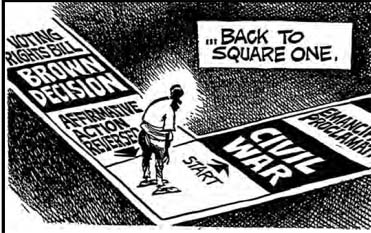
A political cartoonist expresses the view that, because the Supreme Court ruled that affirmative action policies are subject to strict examination, African Americans and other minorities still face discrimination, much as they did before the Civil War (1861–1865). (Mike Peters. Reprinted by permission: Tribune Media Services)
Regents of the University of California v. Bakke
One of the earliest cases to test the boundaries of affirmative action was the Court's 1978 ruling in Regents of the University of California v. Bakke. To ensure diversity as well as minority representation in the student body, the university had set aside sixteen seats for minority applicants in each medical school class of one hundred students. Allan Bakke, a thirty-eight-year-old white engineer, was twice denied admission to the medical school at the University of California at Davis. In each year his application was rejected, the school had accepted some minority applicants with qualifications inferior to his. Bakke argued that he would have been admitted had it not been for the university's rigid preference system.
On one point, the Court, in a 5-4 vote, told state universities that they may not set aside a fixed quota of seats in each class for minority group members, denying white applicants the opportunity to compete for those places. On a second point, a different five-justice majority held that admissions officers do not violate the equal protection guarantee when they consider race as one of many factors that determine which applicant is accepted and which is rejected. The Court ruled that colleges and universities may use a black applicant's race as a “plus factor” in admissions.
...
- Loading...
Get a 30 day FREE TRIAL
-
 Watch videos from a variety of sources bringing classroom topics to life
 -
Read modern, diverse business cases
-
Explore hundreds of books and reference titles

Read next

More like this
Sage Recommends
We found other relevant content for you on other Sage platforms.
Have you created a personal profile? Login or create a profile so that you can save clips, playlists and searches