
Entry
Entries A-Z
Subject index
Veto Power
The president's power to reject legislation passed by Congress. Any bill Congress passes must go to the president, who must either sign it or veto it—send it back to Congress with objections. Congress can, by voting to override a veto, pass the legislation anyway if enough members in each house vote to do so.
The president may exercise either a regular veto or a “pocket veto.” A pocket veto occurs when the president refuses to act on a bill until Congress adjourns, or temporarily suspends its activities. At that time, the bill is automatically killed. To override a veto requires the approval of two-thirds of members present and voting in each chamber.
Early History
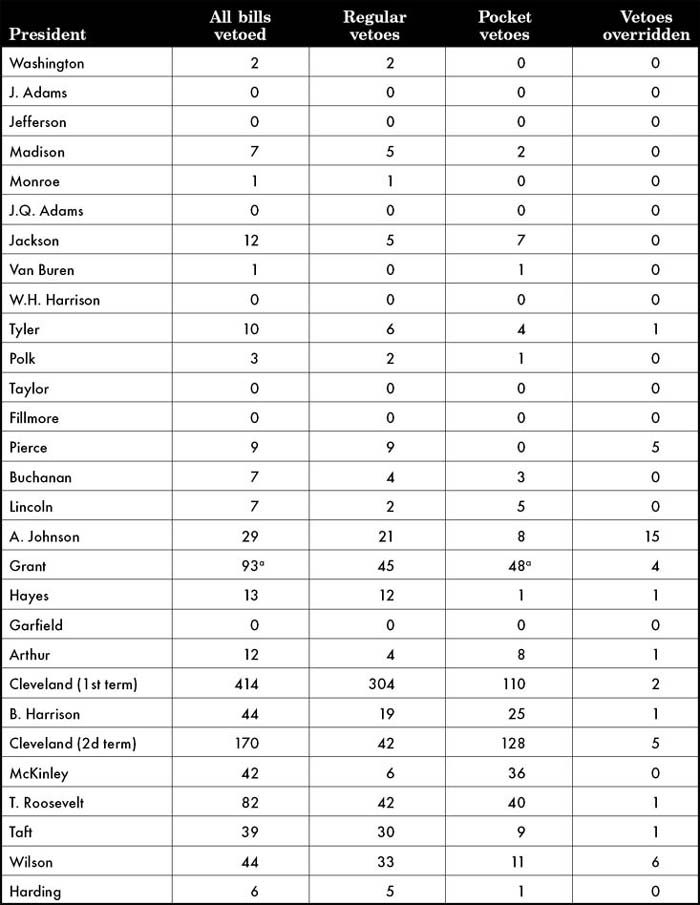
Early American presidents saw the veto as a tool to be used only to prevent Congress from assuming powers the Constitution grants to other branches of government. Of the first six presidents, George Washington (1789–1797) vetoed only two bills; John Adams (1797–1801) and Thomas Jefferson (1801–1809) vetoed none; James Madison (1809–1817) and James Monroe (1817–1825) vetoed eight bills between them; and John Quincy Adams (1825–1829) also did not veto a single bill. In all but one case, presidents vetoed only bills they felt were unconstitutional, not merely those they opposed politically.
The concept of the veto changed dramatically under Andrew Jackson (1829–1837), who vetoed twelve bills—more than all six of his predecessors put together—mostly because he opposed their purpose. Jackson, who used the pocket veto for the first time, believed the president could reject any bill that he felt was harmful to the nation. His most noteworthy veto was of a bill to create a new charter, or founding document, for the Bank of the United States. The Bank's first charter had expired several years earlier. Jackson felt that the Bank existed solely to serve the interests of large business, and not those of the general public. According to one historian, Jackson's veto was “a landmark in the evolution of the presidency. For the first time in American history, a veto message was used as an instrument of party warfare…. Though addressed to Congress, the veto message was an appeal to the nation.”
In 1867, Congress overrode President Andrew Johnson's (1865–1869) veto of a bill to protect the rights of freed slaves. This marked the first override of a presidential veto on a major issue. It was only the first of several bills passed over Johnson's veto. Others included the Tenure of Office Act, which prohibited the president from removing appointed officials from office until the Senate had confirmed their successors. When Johnson refused to abide by the provisions of the act, the House began impeachment proceedings against him.
Vetoes rose during the late nineteenth and early twentieth centuries. Grover Cleveland (1885–1889, 1893–1897), for example, vetoed 584 bills during his two terms of office. Franklin D. Roosevelt (1933–1945) broke Cleveland's record by
Vetoes and Vetoes Overridden, All Bills 1789–2008
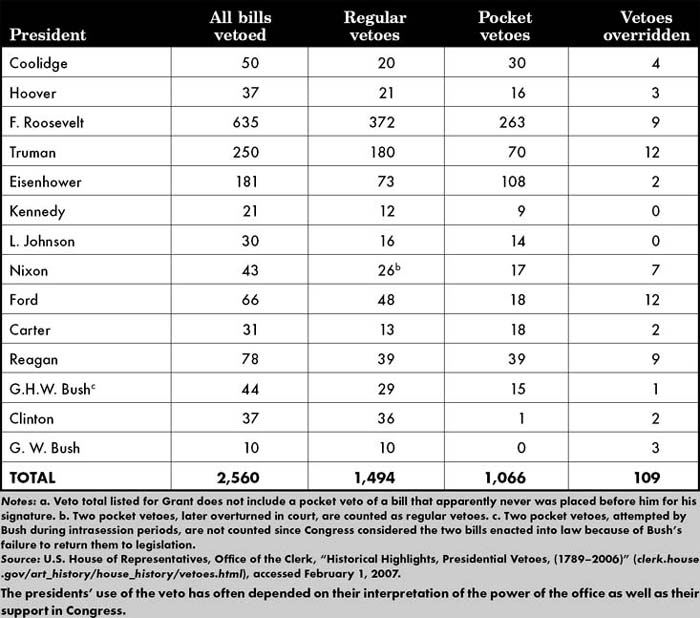
vetoing 635 bills between 1933 and 1944. Roosevelt's immediate successors Harry S. Truman (1945–1953) and Dwight D. Eisenhower (1953–1961) continued to make extensive use of the veto, but Presidents John F. Kennedy (1961–1963) and Lyndon B. Johnson (1963–1969) seldom had to use the veto or threaten it. They were activist presidents whose main interest lay in getting their programs through a Congress controlled by their own party. Like Eisenhower, Republican presidents Richard M. Nixon (1969–1974) and Gerald R. Ford (1974–1977) used the veto and its threat to prevent enactment of Democratic programs in the late 1960s and 1970s.
...
- Loading...
Get a 30 day FREE TRIAL
-
 Watch videos from a variety of sources bringing classroom topics to life
 -
Read modern, diverse business cases
-
Explore hundreds of books and reference titles

Read next

More like this
Sage Recommends
We found other relevant content for you on other Sage platforms.
Have you created a personal profile? Login or create a profile so that you can save clips, playlists and searches