
Entry
Entries A-Z
Subject index
The Transition Period
The time between the election and the inauguration of a president. Some of the president's most fateful decisions are made before the administration takes the reins of power. In filling appointments, developing budget priorities, and taking command of foreign policy, the president-elect goes a long way toward determining the possibilities and limits of the new administration.
To ensure a smooth transition, the incumbent president invites the president-elect to the White House, and the new chief executive and incoming staff receive a battery of briefings on matters ranging from budget deficits to U.S. military alliances. All the while, the new president's transition team pores over resumes and considers legislative strategy.
Growth of Transition Teams and Expenditures, 1952–2001
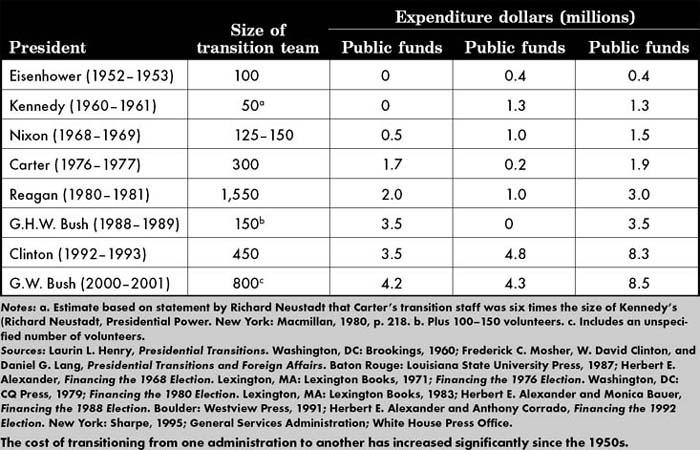
Media and academic accounts stress the cooperative nature of the transition period. Only in the United States, political analysts say, can the government be turned over to political opponents with such good cheer and cooperation. Transitions rarely involve active blame, and seldom is there a struggle over the legitimacy of the electoral outcome like the disputed contest between George W. Bush and Al Gore in 2000. The transition is a rare celebration of a stable democracy based on political parties that differ on specific policies but achieve consensus on the most important matters of state.
Until recently, presidents-elect financed their own transitions. Then in 1964 Congress passed the Presidential Transitions Act, which granted the newly elected president $450,000 and the outgoing president $450,000 to help cover their transition expenses. In 1988, Congress revised the act to grant $3.5 million to each incoming administration and $1.5 million to each outgoing administration, with these amounts to be adjusted for inflation. The revised act also authorized the president-elect to raise money from private donors to cover any additional costs of the transition, provided that donations did not exceed $5,000 per donor and the names of the donors were disclosed publicly. Bill Clinton spent a total of $8.3 million during his transition period in 1992–1993, $4.8 million from private sources. In 2000–2001 George W. Bush spent slightly more, $8.5 million, $4.3 million from private sources. The money is used for staff salaries, travel expenses, talent searches, policy deliberations, and public relations activities. Separate federal funds are used for the inaugural ceremonies.
In many ways, the transition period is the most important phase of the new president's term. It period offers incoming presidents a chance to forge a governing strategy, aided by thorough analyses of national security and economic issues. The incoming administration of Bill Clinton (1993–2001) was especially active during the transition period. For example, the president-elect convened an economic conference in Little Rock, Arkansas, in December 1992 to address the economic and budgetary problems facing the nation. During the five weeks it took to resolve the outcome of the disputed 2000 election, George W. Bush (2001–2009) began transition planning on the assumption that he would win. Bush appointed Richard B. Cheney, his vice-presidential running mate, to oversee the transition.
New presidents often are so confident in the wake of winning the election that they pay little attention to the perils awaiting them at the White House. Presidents-elect have their own agendas and sometimes are unwilling to listen to the counsel of others. Moreover, they may underestimate the challenge.
...
- Loading...
Get a 30 day FREE TRIAL
-
 Watch videos from a variety of sources bringing classroom topics to life
 -
Read modern, diverse business cases
-
Explore hundreds of books and reference titles

Read next

More like this
Sage Recommends
We found other relevant content for you on other Sage platforms.
Have you created a personal profile? Login or create a profile so that you can save clips, playlists and searches