
Entry
Entries A-Z
Subject index
Inaugural Address
The first official speech of a newly inaugurated president after taking the oath of office. George Washington (1789–1789) established the tradition that presidents should deliver an inaugural address after taking the oath. Most presidents have used this speech to restate their political and moral philosophies, invoke the traditions of the Founders, establish a mood of optimism, challenge the nation to pursue ambitious goals, and appeal for unity.
Unity is an important and common theme of inaugural addresses, because presidential elections tend to divide the nation along party lines. After the divisive election of 1800, which led outgoing president John Adams (1797–1801) to snub Thomas Jefferson's inauguration, Jefferson (1801–1809) declared, “We have called by different names brethren of the same principles. We are all Republicans. We are all Federalists.” John F. Kennedy (1961–1963) called for unity after his close election victory over Richard Nixon (1969–1974): “We observe today not a victory of party, but a celebration of freedom.” Jimmy Carter (1977–1981) opened his inaugural address by praising his 1976 election opponent, President Gerald R. Ford (1974–1977): “For myself and for our nation, I want to thank my predecessor for all he has done to heal our land.”
In the second paragraph of George W. Bush's (2001–2009) first inaugural address, he thanked both the outgoing president, Bill Clinton (1993–2001), as well as the person he had defeated in the bitterly contested election in November 2000, Vice President Al Gore. Appealing for unity at a time when many Americans questioned the legitimacy of his victory, the new president said:
Sometimes our differences run so deep, it seems we share a continent, but not a country. We do not accept this, and we will not allow it. Our unity, our union, is the serious work of leaders and citizens in every generation. And this is my solemn pledge: I will work to build a single nation of justice and opportunity.
In his moving inaugural address on January 20, 1961, President John F. Kennedy (1961–1963) challenged his fellow American citizens, “Ask not what your country can do for you—ask what you can do for your country.”
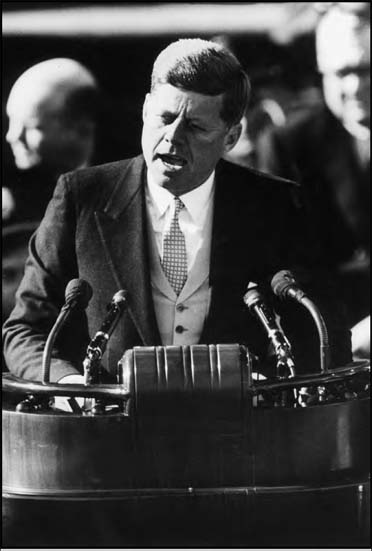
The inauguration and the parades and parties that usually follow it also provide the first glimpse of the new chief of state's ceremonial style. After the stiff formality and royal pomp observed during the Washington and Adams administrations, Jefferson wanted his inaugural to symbolize the democratic spirit he intended to bring to the presidency. He therefore eschewed a carriage in favor of walking unceremoniously from his boardinghouse to the Capitol to take the oath of office.
Andrew Jackson's (1829–1837) election was regarded as a triumph for common people. Thousands of enthusiastic supporters descended on the White House, destroying furniture, china, glassware, and other household items.
More than a century later, John Kennedy's inaugural was a formal affair that reflected the intellectual and cultural sophistication he would bring to his presidency. Kennedy sent 155 special inaugural invitations to noted writers, artists, and scholars; he had Robert Frost read a poem at the inaugural ceremony; and he decreed that male participants in the ceremony should wear top hats.
...
- Loading...
Get a 30 day FREE TRIAL
-
 Watch videos from a variety of sources bringing classroom topics to life
 -
Read modern, diverse business cases
-
Explore hundreds of books and reference titles

Read next

More like this
Sage Recommends
We found other relevant content for you on other Sage platforms.
Have you created a personal profile? Login or create a profile so that you can save clips, playlists and searches