
Entry
Reader's guide
Entries A-Z
Subject index
Clinical Trials within U.S.: Skin Transplants (Burns)
THE SKIN IS a vital organ for maintaining body homeostasis, and is a major immunologie defense against infection. When the integrity of the skin is compromised, such as in severe burn injuries, the person is at risk for complications such as dehydration as well as infection. Therefore, a skin transplant is often performed by splitting skin from a less damaged region of the body to another, more damaged region. The process of skin transplantation, particularly after a burn, is still undergoing improvement, and the way to test novel techniques is via a clinical trial.
A clinical trial is a critical method for determined the safety, efficacy, and benefit of a potential new clinical technique. This technique may be for treatment, therapy, diagnostic purposes, prevention, or improvement of the patient's quality of life. Although based on promising laboratory research, clinical trials are not guaranteed to work and must be understood as trials. For example, the volunteers for clinical trials of a novel therapy are not guaranteed an improvement in their condition and in fact are taking a significant risk. Nevertheless, while these volunteers may not see improvement themselves, they are doing a great service to others with the disease, as clinicians will learn about therapeutics and the potential benefits or harms of a particular technique.
According to the U.S. National Institutes of Health, there are two major classes of clinical trials. These classes are interventional, which measure a treatment type, and observational, where the clinicians monitor a particular patient group. A clinical trial involving a skin transplant, particularly in the treatment of a burn, would be an interventional clinical trial.
Clinical trials that have been completed in the United States include trials examining the optimal method of affixing the transplant to the new location. Options included skin staples, stitches, or medical adhesive such as cyanoacrylate glue. Severely damaged skin especially after a burn injury, is fragile and can be difficult to work with using tools such as sutures or staples, and some studies showed a benefit to using a medical adhesive.
Other trials investigate the use of certain topical healing agents such as anti—inflammatory creams or ointments, or anti—scarring treatments. One study examined the use of cultured skin substitute over using split skin from a less—affected body area. Cultured skin substitute (CSS) is a biopolymer generated in the laboratory that contains an artificial matrix onto which human cells are encouraged to grow using growth factors to induce the differentiation of skin cells. Another type of cultured skin transplant is a cultured epidermal autograft (CEA), which is a cultured skin from the patient's own cells. CEAs do no necessarily have a matrix.
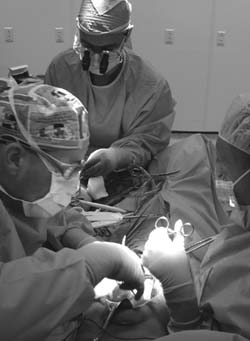
U.S. Air Force surgeons perform a procedure involving skin grafting at Bagram medical facilities in Afghanistan.
Given the nature of the skin excision and graft process, bleeding can be a devastating issue. In order to prevent severe bleeding during and after the procedure, clinical trials have investigated the utility of anti—bleeding factors when used in the adhesives for the graft. A recent study presented at the 2008 American Burn Association meeting showed that a novel product called Recothrom, a recombinant form of Thrombin, made by the company ZymoGenetics, can be used effectively to seal the borders of a skin transplant on a burn patient. This product is a spray and therefore easy to administer. The study was carried out at the University of California, Davis Medical Center and led by Dr. David G. Greenhalgh. Thrombin is physiologically considered a coagulation factor, involved in the cessation of blood flow. An earlier study, in which Greenhalgh also participated, showed that fibrin, a blood clotting factor, was also effective as a spray—on treatment to prevent bleeding.
...
- Biology
- Biotechnology, History of
- Cell Sorting
- Cells, Adult
- Cells, Amniotic
- Cells, Developing
- Cells, Embryonic
- Cells, Fetal
- Cells, Human
- Cells, Monkey
- Cells, Mouse (Embryonic)
- Cells, Neural
- Cells, Sources of
- Cells, Umbilical
- Cytogenetic Instability of Stem Cells
- Developmental Biology
- Differentiation, In Vitro and In Vivo
- Division Types (Symmetrical and Asymmetrical)
- Experimental Models
- Feeder/Feeder—Free Culture
- Gut Stem Cells
- Induced Pluripotent Stem Cells
- Lineages
- Mammary Stem Cells
- Markers of Sternness
- Methods of Growing Cells
- Microenvironment and Immune Issues
- Neuralstem
- Neurosphere Cultures
- Niche Self—Renewal
- Nuclear Reprogramming
- Parthogenesis
- Plant Stem Cells
- Prostate Tissue Stem Cells
- Renal Stem Cells
- Self—Renewal, Stem Cell
- Stem Cell Applications, Articular Cartilage
- Stem Cell Applications, Tendon and Ligament
- Stem—Like Cells, Human Brain
- Tissue Culture
- Transdifferentiation
- Clinical Trials
- Clinical Trials Outside U.S.: Amyotrophic Lateral Sclerosis
- Clinical Trials Outside U.S.: Avascular Necrosis
- Clinical Trials Outside U.S.: Severe Coronary Artery Disease
- Clinical Trials Outside U.S.: Spinal Cord Injury
- Clinical Trials Within U.S.: Batten Disease
- Clinical Trials Within U.S.: Blind Process
- Clinical Trials Within U.S.: Cancer
- Clinical Trials Within U.S.: Heart Disease
- Clinical Trials Within U.S.: Peripheral Vascular Disease
- Clinical Trials Within U.S.: Skin Transplants (Burns)
- Clinical Trials Within U.S.: Spinal Cord Injury
- Clinical Trials Within U.S.: Traumatic Brain Injury
- Clinical Trials Worldwide
- Countries
- Diseases
- Ethics
- History and Technology
- Birth Dating of Cells by Retrovirus
- Bone Marrow Transplants
- BrdU/Thymidine
- Fluorescence—Activated Cell Sorting
- Human Embryonic Stem Cells
- In Vitro Fertilization
- Mouse ES Cell Isolation
- MRI Tracking
- Non—Human Primate Embryonic Stem Cells
- Nuclear Transfer, Altered
- Nuclear Transfer, Somatic
- Parthogenesis
- Preimplantation Genetic Diagnosis
- Viral Vectors: Adeno—Associated Virus
- Viral Vectors: Adenovirus
- Viral Vectors: Lentivirus
- Industry
- Institutions
- Albert Einstein College of Medicine
- Baylor College of Medicine
- Bonn University
- Burnham Institute
- Caltech
- Cambridge University
- Case Western Reserve University/Cleveland Clinic
- Children's Hospital, Boston
- Columbia University
- Coriell Institute
- Duke University
- Genetics Policy Institute
- Harvard University
- Indiana University
- Johns Hopkins University
- Kyoto University
- Massachusetts General Hospital
- Massachusetts Institute of Technology
- Mayo Clinic
- McMaster University
- Mount Sinai School of Medicine
- National Academy of Science
- Northwestern University
- Oregon Health & Science University
- Ottawa Health Research Institute
- Oxford University
- Princeton University
- Reeve—Irvine Research Center
- Robarts Research Institute
- Rockefeller University
- Rutgers University
- Salk Institute
- Scripps Research Institute
- Sloan—Kettering Institute
- Stanford University
- Stowers Institute
- University of California, Berkeley
- University of California, Davis
- University of California, Los Angeles
- University of California, San Diego
- University of California, San Francisco
- University of Connecticut
- University of Georgia
- University of Miami
- University of Michigan
- University of Minnesota
- University of North Carolina, Chapel Hill
- University of Pittsburgh
- University of Southern California
- University of Texas Health Science Center at Houston
- University of Toronto
- University of Washington/Hutchinson Cancer Center
- University of Wisconsin, Madison
- Vanderbilt of University
- Wake Forest University
- Weill—Cornell Medical College
- Whitehead Institute
- Yale University
- Legal Issues
- Organizations
- American Association for the Advancement of Science
- Australian Stem Cell Centre
- California Institute for Regenerative Medicine
- Canadian Stem Cell Network
- China Stem Cell News
- Christopher Reeve Foundation
- Community of Stem Cell Scientists
- Danish Stem Cell Research Center
- East of England Stem Cell Network
- European Consortium for Stem Cell Research—EuroStemCell
- International Society for Stem Cell Research
- International Stem Cell Forum
- Japan Human Cell Society
- Lasker Foundation
- Medical Research Council UK Stem Cell Initiative
- Michael J. Fox Foundation
- National Institutes of Health
- National Stem Cell Bank
- Parkinson's Disease Foundation
- Scottish Stem Cell Network
- Stem Cell Genome Anatomy Projects
- Swiss Stem Cell Network
- UK National Stem Cell Network
- Wisconsin Alumni Research Foundation
- People
- Alvarez—Buylla, Arturo
- Anversa, Piero
- Charo, Robin Alta
- Eaves, Connie
- Eggan, Kevin
- Fuchs, Elaine
- Gage, Fred
- Gearhart, John
- Goldman, Steven A.
- Jaenisch, Rudolf
- Keller, Gordon
- Kriegstein, Arnold
- Lanza, Robert
- Losordo, Douglas
- Macklis, Jeffrey
- McKay, Ronald D. G.
- Melton, Doug
- Morrison, Sean
- Mummery, Christine
- Nottebohm, Fernando
- Okano, Hideyuki
- Orkin, Stuart
- Rao, Mahendra
- Smith, Austin
- Snyder, Evan
- Steindler, Dennis A.
- Studer, Lorenz P.
- Thomson, James
- Van der Kooy, Derek
- Verfaillie, Catherine
- Vescovi, Angelo
- Weissman, Irving
- Wilmut, Ian
- Politics
- Advocacy
- Coalition for the Advancement of Medical Research
- Congress: Votes and Amendments (Cloning/Embryos)
- Dickey Amendment
- Do No Harm: The Coalition of Americans for Research Ethics
- National Right to Life Committee
- President's Council on Bioethics
- Presidential Campaigns
- Reagan, Nancy
- Special Interest/Lobby Groups
- Stem Cells, Bush Ruling
- Religion
- States
- Alabama
- Arizona
- Arkansas
- California
- Colorado
- Connecticut
- Delaware
- Florida
- Georgia
- Hawaii
- Idaho
- Illinois
- Indiana
- Iowa
- Kansas
- Kentucky
- Louisiana
- Maine
- Maryland
- Massachusetts
- Michigan
- Minnesota
- Mississippi
- Missouri
- Montana
- Nebraska
- Nevada
- New Hampshire
- New Jersey
- New Mexico
- New York
- North Carolina
- North Dakota
- Ohio
- Oklahoma
- Oregon
- Pennsylvania
- Rhode Island
- South Carolina
- South Dakota
- Tennessee
- Texas
- Utah
- Vermont
- Virginia
- Washington
- West Virginia
- Wisconsin
- Wyoming
- Loading...
Get a 30 day FREE TRIAL
-
 Watch videos from a variety of sources bringing classroom topics to life
 -
Read modern, diverse business cases
-
Explore hundreds of books and reference titles

Read next

More like this
Sage Recommends
We found other relevant content for you on other Sage platforms.
Have you created a personal profile? Login or create a profile so that you can save clips, playlists and searches