
Entry
Reader's guide
Entries A-Z
Subject index
Appendix B
Internet Sites about Statistics
What follows is a listing of Internet sites and a brief description of each that focus on the general areas of statistics and measurement. Also included are sites where data (on many different topics) have been collected and can be accessed.
As you use these, keep in mind the following:
- Internet addresses (known as URLs) often change, as does the content. If one of these Internet addresses does not work, search for the name of the site using any search engine.
- Any Internet site is only as good as its content. For example, N or N − 1 might be given as the correct denominator for a formula, and although that might be true, you should double check any information with another Internet resource or a book on the subject.
- If you find something that is inaccurate on a site, contact the Webmaster or the author of the site and let him or her know that a correction needs to be made.
Name: http://statistics.com
Where to find it: http://www.statistics.com/
If there is a queen of statistics sites, then http://statistics.com is it. It offers not only links to hundreds of other sites and an online introductory statistics course, but also online professional development courses. You can try statistics software, look at the free stuff available on the Web, get help if you're a teacher with quizzes and other teaching materials, and even participate in online discussions. This is the place to start your travels.
Name: U.S. Department of Labor, Bureau of Labor Statistics
Where to find it: http://www.bls.gov/
Local, state, and federal government agencies are data warehouses, full of information about everything from employment to demographics to consumer spending. This particular site (which is relatively old at 10 years on the Web) is for the Bureau of Labor Statistics, the principal fact-finding agency for the federal government in the areas of labor economics and statistics. It is full of numbers and ideas. Some of the data can be downloaded as HTML or Excel files, and you can also get historical data going back 10 years in some instances.
Name: Probability and Quintile Applets Where to find it: http://www.stat.stanford.edu/~naras/jsm/FindProbability.html
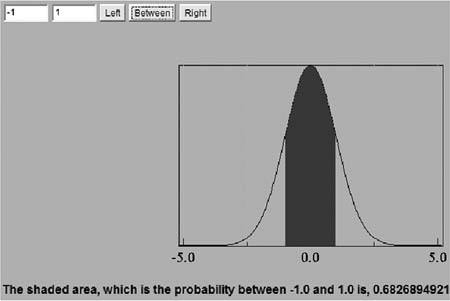
Applets are small programs that can visually represent an idea or a process very effectively. These two, by Balasubramanian Narasimhan from Stanford University, do such things as compute the probability of a score under the normal curve (see Figure 1 on the following page) and calculate the quintiles (fifths) of a distribution. They are easy to use, fun to play with, and very instructional. You can find another similar applet by Gary McClelland at http://psych.colorado.edu/~mcclella/java/normal/handleNormal.html
Figure 1 Probability Applet
Name: FedStats
Where to find it: http://www.fedstats.gov/
Here's another huge storehouse of data that is the entry point for many different federal agencies. You can easily access data from individual states or from agencies by subjects (such as health), access published collections of statistics, and even get the kids involved in child-oriented agency Web sites both entertaining and educational.
Name: Random Birthday Applet
Where to find it: http://www-stat.stanford.edu/~susan/surprise/Birthday.html
This is an incredible illustration of how probability works. You enter the number of birthdays you want generated at random, and the laws of probability should operate so that in a group of 30 such random selections, the odds are very high that there will be at least two matches for the same birthday. Try it—it works.
Name: The Statistics Homepage
Where to find it: http://www.statsoftinc.com/textbook/stathome.html
Here you'll find a self-contained course in basic statistics, brought to you by the people who developed and sell StatSoft, one of many statistical programs. On this site, you will find tutorials that take you from the elementary concepts of statistics through the more advanced topics, such as factor and discriminant analysis.
Name: National Center for Health Statistics
Where to find it: http://www.cdc.gov/nchs/
The National Center for Health Statistics compiles information that helps guide actions and policies to improve health in the United States. Among other things, these data are used to help identify health problems, evaluate the effectiveness of programs, and provide data for policymakers.
Name: The World Wide Web Virtual Library: Statistics
Where to find it: http://www.stat.ufl.edu/vlib/statistics.html
The good people at the University of Florida's Department of Statistics bring you this page, which contains links to statistics departments all over the world. It provides a great deal of information about graduate study in these areas as well as other resources.
Name: Social Statistics Briefing Room
Where to find it: http://www.whitehouse.gov/fsbr/ssbr.html
This service, which calls the White House home, provides access to current federal social statistics and links to information from a wide range of federal agencies. This is a very good, and broad, starting point to access data made available through different agencies.
Name: Statistics on the Web
Where to find it: http://my.execpc.com/~helberg/statistics.html
More groupings of URLs and Internet addresses from Clay Helberg. A bit like http://statistics.com, but full of listings of professional organizations, publications, and software packages (many of which you can download for a trial).
Name: Food and Agriculture Organization for the United Nations
Where to find it: http://faostat.fao.org/
If you want to go international, this is a site containing online information (in multilingual formats) and databases for more than 3 million time series records covering international statistics in areas such as production, population, and exports.
Name: Web Pages That Perform Statistical Calculations!
Where to find it: http://members.aol.com/johnp71/javastat.html
At the time of this writing, this site contains more than 600 links to books, tutorials, free software, and interactive tools, such as a guide to what statistical test to use to answer what questions, all assembled by John Pezzullo.
Name: Free Statistical Software
Where to find it: http://freestatistics.altervista.org/stat.php
An extensive collection of statistical analysis software packages that range from simple programs for students to advanced programs that do everything from statistical visualization to time series analysis. Many of these programs are freeware, and many are open source, available to be modified by users.
Name: Java Applets
Where to find it: http://www.stat.duke.edu/sites/java.html
The Institute of Statistics and Decision Sciences at Duke University and NWP Associates put together a collection of Java applets (Java is the language in which these small programs are written, and applets are small applications) that allows the user to demonstrate interactively various statistical techniques and tools, such as constructing histograms and illustrating how the central limit theorem works.
Name: HyperStat Online Textbook
Where to find it: http://davidmlane.com/hyperstat/
This site contains an entire online course in basic statistics from David Lane that covers every topic from simple descriptive statistics to effect size. The “Hyper” nature of the site allows the user to easily move from one topic to another through the extensive use of live links. And, as a bonus, each new screen has additional links to sites that focus on learning statistics.
Name: Rice Virtual Lab in Statistics
Where to find it: http://www.ruf.rice.edu/~lane/rvls.html
This is where the HyperStat Online Textbook has its home and is the main page (also done by David Lane) of Rice University's statistics program. In addition to the HyperStat link, it has links to simulations, case studies, and a terrific set of applets that are very useful for teaching and demonstration purposes.
Name: Reliability, Validity, and Fairness of Classroom Assessments
Where to find it: http://www.ncrel.org/sdrs/areas/issues/methods/assment/as5relia.htm
A discussion of the reliability, validity, and fairness of classroom testing from the North Central Educational Laboratory.
Name: The Multitrait Multimethod Matrix
Where to find it: http://www.socialresearchmethods.net/kb/mtmmmat.htm
A very good site for a discussion of validity issues in measurement in general and specific discussion about the multitrait multimethod brought to you by William M. K. Trochim.
Name: Content Validity, Face Validity, and Quantitative Face Validity
Where to find it: http://www.burns.com/wcbcontval.htm
Although a bit dated (around 1996), this Web site offers a detailed discussion by William C. Burns on content, face, quantitative, and other types of validity.
Name: The National Education Association
Where to find it: http://www.nea.org/parents/testingguide.html. also
This national organization of teaching professionals provides assistance to parents, teachers, and others in understanding test scores.
Name: The Learning Center
Where to find it: http://webster.commnet.edu/faculty/~simonds/tests.htm
It's a reality that other than through studying, test scores can be improved if test takers understand the different demands of different types of tests. This item contains information on using different strategies to increase test scores.
Name: The Advanced Placement
Where to find it: http://apbio.biosci.uga.edu/exam/Essays/
This is an old site, but people at the University of Georgia have posted items from a variety of different topic areas covered in the Advanced Placement (AP) exams that high school students can take in a step to qualify for college credit.
Name: Essay Question
Where to find it: http://www.salon.com/tech/feature/1999/05/25/computer_grading/
http://Salon.com offers a discussion of automated grading in general and specially, as well as essay question grading using computers.
Name: Matching Questions on Minerals and Rocks
Where to find it: http://www.usd.edu/esci/exams/matching.html
A good example of how easy it is to adapt matching questions to an interactive electronic format.
An increasingly large part of doing research, as well as other intensive, more qualitative projects, involves specially designed software. At http://www.scolari.com/, you can find a listing of several different types and explore which might be right for you if you intend to pursue this method (interviewing) and this methodology (qualitative).
FairTest—The National Center for Fair and Open Testing at http://www.fairtest.org/index.htm has as its mission to “end the misuses and flaws of standardized testing and to ensure that evaluation of students, teachers and schools is fair, open, valid and educationally beneficial.” A really interesting site to visit.
Preparing Students to Take Standardized Achievement Tests (at http://pareonline.net/getvn.asp?v=1&n=11) was written by William A. Mehrens (and first appeared in Practical Assessment, Research & Evaluation) for school administrators and teachers and discusses what test scores mean and how they can be most useful in understanding children's performance.
The Clifton StrengthsFinder™ at http://education.gallup.com/content/default.asp?ci=886 is a Webbased assessment tool published by the Gallup Organization (yep, the poll people) to help people better understand their talents and strengths by measuring the presence of 34 themes of talent. You might want to take it and explore these themes.
Find out just about everything you ever wanted to know (and more) about human intelligence at Human Intelligence: Historical Influences, Current Controversies and Teaching Resources at http://www.indiana.edu/~intell/
The following text is taken from Neil J. Salkind's best-selling introduction to statistics text, Statistics for People Who (Think They) Hate Statistics, 2nd edition (2004).
Pages and pages of every type of statistical resource you can want has been creatively assembled by Professor David W. Stockburger at http://www.psychstat.smsu.edu/scripts/dws148f/statisticsresourcesmain.asp. This site receives the gold medal of statistics sites. Don't miss it.
For example, take a look at Berrie's page (at http://www.huizen.dds.n~berrie/) and see some QuickTime (short movies) of the effects of changing certain data points on the value of the mean and standard deviation. Or, look at the different home pages that have been created by instructors for courses offered around the country. Or, look at all of the different software packages that can do statistical analysis.
Want to draw a histogram? How about a table of random numbers? A sample-size calculator? The Statistical Calculators page at http://www.stat.ucla.edu/calculators/ has just about every type (more than 15) of calculator and table you could need. Enough to carry you through any statistics course that you might take and even more.
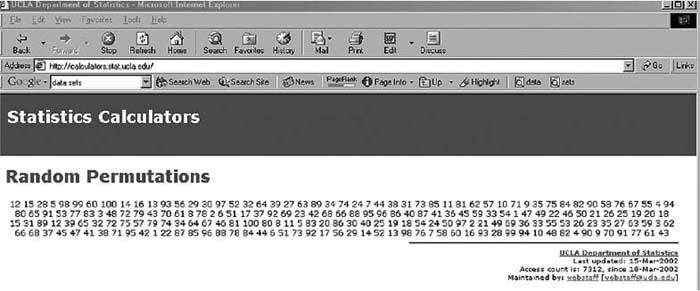
For example, you can click on the Random Permutations link and complete the two boxes (as you see in Figure 2 for 2 random permutations of 100 integers), and you get the number of permutations you want. This is very handy when you need a table of random numbers for a specific number of participants so you can assign them to groups.
Figure 1 Generating a Set of Random Numbers
The History of Statistics page located at http://www.Anselm.edu/homepage/jpitocch/biostatshist.html contains portraits and bibliographies of famous statisticians and a time line of important contributions to the field of statistics. So, do names like Bernoulli, Galton, Fisher, and Spearman pique your curiosity? How about the development of the first test between two averages during the early 20th century? It might seem a bit boring until you have a chance to read about the people who make up this field and their ideas—in sum, pretty cool ideas and pretty cool people.
SurfStat Australia (at http://www.anu.edu.au/nceph/surfstat/surfstat-home/surfstat.html) is the online component of a basic stat course taught at the University of Newcastle, Australia, but has grown far beyond just the notes originally written by Annette Dobson in 1987, and updated over several years' use by Anne Young, Bob Gibberd, and others. Among other things, SurfStat contains a complete interactive statistics text. Besides the text, there are exercises, a list of other statistics sites on the Internet, and a collection of Java applets (cool little programs you can use to work with different statistical procedures).
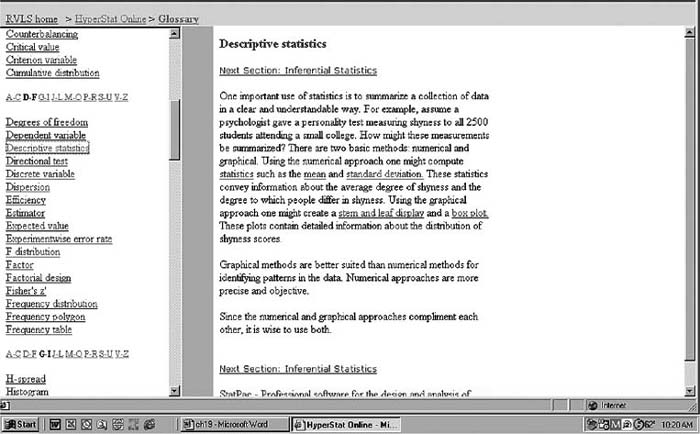
This online tutorial with 18 lessons, at http://www.davidmlane.com/hyperstat/index.html, offers nicely designed and userfriendly coverage of the important basic topics. What we really liked about the site was the glossary, which uses hypertext to connect different concepts to one another. For example, in Figure 3, you can see the definition of descriptive statistics also linked to other glossary terms, such as mean, standard deviation, and box plot. Click on any of those and zap! you're there.
Figure 1 Sample HyperStat Screen
There are data all over the place, ripe for the picking. Here are just a few. What to do with these? Download them to be used as examples in your work or as examples of analysis that you might want to do, and you can use these as a model.
- Statistical Reference Datasets at http://www.itl.nist.gov/div898/strd/
- United States Census Bureau (a huge collection and a gold mine of data) at http://factfinder.census.gov/servlet/DatasetMainPage-Servlet?_lang=en
- The Data and Story Library (http://lib.stat.cmu.edu/DASL/) with great annotations about the data (look for the stories link)
- Tons of economic data sets at Growth Data Sets (at http://www.bris.ac.uk/Depts/Economics/Growth/datasets.htm)
Then there are all the data sets that are available through the federal government (besides the census). Your tax money supports it, so why not use it? For example, there's FEDSTATS (at http://www.fedstats.gov/), where more than 70 agencies in the U.S. federal government produce statistics of interest to the public. The Federal Interagency Council on Statistical Policy maintains this site to provide easy access to the full range of statistics and information produced by these agencies for public use. Here you can find country profiles contributed by the (boo!) CIA; public school student, staff, and faculty data (from the National Center for Education Statistics); and the Atlas of the United States Mortality (from the National Center for Health Statistics). What a ton of data!
The University of Michigan's Statistical Resources on the Web (at http://www.lib.umich.edu/govdocs/stats.html) has hundreds and hundreds of resource links, including those to banking, book publishing, the elderly, and, for those of you with allergies, pollen count. Browse, search for what exactly it is that you need—no matter, you are guaranteed to find something interesting.
At http://mathforum.org/workshops/sum96/data.collections/datalibrary/data.set6.html, you can find a data set including the 1994 National League Baseball Salaries or the data on TV, Physicians, and Life Expectancy. Nothing earth-shaking, just fun to download and play with.
The World Wide Web Virtual Library: Statistics is the name of the page, but the one-word title is misleading because the site (from the good people at the University of Florida at http://www.stat.ufl.edu/vlib/statistics.html) includes information on just about every facet of the topic, including data sources, job announcements, departments, divisions and schools of statistics (a huge description of programs all over the world), statistical research groups, institutes and associations, statistical services, statistical archives and resources, statistical software vendors and software, statistical journals, mailing list archives, and related fields. Tons of great information is available here. Make it a stop along the way.
Statistics on the Web at http://www.maths.uq.edu.au/~gks/webguide/datasets.html is another location that's just full of information and references that you can easily access. Here, you'll find information on professional organizations, institutes and consulting groups, educational resources, Web courses, online textbooks, publications and publishers, statistics book lists, software-oriented pages, mailing lists and discussion groups, and even information on statisticians and other statistical people.
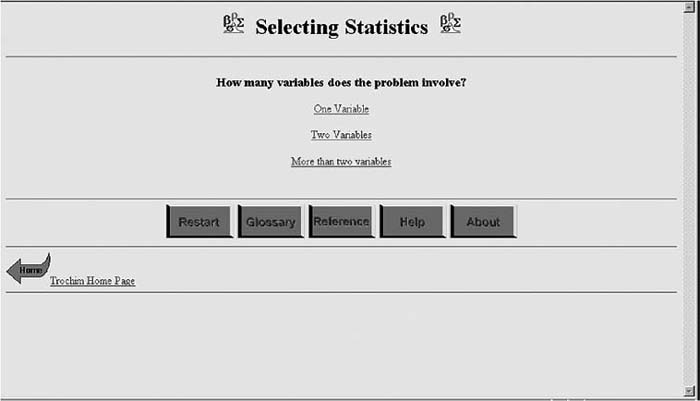
Figure 1 Selecting the Correct Stat Technique to Use—Just a Few Clicks Away
If you do ever have to teach statistics, or even tutor fellow students, this is one place you'll want to visit: http://noppa5.pc.helsinki.fi/links.html. It contains hundreds of resources on every topic that was covered in Statistics for People Who (Think They) Hate Statistics and more. You name it and it's here: regression, demos, history, Sila (a demonstration of inference), an interactive online tutorial, statistical graphics, handouts to courses, teaching materials, journal articles, and even quizzes! Whew, what a deal. There tends to be a lot of material that may not be suited to what you are doing in this class, but this wide net has certainly captured some goodies.
http://Statistics.com (http://www.statistics.com) has it all—a wealth of information on courses, software, statistical methods, jobs, books, and even a homework helper. For example, if you want to know about free Webbased stat packages, click on that link on the left-hand side of the page. Here's one (see Figure 4) from Dr. Bill Trochim…. You just click your way through answering questions to get the answer to what type of analysis should be used.
- Biographies
- Babbage, Charles
- Bernoulli, Jakob
- Bonferroni, Carlo Emilio
- Bruno, James Edward
- Comrey, Andrew L.
- Cronbach, Lee J.
- Darwin, Charles
- Deming, William Edwards
- Fisher, Ronald Aylmer
- Galton, Sir Francis
- Gauss, Carl Friedrich
- Gresham, Frank M.
- Jackson, Douglas N.
- Malthus, Thomas
- Markov, Andrei Andreevich
- Pascal, Blaise
- Pearson, Karl
- Poisson, Siméon Denis
- Reynolds, Cecil R.
- Torrance, E. Paul
- Wilcoxon, Frank
- Charts, Graphs, and Visual Displays
- Computer Topics and Tools
- Concepts and Issues in Measurement
- T Scores
- z Scores
- Ability Tests
- Achievement Tests
- Alternate Assessment
- Americans with Disabilities Act
- Anthropometry
- Aptitude Tests
- Artificial Neural Network
- Asymmetry of G
- Attitude Tests
- Basal Age
- Categorical Variable
- Classical Test Theory
- Coefficient Alpha
- Completion Items
- Computerized Adaptive Testing
- Construct Validity
- Content Validity
- Criterion Validity
- Criterion-Referenced Test
- Cronbach, Lee J.
- Curriculum-Based Measurement
- Diagnostic Validity
- Educational Testing Service
- Equivalence Testing
- Essay Items
- Ethical Issues in Testing
- Face Validity
- Gf-Gc Theory of Intelligence
- Guttman Scaling
- Health Insurance Portability and Accountability Act
- High-Stakes Tests
- Immediate and Delayed Memory Tasks
- Individuals with Disabilities Education Act
- Information Referenced Testing
- Informed Consent
- Intelligence Quotient
- Intelligence Tests
- Internal Review Board
- Interrater Reliability
- Interval Level of Measurement
- Ipsative Measure
- Item and Test Bias
- Item Response Theory
- KR-20 and KR-21
- Likert Scaling
- Measurement
- Measurement Error
- Metric Multidimensional Scaling
- Multiple-Choice Items
- Multitrait Multimethod Matrix and Construct Validity
- Nomothetic Versus Idiographic
- Ordinal Level of Measurement
- Parallel Forms Reliability
- Performance IQ
- Performance-Based Assessment
- Personality Tests
- Portfolio Assessment
- Predictive Validity
- Projective Testing
- Q Methodology
- Questionnaires
- Ratio Level of Measurement
- Reliability Theory
- Response to Intervention
- Reverse Scaling
- Scaling
- Section 504 of the Rehabilitation Act of 1973
- Self-Report
- Semantic Differential
- Semantic Differential Scale
- Six Sigma
- Spearman's Rho
- Split Half Reliability
- Standard Error of Measurement
- Standard Scores
- Standards for Educational and Psychological Testing
- Test-Retest Reliability
- Thurstone Scaling
- Torrance, E. Paul
- True/False Items
- Validity Coefficient
- Validity Theory
- Verbal IQ
- Concepts and Issues in Statistics
- Artificial Neural Network
- Attenuation, Correction for
- Autocorrelation
- Bayesian Statistics
- Bioinformatics
- Central Limit Theorem
- Decision Theory
- Diggle-Kenward Model for Dropout
- DISTATIS
- Exploratory Factor Analysis
- Factorial Design
- Fourier Transform
- Generalized Additive Model
- Generalized Method of Moments
- Generalized Procrustes Analysis
- Graphical Statistical Methods
- Hierarchical Linear Modeling
- Historiometrics
- Logistic Regression Analysis
- Loglinear Analysis
- Markov Chain Monte Carlo Methods
- Matrix Operations
- Mean
- Measurement Error
- Mixtures of Experts
- Nonparametric Statistics
- Propensity Scores
- Rasch Measurement Model
- Regression Analysis
- Sampling Distribution of a Statistic
- Signal Detection Theory
- Simpson's Paradox
- Spurious Correlation
- Standard Error of the Mean
- Standard Scores
- Support Vector Machines
- Survival Analysis
- Type I Error
- Type II Error
- Data and Data Reduction Techniques
- Descriptive Statistics
- Arithmetic Mean
- Attenuation, Correction for
- Autocorrelation
- Average
- Average Deviation
- Bayley Scales of Infant Development
- Biserial Correlation Coefficient
- Class Interval
- Coefficients of Correlation, Alienation, and Determination
- Cognitive Psychometric Assessment
- Cohen's Kappa
- Correlation Coefficient
- Cumulative Frequency Distribution
- Deviation Score
- Difference Score
- Estimates of the Population Median
- Fisher's Z Transformation
- Frequency Distribution
- Galton, Sir Francis
- Grand Mean
- Harmonic Mean
- Histogram
- Kendall Rank Correlation
- Mean
- Measures of Central Tendency
- Median
- Mode
- Moving Average
- Parameter
- Parameter Invariance
- Part and Partial Correlations
- Pearson Product-Moment Correlation Coefficient
- Pearson, Karl
- Percentile and Percentile Rank
- Scattergram
- Semi-Interquartile Range
- Spurious Correlation
- Standard Deviation
- Survey Weights
- Text Analysis
- Evaluation
- Experimental Methods
- Alternative Hypothesis
- American Statistical Association
- Americans with Disabilities Act
- Association for Psychological Science
- Basic Research
- Bioinformatics
- Complete Independence Hypothesis
- Continuous Variable
- Critical Value
- Data Collection
- Data Mining
- Delphi Technique
- Dependent Variable
- Descriptive Research
- Ethical Issues in Testing
- Ethical Principles in the Conduct of Research With Human Participants
- Fractional Randomized Block Design
- Hello-Goodbye Effect
- Hypothesis and Hypothesis Testing
- Independent Variable
- Informed Consent
- Instrumental Variables
- Internal Review Board
- Longitudinal/Repeated Measures Data
- Meta-Analysis
- Missing Data Method
- Mixed Models
- Mixture Models
- Moderator Variable
- Monte Carlo Methods
- Null Hypothesis Significance Testing
- Ockham's Razor
- Pairwise Comparisons
- Post Hoc Comparisons
- Projective Testing
- Quasi-Experimental Method
- Sample Size
- Section 504 of the Rehabilitation Act of 1973
- Significance Level
- Simple Main Effect
- Simulation Experiments
- Single-Subject Designs
- Standards for Educational and Psychological Testing
- Statistical Significance
- Suppressor Variable
- Variable
- Variable Deletion
- Variance
- Inferential Statistics
- Akaike Information Criterion
- Analysis of Covariance (ANCOVA)
- Analysis of Variance (ANOVA)
- Bayes Factors
- Bayesian Information Criterion
- Binomial Test
- Bonferroni, Carlo Emilio
- Complete Independence Hypothesis
- Data Analysis ToolPak
- Exploratory Factor Analysis
- Factorial Design
- Fisher, Ronald Aylmer
- Hierarchical Linear Modeling
- Hypothesis and Hypothesis Testing
- Inferential Statistics
- Logistic Regression Analysis
- Markov, Andrei Andreevich
- Null Hypothesis Significance Testing
- Pairwise Comparisons
- Part and Partial Correlations
- Repeated Measures Analysis of Variance
- Type I Error
- Type II Error
- Wilcoxon, Frank
- Organizations and Publications
- Abstracts
- American Doctoral Dissertations
- American Psychological Association
- American Statistical Association
- Association for Psychological Science
- Buros Institute of Mental Measurements
- Centers for Disease Control and Prevention
- Educational Testing Service
- Journal of Modern Applied Statistical Methods
- Journal of Statistics Education
- Journal of the American Statistical Association
- National Science Foundation
- Psychometrics
- PsycINFO
- Society for Research in Child Development
- Prediction and Estimation
- Attributable Risk
- Bernoulli, Jakob
- Chance
- Conditional Probability
- Confidence Intervals
- Continuous Variable
- Curse of Dimensionality
- Decision Boundary
- Decision Theory
- File Drawer Problem
- Gambler's Fallacy
- Generalized Estimating Equations
- Law of Large Numbers
- Maximum Likelihood Method
- Nonprobability Sampling
- Pascal, Blaise
- Probability Sampling
- Random Numbers
- Relative Risk
- Signal Detection Theory
- Significance Level
- Three-Card Method
- Probability
- Qualitative Methods
- Samples, Sampling, and Distributions
- Acceptance Sampling
- Adaptive Sampling Design
- Age Norms
- Attrition Bias
- Career Maturity Inventory
- Central Limit Theorem
- Class Interval
- Cluster Sampling
- Confidence Intervals
- Convenience Sampling
- Cumulative Frequency Distribution
- Data Collection
- Diggle-Kenward Model for Dropout
- Gauss, Carl Friedrich
- Heteroscedasticity and Homoscedasticity
- Homogeneity of Variance
- Hypergeometric Distribution
- Kurtosis
- Malthus, Thomas
- Multicollinearity
- Multivariate Normal Distribution
- Nonprobability Sampling
- Normal Curve
- Ogive
- Parameter
- Percentile and Percentile Rank
- Poisson Distribution
- Poisson, Siméon Denis
- Posterior Distribution
- Prior Distribution
- Probability Sampling
- Quota Sampling
- Random Sampling
- Sample
- Sample Size
- Semi-Interquartile Range
- Simpson's Rule
- Skewness
- Smoothing
- Stanine
- Stratified Random Sampling
- Unbiased Estimator
- Statistical Techniques
- k-Means Cluster Analysis
- t Test for Two Population Means
- Binomial Distribution/Binomial and Sign Tests
- Bivariate Distributions
- Bonferroni Test
- Bowker Procedure
- Causal Analysis
- Centroid
- Chance
- Chi-Square Test for Goodness of Fit
- Chi-Square Test for Independence
- Classification and Regression Tree
- Cochran Q Test
- Cohen's Kappa
- Delta Method
- Dimension Reduction
- Discriminant Analysis
- Dissimilarity Coefficient
- Dixon Test for Outliers
- Dunn's Multiple Comparison Test
- Eigendecomposition
- Eigenvalues
- EM Algorithm
- Exploratory Data Analysis
- Factor Analysis
- Factor Scores
- Fisher Exact Probability Test
- Fisher's LSD
- Friedman Test
- Goodness-of-Fit Tests
- Grounded Theory
- Kolmogorov-Smirnov Test for One Sample
- Kolmogorov-Smirnov Test for Two Samples
- Kruskal-Wallis One-Way Analysis of Variance
- Latent Class Analysis
- Likelihood Ratio Test
- Lilliefors Test for Normality
- Mann-Whitney U Test (Wilcoxon Rank-Sum Test)
- McNemar Test for Significance of Changes
- Median Test
- Meta-Analysis
- Multiple Comparisons
- Multiple Factor Analysis
- Multiple Imputation for Missing Data
- Multivariate Analysis of Variance (MANOVA)
- Newman-Keuls Test
- O'Brien Test for Homogeneity of Variance
- Observational Studies
- One-Way Analysis of Variance
- Page's L Test
- Paired Samples t Test (Dependent Samples t Test)
- Path Analysis
- Peritz Procedure
- Scan Statistic
- Shapiro-Wilk Test for Normality
- Structural Equation Modeling
- Tests of Mediating Effects
- Three-Card Method
- Tukey-Kramer Procedure
- Wilcoxon Signed Ranks Test
- Statistical Tests
- t Test for Two Population Means
- Analysis of Covariance (ANCOVA)
- Analysis of Variance (ANOVA)
- Behrens-Fisher Test
- Binomial Distribution/Binomial and Sign Tests
- Binomial Test
- Bonferroni Test
- Bowker Procedure
- Chi-Square Test for Goodness of Fit
- Chi-Square Test for Independence
- Classification and Regression Tree
- Cochran Q Test
- Dixon Test for Outliers
- Dunn's Multiple Comparison Test
- Excel Spreadsheet Functions
- Fisher Exact Probability Test
- Fisher's LSD
- Friedman Test
- Goodness-of-Fit Tests
- Kolmogorov-Smirnov Test for One Sample
- Kolmogorov-Smirnov Test for Two Samples
- Kruskal-Wallis One-Way Analysis of Variance
- Latent Class Analysis
- Likelihood Ratio Test
- Lilliefors Test for Normality
- Mann-Whitney U Test (Wilcoxon Rank-Sum Test)
- McNemar Test for Significance of Changes
- Median Test
- Multiple Comparisons
- Multivariate Analysis of Variance (MANOVA)
- Newman-Keuls Test
- O'Brien Test for Homogeneity of Variance
- One- and Two-Tailed Tests
- One-Way Analysis of Variance
- Page's L Test
- Paired Samples t Test (Dependent Samples t Test)
- Peritz Procedure
- Repeated Measures Analysis of Variance
- Shapiro-Wilk Test for Normality
- Tests of Mediating Effects
- Tukey-Kramer Procedure
- Wilcoxon Signed Ranks Test
- Tests by Name
- Adjective Checklist
- Alcohol Use Inventory
- Armed Forces Qualification Test
- Armed Services Vocational Aptitude Battery
- Basic Personality Inventory
- Bayley Scales of Infant Development
- Beck Depression Inventory
- Behavior Assessment System for Children
- Bender Visual Motor Gestalt Test
- Bracken Basic Concept Scale–Revised
- California Psychological Inventory
- Career Assessment Inventory
- Career Development Inventory
- Career Maturity Inventory
- Carroll Depression Scale
- Children's Academic Intrinsic Motivation Inventory
- Clinical Assessment of Attention Deficit
- Clinical Assessment of Behavior
- Clinical Assessment of Depression
- Cognitive Abilities Test
- Cognitive Psychometric Assessment
- Comrey Personality Scales
- Coping Resources Inventory for Stress
- Culture Fair Intelligence Test
- Differential Aptitude Test
- Ecological Momentary Assessment
- Edwards Personal Preference Schedule
- Embedded Figures Test
- Fagan Test of Infant Intelligence
- Family Environment Scale
- Gerontological Apperception Test
- Goodenough Harris Drawing Test
- Graduate Record Examinations
- Holden Psychological Screening Inventory
- Illinois Test of Psycholinguistic Abilities
- Information Systems Interaction Readiness
- Internal External Locus of Control Scale
- International Assessment of Educational Progress
- Iowa Tests of Basic Skills
- Iowa Tests of Educational Development
- Jackson Personality Inventory–Revised
- Jackson Vocational Interest Survey
- Kaufman Assessment Battery for Children
- Kinetic Family Drawing Test
- Kingston Standardized Cognitive Assessment
- Kuder Occupational Interest Survey
- Laboratory Behavioral Measures of Impulsivity
- Law School Admissions Test
- Life Values Inventory
- Luria Nebraska Neuropsychological Battery
- Male Role Norms Inventory
- Matrix Analogies Test
- Millon Behavioral Medicine Diagnostic
- Millon Clinical Multiaxial Inventory-III
- Minnesota Clerical Test
- Minnesota Multiphasic Personality Inventory
- Multidimensional Aptitude Battery
- Multiple Affect Adjective Checklist–Revised
- Myers-Briggs Type Indicator
- NEO Personality Inventory
- Neonatal Behavioral Assessment Scale
- Peabody Picture Vocabulary Test
- Personal Projects Analysis
- Personality Assessment Inventory
- Personality Research Form
- Piers-Harris Children's Self-Concept Scale
- Preschool Language Assessment Instrument
- Profile Analysis
- Projective Hand Test
- Quality of Well-Being Scale
- Raven's Progressive Matrices
- Roberts Apperception Test for Children
- Rorschach Inkblot Test
- Sixteen Personality Factor Questionnaire
- Social Climate Scales
- Social Skills Rating System
- Spatial Learning Ability Test
- Stanford Achievement Test
- Stanford-Binet Intelligence Scales
- Strong Interest Inventory
- Stroop Color and Word Test
- Structured Clinical Interview for DSM-IV
- System of Multicultural Pluralistic Assessment
- Thematic Apperception Test
- Torrance Tests of Creative Thinking
- Torrance Thinking Creatively in Action and Movement
- Universal Nonverbal Intelligence Test
- Vineland Adaptive Behavior Scales
- Vineland Social Maturity Scale
- Wechsler Adult Intelligence Scale
- Wechsler Individual Achievement Test
- Wechsler Preschool and Primary Scale of Intelligence
- West Haven-Yale Multidimensional Pain Inventory
- Woodcock Johnson Psychoeducational Battery
- Woodcock Reading Mastery Tests Revised
- Loading...
Get a 30 day FREE TRIAL
-
 Watch videos from a variety of sources bringing classroom topics to life
 -
Read modern, diverse business cases
-
Explore hundreds of books and reference titles
Read next

More like this
Sage Recommends
We found other relevant content for you on other Sage platforms.
Have you created a personal profile? Login or create a profile so that you can save clips, playlists and searches