
Entry
Reader's guide
Entries A-Z
Subject index
Working Poor
Despite being formally employed, the working poor fail to earn enough income to achieve basic economic security. They struggle to make ends meet, as they fail to earn family-sustaining wages and often lack adequate job-based benefits. Although many of these individuals and families earn less than the poverty line in the United States, others earn somewhat more but still not enough to provide economic security and avoid hardships. This article presents some definitions xof the working poor, describes the recent trends of growing working poverty, and presents some of the experiences of the working poor. It then explores the causes and consequences of working poverty as well as coping strategies employed by the working poor. It concludes by describing some of the policies that could reduce or mitigate working poverty, and the organizing and coalitions required to implement these reforms.
Overview: Who Are the Working Poor?
One could define the working poor as all individuals whose earnings place them below the U.S. poverty line. Another strict definition would include only those living in households below the poverty line where one individual was formally employed. A surprisingly large number of poor adults, and even homeless individuals, hold at least one formal job. Many others work informally, or “off the books.” A more accurate definition of the working poor would include households with income near the poverty level, perhaps up to twice the official poverty line, where one individual is formally employed. A more expansive definition of the working poor includes all households with a formally employed individual yet still lacking economic security, which includes approximately 33 percent to 50 percent of Americans. Katherine Newman and Victor Tan Chen characterize the near poor as the “missing class.” Together, these financially insecure individuals, who despite “playing by the rules” and working (many with full-time or near full-time hours) continue to toil for less remuneration than required for economic security. These families exist on the precipice of hardship, one missed paycheck or health emergency from destitution.
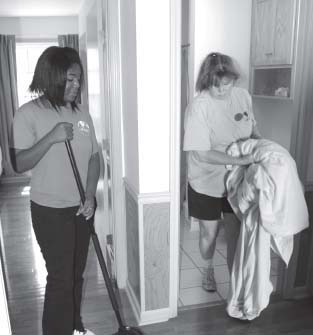
Housekeepers clean at the Lake Tholocco West Beach Singing Pines Cabins, July 24, 2009. Many working-poor jobs are low-status positions and can also can be repetitive. Some working poor, such as in hospitals or hotels, report feeling invisible.
The working poor can be found in almost every sector of the American economy. They occupy job positions in hospitality, retail, food services, meatpacking, call centers, and health care. Some of the working poor are employed by major multinational corporations, and others work for universities, nonprofits, or small businesses, among other employers.
The growth of the working poor parallels the increased formal employment of women. Because a disproportionate number of poverty-wage jobs are held by women, especially in the service sector, the working poor are disproportionately female. Less-educated single mothers are particularly at risk to end up in the ranks of the working poor. In addition, recent immigrants, such as those with limited English language fluency and/or lacking formal education, skills, and training, such as youth or women re-entering the labor market after raising children, are at higher risk of joining the working poor. Racial and ethnic minority workers are also disproportionately represented among the working poor. Although some working poor, such as suburban teenagers working at local fast food restaurants, occupy poverty-wage job positions only for a temporary period of time before capitalizing on additional education, training, and work experience to secure better employment opportunities, a substantial number of working poor remain trapped in poverty-wage jobs over the long term (or even worse, in the cases of incarceration or long-term unemployment). When the working poor secure a new job position, they often find themselves in jobs with characteristics similar to their previous employment: inadequate wages and benefits and limited job security. Even in a time of economic recession, when struggling American families receive much media attention, the working poor remain understudied and largely invisible in the public realm. They struggle in some of the most physically challenging and dangerous jobs in the lower tiers of the service sector, agriculture, and what's left of manufacturing, and their large and growing ranks pose a fundamental challenge.
...
- Digital and Computer Revolution: Reshaping Jobs and Workplaces
- Biotechnology
- Call Centers
- Computer Programmers
- Computer-Mediated Work
- Electronic Surveillance
- Engineers
- Film Industry Workers
- High-Tech and Internet Industry, Employment in
- Innovation
- Management Information Systems
- Management, Scientific
- Media Workers
- Networked Organizations
- Networks
- Occupations, Distribution of
- Open Source Movement
- Polarized Workforce
- Social Media
- Systems Analysts
- Telecommunications Workers
- Telework
- Training and Skill Acquisition
- Employment Relationships
- “Good” Employment Model, Rise and Erosion of
- At-Will Employment
- Boundaryless Careers
- Casual Labor and Informal Economy
- Contingent Work
- Contract Workers
- Contract, Employment (Common Law)
- Contracts
- Disappearing Work
- Employability
- Employee Participation
- Employee Stock Ownership Plans
- Employee Voice
- Employment Relationship
- Entrepreneurship
- Flexible Scheduling
- Franchises
- Freelancing
- Glass Cage
- Headhunters
- Japanese Transplants
- Job Security
- Job Sharing
- Job Tenure
- Labor Market Intermediaries
- Labor Markets, External
- Outsourcing and Subcontracting
- Risk Shift
- Self-Employment
- Seniority
- Teamwork
- Temporary Placement Agencies
- Temporary Work
- Turnover
- Undocumented Workers
- Walmart Employment Template
- Welfare-to-Work
- Everyday Life at Work
- Alienation
- Bureaucracy
- Corporate Closet
- Cubicles
- Deception
- Distractions, Online
- Dress Codes
- Drug Testing
- Dual-Career Couples
- Emotion
- Ethics
- Face Time
- Feeling Rules
- Game Playing
- Gossip
- Health and Safety
- Illness
- Meetings
- Office Artifacts
- Organizational Structure, New Forms of
- Power
- Productivity
- Project Management
- Resistance, Gendered and Racialized
- Social Interactions at Work
- Stress
- Subcultures
- Substance Abuse
- Violence, Workplace
- Work Overload
- Globalization and Cross-National Perspectives on Work
- Brazil
- Canada
- Child Labor
- China
- Factory Work, Globalization of
- France
- Germany
- Human Trafficking
- Immigrant Workers
- Importing Labor
- India
- Indonesia
- International Division of Labor
- Japan
- Labor Markets
- Logistics Revolution
- Market Fundamentalism
- Mexico
- Mothering, Transnational
- Multinational Corporations
- Singapore
- South Africa
- South Korea
- Sweden
- Inequality, Stratification, and Power at Work
- “Big Squeeze”
- “Blacks on the Bubble”
- “Doing Gender”
- Authority Gap
- Benefits
- Bodies
- Boundary Work
- Cognitive Biases
- Comparable Worth
- Control, Workplace
- Crime as Work
- Cultural Capital
- Disabled Workers
- Discouraged Workers
- Discrimination, Employment
- Discrimination: Institutional, Statistical, and Direct
- Displaced Workers
- Disposable Workers
- Diversity Programs
- Downward Mobility
- Education and Work
- Gatekeepers
- Gender Gap
- Gendered Organizations
- Glass Ceiling
- Glass Escalator
- Homophily
- Homosocial Reproduction
- Human Capital
- Human Relations Theory
- Ideal Worker
- Impression Management
- Income Inequality
- Inequality, Policies to Correct
- Invisible Work
- Job Quality
- Job Queues Theory
- Jobs, Marginal
- Labor Force Participation
- Labor Force Participation Rates
- Labor, Devaluation of
- Lesbian, Gay, Bisexual, and Transgender (LGBT) Workers
- Life Course
- Men in Women's Jobs
- Minimum-Wage and Low-Wage Jobs
- Mobility Mechanisms
- Moonlighting
- Occupational Segregation by Gender and Race
- Organizational Wage Inequality
- Poverty
- Precarious Labor
- Revolving Door Theory
- Sex Typing
- Sexual Harassment
- Sexuality
- Social Capital
- Sticky Floor
- Sweatshops
- Tokenism
- Underemployed Workers
- Unemployment
- Whistleblowing
- White-Collar Crime
- White-Collar Sweatshop
- Women in Men's Jobs
- Workforce Development
- Working Poor
- Labor Movement and Other Forms of Collective Action
- Boycotts, Consumer
- Collective Bargaining
- Eight-Hour Day
- Government Regulation of Employment, U.S.
- Human Rights Campaigns
- Immigrants, Organizing
- Labor Law
- Living Wage Campaign
- Moral Underground
- Organized Labor
- Organized Labor, Cross-National Perspective
- Social Responsibility, Corporate
- Social Support Programs
- Strategies, New Organizing
- Strikes and Protests
- Students against Sweatshops
- Union and Community Partnerships
- Union Membership, Benefits of
- Unionism, Public Sector
- Unionism, Social Movement
- Unionized Professionals
- Unions
- Unions, Craft
- Unions, Gender and Race in
- United Students for Fair Trade
- Weekend
- Worker Centers
- Occupations and Professions, Labor Processes, Jobs, and Careers
- “Fun” Workplaces
- Assembly
- Blue-Collar Jobs
- Brown-Collar Jobs
- Care Work
- Career Ladders
- Clerical Work
- Cool Industries
- Craft Work
- Creative Class
- Day Labor
- Dead-End Jobs
- Deskilling and Upgrading
- Direct Sales Work
- Dirty Work
- Domestic Work, Paid
- Emotional Labor
- Entry-Level Work
- Facebook as Labor
- Feminization of Work
- Health Care Professions
- Information Technology Workers
- Job Creation
- Jobs and Careers
- Knowledge Workers
- Labor, Aesthetic
- Managers
- Manufacturing
- Military
- Nonprofits
- Nonstandard Work
- Occupations and Professions
- Part-Time Work
- Pink Collar
- Professional Work
- Professionalization
- Retail Employment
- Semiprofessionals
- Service Work
- Sex Work
- Skilled Work
- Small Business
- Soft Skills
- Supervisors
- Symbolic Analysts
- Tacit Skills
- Teen Employment
- Tipping
- Unskilled Work
- Wall Street Jobs
- White Collar
- Theories of Work and Economy Key Concepts
- “Good” Jobs and “Bad” Jobs
- “McDonaldization”
- “New Economy”
- “Prosumer”
- 24/7 Economy
- Alternative Organizations and Cooperatives
- Bell, Daniel
- Bendix, Reinhard
- Bourdieu, Pierre
- Braverman, Harry
- Burawoy, Michael
- Command Economies
- Dual Labor Markets
- Durkheim, Émile
- Edwards, Richard
- End of Work
- Feminist Theories of Work
- Firms
- Fordism and Post-Fordism
- Foucault, Michel
- Globalization
- Goffman, Erving
- Granovetter, Mark
- Hochschild, Arlie
- Human Resources
- Internal Labor Markets
- Kanter, Rosabeth Moss
- Markets and Economies
- Marx, Karl
- Mergers and Acquisitions
- Neoliberalism
- Personnel Professionals
- Postbureaucratic Organizations
- Postindustrial Society
- Protestant Ethic and Spirit of Capitalism
- Restructuring, Corporate
- Right-to-Work
- Smith, Adam
- Starbucks Employment Model
- Technology
- Weber, Max
- Work Redesign
- Work, Definitional
- Unpaid Work
- Work and Identity, Social Psychology of Work
- “Organization Man”
- Consumption
- Culture, Employment
- Culture, Workplace
- Dignity
- Free Agents
- Gendered Work Identities
- Identity at Work
- Job Satisfaction
- Leisure
- Lifestyle Work
- Loyalty
- Meaning
- Motivation
- Overqualified and Overeducated
- Personality
- Race and Ethnic Groups
- Terkel, Studs
- Values
- Women's and Men's Employment, Temporal Dimensions of
- Work Ethic
- Work, Family, and Personal Life
- “Unfinished Revolution”
- Boundaries between Home and Market, Blurred
- Career Mystique
- Child Care
- Class and Families
- Computer Widows and Orphans
- Elder Care
- Family-Responsive Corporations
- Family-Supportive State and Federal Policies
- Fathers at Home
- Home Production
- Households, Changing Demographic Composition of
- Housework
- Male Model of Career
- Motherhood Penalty and Daddy Bonus
- Mothering, Ideologies of
- Opting Out
- Overwork
- Retirement
- Second Shift
- Stay-at-Home Mothers
- Work Spillover
- Work/Life Balance
- Loading...
Get a 30 day FREE TRIAL
-
 Watch videos from a variety of sources bringing classroom topics to life
 -
Read modern, diverse business cases
-
Explore hundreds of books and reference titles

Read next

More like this
Sage Recommends
We found other relevant content for you on other Sage platforms.
Have you created a personal profile? Login or create a profile so that you can save clips, playlists and searches