
Entry
Reader's guide
Entries A-Z
Subject index
Dirty Work
In 1951, Everett C. Hughes, a prominent Chicago School sociologist of work, ethnography, and the sociological imagination in general, wrote just a few very salient and definitional words about “dirty work.” These words and ideas spawned sociological inquiry into work that is held in low esteem by society because the work is perceived as somehow degrading, undignified, or morally dubious. He wrote,
Now every occupation is not one but several activities; some of them are the “dirty work” of that trade. It may be dirty in one of several ways. It may be simply physically disgusting. It may be a symbol of degradation, something that wounds one's dignity. Finally, it may be dirty work in that it in some way goes counter to the more heroic of our moral conceptions.
Hughes offered an analytic framework that preceded his student Erving Goffman's famous writing on stigma (1963), though stigma has much to do with dirty work. In the case of dirty work, stigma attaches to the worker through her or his occupation; the person may be tainted by the work, or taint may be acquired through contact with stigmatized persons while doing the work; thus, taint can be contagious.
Where dirty work seems to encompass a broader range of experiences than occupationally derived stigma is in the notion that dirty work can have a charismatic or prestigious component, especially when such specialized skill is required that the work cannot be delegated to those lower down the line. This is evident in certain types of medical work where the human body is handled or opened. Thus, the richness of the concept of dirty work, as laid out by Hughes, is that it encompasses work generally viewed as physically distasteful or morally problematic, but at the same time necessary in order to maintain the standard or quality of life to which people have become accustomed. Critical to understanding the nature of dirty work, though, is this additional piece: the work may have heroic or charismatic elements or framings. Several sociologists have taken Hughes's framework and applied it in different occupational realms in order to understand how people view their “dirty work,” how they believe others view it, the way this affects one's self-identity, and the ways workers learn to manage or mitigate the taint. The list alone provides a richer understanding of the concept: The concept of dirty work has been applied to the study of custodial workers, garbage collectors, topless dancers, beef-packers, bike messengers, abortion providers, prison guards, scavengers, domestic workers, service workers, lawyers, truck drivers, nurses, caregivers, police, and forensic scientists.
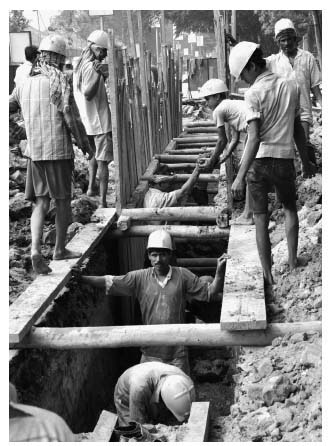
Sewer pipe is laid by workers using an indigenous manual labor process in Kolkata, India, in 2009. Dirty and dangerous work in India is relegated to members of lower castes.
Fifty years after Hughes first wrote on the topic, scholars within the field of management studies have further theorized it to reflect the agency of those doing dirty work. Blake Ashforth and Glen Kreiner posit that dirty work jobs generally fall into categories of physical taint, social taint, and/or moral taint. Their framework addresses how workers manage taint in order to maintain a positive work identity and sense of self.
...
- Digital and Computer Revolution: Reshaping Jobs and Workplaces
- Biotechnology
- Call Centers
- Computer Programmers
- Computer-Mediated Work
- Electronic Surveillance
- Engineers
- Film Industry Workers
- High-Tech and Internet Industry, Employment in
- Innovation
- Management Information Systems
- Management, Scientific
- Media Workers
- Networked Organizations
- Networks
- Occupations, Distribution of
- Open Source Movement
- Polarized Workforce
- Social Media
- Systems Analysts
- Telecommunications Workers
- Telework
- Training and Skill Acquisition
- Employment Relationships
- “Good” Employment Model, Rise and Erosion of
- At-Will Employment
- Boundaryless Careers
- Casual Labor and Informal Economy
- Contingent Work
- Contract Workers
- Contract, Employment (Common Law)
- Contracts
- Disappearing Work
- Employability
- Employee Participation
- Employee Stock Ownership Plans
- Employee Voice
- Employment Relationship
- Entrepreneurship
- Flexible Scheduling
- Franchises
- Freelancing
- Glass Cage
- Headhunters
- Japanese Transplants
- Job Security
- Job Sharing
- Job Tenure
- Labor Market Intermediaries
- Labor Markets, External
- Outsourcing and Subcontracting
- Risk Shift
- Self-Employment
- Seniority
- Teamwork
- Temporary Placement Agencies
- Temporary Work
- Turnover
- Undocumented Workers
- Walmart Employment Template
- Welfare-to-Work
- Everyday Life at Work
- Alienation
- Bureaucracy
- Corporate Closet
- Cubicles
- Deception
- Distractions, Online
- Dress Codes
- Drug Testing
- Dual-Career Couples
- Emotion
- Ethics
- Face Time
- Feeling Rules
- Game Playing
- Gossip
- Health and Safety
- Illness
- Meetings
- Office Artifacts
- Organizational Structure, New Forms of
- Power
- Productivity
- Project Management
- Resistance, Gendered and Racialized
- Social Interactions at Work
- Stress
- Subcultures
- Substance Abuse
- Violence, Workplace
- Work Overload
- Globalization and Cross-National Perspectives on Work
- Brazil
- Canada
- Child Labor
- China
- Factory Work, Globalization of
- France
- Germany
- Human Trafficking
- Immigrant Workers
- Importing Labor
- India
- Indonesia
- International Division of Labor
- Japan
- Labor Markets
- Logistics Revolution
- Market Fundamentalism
- Mexico
- Mothering, Transnational
- Multinational Corporations
- Singapore
- South Africa
- South Korea
- Sweden
- Inequality, Stratification, and Power at Work
- “Big Squeeze”
- “Blacks on the Bubble”
- “Doing Gender”
- Authority Gap
- Benefits
- Bodies
- Boundary Work
- Cognitive Biases
- Comparable Worth
- Control, Workplace
- Crime as Work
- Cultural Capital
- Disabled Workers
- Discouraged Workers
- Discrimination, Employment
- Discrimination: Institutional, Statistical, and Direct
- Displaced Workers
- Disposable Workers
- Diversity Programs
- Downward Mobility
- Education and Work
- Gatekeepers
- Gender Gap
- Gendered Organizations
- Glass Ceiling
- Glass Escalator
- Homophily
- Homosocial Reproduction
- Human Capital
- Human Relations Theory
- Ideal Worker
- Impression Management
- Income Inequality
- Inequality, Policies to Correct
- Invisible Work
- Job Quality
- Job Queues Theory
- Jobs, Marginal
- Labor Force Participation
- Labor Force Participation Rates
- Labor, Devaluation of
- Lesbian, Gay, Bisexual, and Transgender (LGBT) Workers
- Life Course
- Men in Women's Jobs
- Minimum-Wage and Low-Wage Jobs
- Mobility Mechanisms
- Moonlighting
- Occupational Segregation by Gender and Race
- Organizational Wage Inequality
- Poverty
- Precarious Labor
- Revolving Door Theory
- Sex Typing
- Sexual Harassment
- Sexuality
- Social Capital
- Sticky Floor
- Sweatshops
- Tokenism
- Underemployed Workers
- Unemployment
- Whistleblowing
- White-Collar Crime
- White-Collar Sweatshop
- Women in Men's Jobs
- Workforce Development
- Working Poor
- Labor Movement and Other Forms of Collective Action
- Boycotts, Consumer
- Collective Bargaining
- Eight-Hour Day
- Government Regulation of Employment, U.S.
- Human Rights Campaigns
- Immigrants, Organizing
- Labor Law
- Living Wage Campaign
- Moral Underground
- Organized Labor
- Organized Labor, Cross-National Perspective
- Social Responsibility, Corporate
- Social Support Programs
- Strategies, New Organizing
- Strikes and Protests
- Students against Sweatshops
- Union and Community Partnerships
- Union Membership, Benefits of
- Unionism, Public Sector
- Unionism, Social Movement
- Unionized Professionals
- Unions
- Unions, Craft
- Unions, Gender and Race in
- United Students for Fair Trade
- Weekend
- Worker Centers
- Occupations and Professions, Labor Processes, Jobs, and Careers
- “Fun” Workplaces
- Assembly
- Blue-Collar Jobs
- Brown-Collar Jobs
- Care Work
- Career Ladders
- Clerical Work
- Cool Industries
- Craft Work
- Creative Class
- Day Labor
- Dead-End Jobs
- Deskilling and Upgrading
- Direct Sales Work
- Dirty Work
- Domestic Work, Paid
- Emotional Labor
- Entry-Level Work
- Facebook as Labor
- Feminization of Work
- Health Care Professions
- Information Technology Workers
- Job Creation
- Jobs and Careers
- Knowledge Workers
- Labor, Aesthetic
- Managers
- Manufacturing
- Military
- Nonprofits
- Nonstandard Work
- Occupations and Professions
- Part-Time Work
- Pink Collar
- Professional Work
- Professionalization
- Retail Employment
- Semiprofessionals
- Service Work
- Sex Work
- Skilled Work
- Small Business
- Soft Skills
- Supervisors
- Symbolic Analysts
- Tacit Skills
- Teen Employment
- Tipping
- Unskilled Work
- Wall Street Jobs
- White Collar
- Theories of Work and Economy Key Concepts
- “Good” Jobs and “Bad” Jobs
- “McDonaldization”
- “New Economy”
- “Prosumer”
- 24/7 Economy
- Alternative Organizations and Cooperatives
- Bell, Daniel
- Bendix, Reinhard
- Bourdieu, Pierre
- Braverman, Harry
- Burawoy, Michael
- Command Economies
- Dual Labor Markets
- Durkheim, Émile
- Edwards, Richard
- End of Work
- Feminist Theories of Work
- Firms
- Fordism and Post-Fordism
- Foucault, Michel
- Globalization
- Goffman, Erving
- Granovetter, Mark
- Hochschild, Arlie
- Human Resources
- Internal Labor Markets
- Kanter, Rosabeth Moss
- Markets and Economies
- Marx, Karl
- Mergers and Acquisitions
- Neoliberalism
- Personnel Professionals
- Postbureaucratic Organizations
- Postindustrial Society
- Protestant Ethic and Spirit of Capitalism
- Restructuring, Corporate
- Right-to-Work
- Smith, Adam
- Starbucks Employment Model
- Technology
- Weber, Max
- Work Redesign
- Work, Definitional
- Unpaid Work
- Work and Identity, Social Psychology of Work
- “Organization Man”
- Consumption
- Culture, Employment
- Culture, Workplace
- Dignity
- Free Agents
- Gendered Work Identities
- Identity at Work
- Job Satisfaction
- Leisure
- Lifestyle Work
- Loyalty
- Meaning
- Motivation
- Overqualified and Overeducated
- Personality
- Race and Ethnic Groups
- Terkel, Studs
- Values
- Women's and Men's Employment, Temporal Dimensions of
- Work Ethic
- Work, Family, and Personal Life
- “Unfinished Revolution”
- Boundaries between Home and Market, Blurred
- Career Mystique
- Child Care
- Class and Families
- Computer Widows and Orphans
- Elder Care
- Family-Responsive Corporations
- Family-Supportive State and Federal Policies
- Fathers at Home
- Home Production
- Households, Changing Demographic Composition of
- Housework
- Male Model of Career
- Motherhood Penalty and Daddy Bonus
- Mothering, Ideologies of
- Opting Out
- Overwork
- Retirement
- Second Shift
- Stay-at-Home Mothers
- Work Spillover
- Work/Life Balance
- Loading...
Get a 30 day FREE TRIAL
-
 Watch videos from a variety of sources bringing classroom topics to life
 -
Read modern, diverse business cases
-
Explore hundreds of books and reference titles

Read next

More like this
Sage Recommends
We found other relevant content for you on other Sage platforms.
Have you created a personal profile? Login or create a profile so that you can save clips, playlists and searches