
Entry
Reader's guide
Entries A-Z
Subject index
Elementary Theory
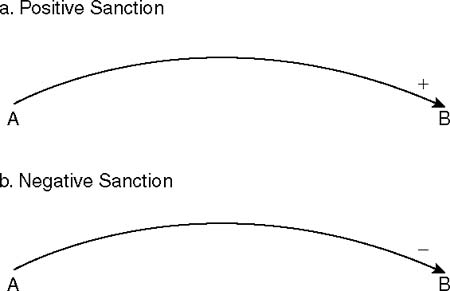
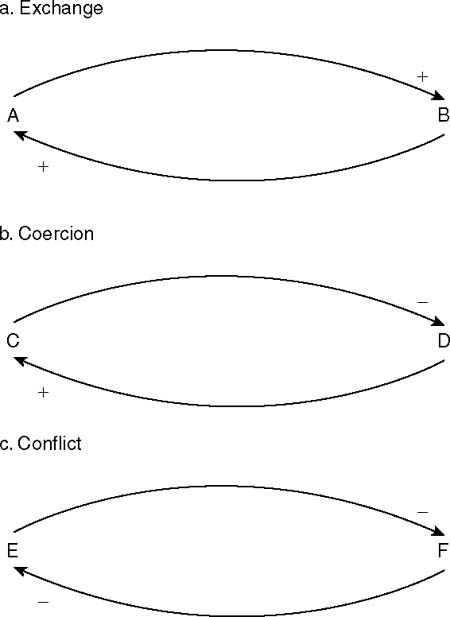
Elementary theory is a theory for human activity in social relations embedded in social structures. The theory takes the following form: Fundamental concepts are introduced by interpreting network points and arcs such as those of Figure 1. Derived concepts are built up, first, from combining fundamental concepts and, later, from combining fundamental concepts and concepts already derived. For example, the Points A and B become social actors as formulations are introduced for preference system, belief system, and decisions. Then the sanction displayed in Figure 1.a is an act that positively affects the preference state of B, the actor receiving it. By contrast, the sanction of Figure 1.b negatively affects the preference state of B. Sanctions may also affect the preference state of the transmitting actor. Moving one step further, as shown in Figure 2, sanctions can be paired to define three basic types of social relationships: exchange, coercion, and conflict.
Figure 1 Types of Sanctions
An orienting perspective associated with this formalism is a view of society common to the classical theories of Marx, Weber, Simmel, and Michels. As a part of that view, analyses begin by assuming that the interests that actors pursue are not carried by actors from one social location to another. Instead, interests are embedded in social relations and reflected in actors while acting in that relation. Interests are valued states that actors seek. For example, when any of the four classical theorists found that masters exploited their slaves and capitalists profited from their workers, they framed their explanations, first, in terms of values and beliefs embedded in master-slave and capitalist-work relations. Nevertheless, classical theorists also understood that at times, values and beliefs acquired at one social location affect actions in another.
Like classical theory, elementary theory builds its simplest explanations by reflecting actors' values and beliefs from relations and structures. For example, in the coercive relationship of Figure 2, C has an interest in gaining D's positive sanction by threat of the negative sanction that D has an interest in avoiding. When sanctions are quantitative, elementary theory seeks to relate the size of positive sanction that D will send to the size of negative that C has as a threat. The interests in seeking large positives and avoiding any negatives are embedded in the relation displayed. Nevertheless, paralleling the classics, when actors carry interests to a relation, elementary theory can be used to build the more complex models needed to accurately predict behavior.
Figure 2 Three Types of Social Relations
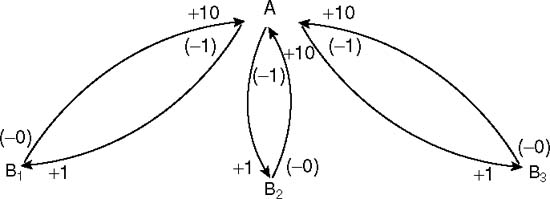
Beyond recognizing that actors' interests are in social relations, classical theory understood that the conditions under which interests are pursued are given by the social structures in which relations are embedded. Sharing that understanding but using concepts as simple and few in number as possible, elementary theory builds models for social relations in social structures as shown in Figure 3. Then, modeled structures are made dynamic so that they can be compared with corresponding social structures in the world for explanation, prediction, and theory testing.
Figure 3 A Branch Connected at A
...
- Topics and Concepts in Social Theory
- Affect Control Theory
- AGIL
- Alienation
- Anomie
- Authority
- Body
- Bureaucracy
- Capital
- Capitalism
- Celebrity
- Citizenship
- Civil Society
- Civility
- Civilizing Processes
- Collective Conscience
- Collective Memory
- Commitment
- Compulsory Heterosexuality
- Consumer Culture
- Crime
- Cultural Capital
- Culture and Civilization
- Deconstruction
- Democracy
- Deviance
- Dialectic
- Discourse
- Disneyization
- Distributive Justice
- Dramaturgy
- Emergence
- Emotion Work
- Enchantment/Disenchantment
- Essentialism
- Exchange Coalitions
- Exchange Networks
- Exploitation
- Family Wage
- Feminism
- Feminist Epistemology
- Feminist Ethics
- Film
- Fordism and Post-Fordism
- Frame Analysis
- Gender
- Genealogy
- Generalized Exchange
- Globalization
- Governmentality
- Graph Theoretic Measures of Power
- Green Movements
- Habitus
- Herrschaft (Rule)
- Hollywood Film
- Holocaust
- Hyperreality
- Ideal Type
- Identity
- Imperialism
- Impression Management
- Individualism
- Industrial Society
- Internet and Cyberculture
- Intimacy
- Lesbian Continuum
- Levels of Social Structure
- Lifeworld
- Logocentrism
- Madness
- Male Gaze
- Maternal Thinking
- Matrix of Domination
- McDonaldization
- Means of Consumption
- Means of Production
- Metatheory
- Modernity
- Morality and Aesthetic Judgement
- Nationalism
- Negotiated Order
- Outsider-Within
- Paradigm
- Patriarchy
- Political Economy
- Popular Music
- Pornography and Cultural Studies
- Postcolonialism
- Postmodernism
- Postsocial
- Power
- Power-Dependence Relations
- Procedural Justice
- Professions
- Public Sphere
- Rationalization
- Reform
- Relational Cohesion
- Religion
- Religion in French Social Theory
- Revolution
- Risk Society
- Sacred and Profane
- Scottish Enlightenment
- Secularization
- Self and Self-Concept
- Sexuality and the Subject
- Simulation
- Simulations
- Social Capital
- Social Class
- Social Dilemma
- Social Facts
- Social Interaction
- Social Market Economy (Soziale Markwirtschaft)
- Social Movement Theory
- Social Rationality
- Social Space
- Social Studies of Science
- Social Worlds
- Socialism
- Sport
- State
- Statics and Dynamics
- Status Relations
- Stratification
- Strength of Weak Ties
- Structuration
- Surveillance and Society
- Television and Social Theory
- Time and Social Theory
- Total Institutions
- Trust
- Urbanization
- Utopia
- Verstehen
- Video and Computer Games
- Vocabularies of Motives
- Theorists
- Žižek, Slavoj
- Alexander, Jeffrey
- Althusser, Louis
- Anzaldua, Gloria
- Augé, Marc
- Bartky, Sandra Lee
- Bataille, Georges
- Baudrillard, Jean
- Bauman, Zygmunt
- Beauvoir, Simone de
- Beck, Ulrich
- Becker, Howard
- Bell, Daniel
- Bellah, Robert
- Benjamin, Jessica
- Benjamin, Walter
- Berger, Joseph
- Blau, Peter
- Blumberg, Rae
- Blumer, Herbert
- Bonald, Louis de
- Bourdieu, Pierre
- Butler, Judith
- Cassirer, Ernst
- Castoriadis, Cornelius
- Certeau, Michel de
- Chafetz, Janet
- Chodorow, Nancy
- Coleman, James
- Collins, Patricia Hill
- Collins, Randall
- Comte, Auguste
- Cook, Karen
- Cooley, Charles Horton
- Coser, Lewis
- Dahrendorf, Ralf
- Davis, Angela
- Debord, Guy
- Deleuze, Gilles
- Derrida, Jacques
- Dilthey, Wilhelm
- Du Bois, William Edward Burghardt (W. E. B)
- Durkheim, Émile
- Eisenstadt, Shmuel N.
- Elias, Norbert
- Emerson, Richard
- Foucault, Michel
- Freud, Sigmund
- Garfinkel, Harold
- Giddens, Anthony
- Gilligan, Carol
- Gilman, Charlotte Perkins
- Goffman, Erving
- Goldstone, Jack
- Gouldner, Alvin
- Gramsci, Antonio
- Habermas, Jürgen
- Hall, Stuart
- Harding, Sandra
- Hartsock, Nancy
- Hawley, Amos
- Heller, Agnes
- Homans, George
- Hughes, Everett
- Irigaray, Luce
- Jameson, Frederic
- Kristeva, Julia
- Lévi-Strauss, Claude
- Lacan, Jacques
- Latour, Bruno
- Lawler, Edward
- Lefebvre, Henri
- Lindenberg, Siegwart
- Lorde, Audre
- Luhmann, Niklas
- Lukács, György
- Maistre, Joseph de
- Mann, Michael
- Mannheim, Karl
- Markovsky, Barry
- Marx, Karl
- Mead, George Herbert
- Merton, Robert
- Mills, C. Wright
- Minnich, Elizabeth
- Molm, Linda
- Montesquieu, Charles Louis de Secondat
- Pareto, Vilfredo
- Park, Robert
- Parsons, Talcott
- Rieff, Philip
- Ritzer, George
- Rorty, Richard
- Rousseau, Jean-Jacques
- Rubin, Gayle
- Ruddick, Sara
- Sartre, Jean-Paul
- Saussure, Ferdinand de
- Schütz, Alfred
- Scheler, Max
- Simmel, Georg
- Smelser, Neil
- Smith, Dorothy
- Sombart, Werner
- Sorokin, Pitirim A.
- Spencer, Herbert
- Strauss, Anselm
- Sumner, William Graham
- Tönnies, Ferdinand
- Taylor, Charles
- Thomas, William Isaac
- Tilly, Charles
- Tocqueville, Alexis de
- Touraine, Alain
- Turner, Bryan
- Turner, Jonathan
- Veblen, Thorstein
- Virilio, Paul
- Wallerstein, Immanuel
- Weber, Marianne
- Weber, Max
- White, Harrison
- Willer, David
- Wright, Erik Olin
- Wuthnow, Robert
- Znaniecki, Florian Witold
- Schools and Theoretical Approaches
- Annales School
- Actor Network Theory
- Behaviorism
- Cognitive Sociology
- Collège de Sociologie and Acéphale
- Complexity Theory
- Conflict Theory
- Conversation Analysis
- Cosmopolitan Sociology
- Critical Pedagogy
- Cultural Marxism and British Cultural Studies
- Cultural Studies and the New Populism
- Ecofeminism
- Ecological Theory
- Elementary Theory
- Ethnomethodology
- Evolutionary Theory
- Feminism
- Feminist Cultural Studies
- Figurational Sociology
- Frankfurt School
- Game Theory
- General Systems Theory
- German Idealism
- Hermeneutics
- Historical and Comparative Theory
- Historical Materialism
- Historicism
- Institutional Theory
- Labeling Theory
- Learning Theory
- Liberal Feminism
- Marxism
- Media Critique
- Neo-Kantianism
- Network Exchange Theory
- Network Theory
- Phenomenology
- Philosophical Anthropology
- Political Economy
- Positivism
- Post-Marxism
- Postmodernism
- Postsocial
- Poststructuralism
- Pragmatism
- Psychoanalysis and Social Theory
- Queer Theory
- Radical Feminism
- Rational Choice
- Rhetorical Turn in Social Theory
- Role Theory
- Scottish Enlightenment
- Semiology
- Situationists
- Social Constructionism
- Social Darwinism
- Social Exchange Theory
- Social Studies of Science
- Sociologies of Everyday Life
- Standpoint Theory
- Structural Functionalism
- Structuralism
- Structuralist Marxism
- Structuration
- Symbolic Interaction
- World-Systems Theory
- Cultural Theory
- Žižek, Slavoj
- Althusser, Louis
- Bellah, Robert
- Benjamin, Walter
- Bourdieu, Pierre
- Butler, Judith
- Celebrity
- Civility
- Civilizing Processes
- Collective Memory
- Consumer Culture
- Critical Pedagogy
- Cultural Capital
- Cultural Marxism and British Cultural Studies
- Cultural Studies and the New Populism
- Culture and Civilization
- Debord, Guy
- Deleuze, Gilles
- Derrida, Jacques
- Dilthey, Wilhelm
- Discourse
- Disneyization
- Eisenstadt, Shmuel N.
- Elias, Norbert
- Feminist Cultural Studies
- Film
- Frankfurt School
- Genealogy
- Gramsci, Antonio
- Hall, Stuart
- Hermeneutics
- Hollywood Film
- Hyperreality
- Individualism
- Internet and Cyberculture
- Jameson, Frederic
- Latour, Bruno
- Lukács, György
- McDonaldization
- Means of Consumption
- Media Critique
- Morality and Aesthetic Judgement
- Popular Music
- Pornography and Cultural Studies
- Postcolonialism
- Postmodernism
- Postsocial
- Risk Society
- Semiology
- Sexuality and the Subject
- Simulation
- Situationists
- Social Studies of Science
- Sport
- Television and Social Theory
- Turner, Bryan
- Utopia
- Video and Computer Games
- Virilio, Paul
- Wuthnow, Robert
- Marxist and Neo-Marxist Theory
- Žižek, Slavoj
- Alienation
- Althusser, Louis
- Bartky, Sandra Lee
- Benjamin, Walter
- Bourdieu, Pierre
- Capital
- Capitalism
- Castoriadis, Cornelius
- Cultural Marxism and British Cultural Studies
- Davis, Angela
- Dialectic
- Exploitation
- Frankfurt School
- Gramsci, Antonio
- Heller, Agnes
- Historical Materialism
- Imperialism
- Jameson, Frederic
- Lefebvre, Henri
- Lukács, György
- Marx, Karl
- Marxism
- Means of Consumption
- Means of Production
- Mills, C. Wright
- Political Economy
- Post-Marxism
- Reform
- Revolution
- Social Class
- Socialism
- Structuralist Marxism
- World-Systems Theory
- Wright, Erik Olin
- Feminist Theory
- Anzaldua, Gloria
- Bartky, Sandra Lee
- Beauvoir, Simone de
- Benjamin, Jessica
- Blumberg, Rae
- Body
- Butler, Judith
- Chafetz, Janet
- Chodorow, Nancy
- Collins, Patricia Hill
- Compulsory Heterosexuality
- Davis, Angela
- Ecofeminism
- Essentialism
- Family Wage
- Feminism
- Feminist Cultural Studies
- Feminist Epistemology
- Feminist Ethics
- Gender
- Gilligan, Carol
- Gilman, Charlotte Perkins
- Harding, Sandra
- Hartsock, Nancy
- Irigaray, Luce
- Kristeva, Julia
- Lesbian Continuum
- Liberal Feminism
- Lorde, Audre
- Male Gaze
- Maternal Thinking
- Matrix of Domination
- Minnich, Elizabeth
- Outsider-Within
- Patriarchy
- Postmodernist Feminism
- Queer Theory
- Radical Feminism
- Rubin, Gayle
- Ruddick, Sara
- Sexuality and the Subject
- Smith, Dorothy
- Standpoint Theory
- Weber, Marianne
- French Social Theory
- Annales School
- Althusser, Louis
- Anomie
- Augé, Marc
- Bataille, Georges
- Baudrillard, Jean
- Beauvoir, Simone de
- Bonald, Louis de
- Bourdieu, Pierre
- Certeau, Michel de
- Collège de Sociologie and Acéphale
- Collective Conscience
- Comte, Auguste
- Debord, Guy
- Deconstruction
- Deleuze, Gilles
- Derrida, Jacques
- Discourse
- Durkheim, Émile
- Foucault, Michel
- Genealogy
- Governmentality
- Habitus
- Hyperreality
- Irigaray, Luce
- Kristeva, Julia
- Lévi-Strauss, Claude
- Lacan, Jacques
- Latour, Bruno
- Lefebvre, Henri
- Logocentrism
- Maistre, Joseph de
- Montesquieu, Charles Louis de Secondat
- Poststructuralism
- Religion in French Social theory
- Rousseau, Jean-Jacques
- Sacred and Profane
- Sartre, Jean-Paul
- Saussure, Ferdinand de
- Semiology
- Situationists
- Social Facts
- Statics and Dynamics
- Structuralism
- Structuralist Marxism
- Tocqueville, Alexis de
- Touraine, Alain
- Virilio, Paul
- German Social Theory
- Authority
- Beck, Ulrich
- Benjamin, Walter
- Cassirer, Ernst
- Cosmopolitan Sociology
- Culture and Civilization
- Dahrendorf, Ralf
- Dilthey, Wilhelm
- Frankfurt School
- German Idealism
- Green Movements
- Habermas, Jürgen
- Hermeneutics
- Herrschaft (Rule)
- Historicism
- Holocaust
- Ideal Type
- Lifeworld
- Luhmann, Niklas
- Marx, Karl
- Neo-Kantianism
- Phenomenology
- Philosophical Anthropology
- Positivismusstreit (Positivist Dispute)
- Risk Society
- Scheler, Max
- Simmel, Georg
- Social Action
- Social Market Economy (Soziale Markwirtscaft)
- Sombart, Werner
- Tönnies, Ferdinand
- Verstehen
- Weber, Marianne
- Weber, Max
- Werturteilsstreit (Value Judgment Dispute)
- British Social Theory
- American Social Theory
- AGIL
- Alexander, Jeffrey
- Anzaldua, Gloria
- Bartky, Sandra Lee
- Becker, Howard
- Behaviorism
- Bell, Daniel
- Bellah, Robert
- Benjamin, Jessica
- Berger, Joseph
- Blau, Peter
- Blumer, Herbert
- Butler, Judith
- Chafetz, Janet
- Chodorow, Nancy
- Coleman, James
- Collins, Patricia Hill
- Collins, Randall
- Conversation Analysis
- Cook, Karen
- Cooley, Charles Horton
- Coser, Lewis
- Davis, Angela
- Dramaturgy
- Du Bois, William Edward Burghardt (W. E. B)
- Emerson, Richard
- Ethnomethodology
- Fordism and Post-Fordism
- Frame Analysis
- Garfinkel, Harold
- Gilligan, Carol
- Gilman, Charlotte Perkins
- Goffman, Erving
- Goldstone, Jack
- Gouldner, Alvin
- Harding, Sandra
- Hartsock, Nancy
- Hawley, Amos
- Hollywood Film
- Homans, George
- Hughes, Everett
- Jameson, Frederic
- Labeling Theory
- Lawler, Edward
- Learning Theory
- Liberal Feminism
- Lorde, Audre
- Markovsky, Barry
- McDonaldization
- Mead, George Herbert
- Merton, Robert
- Minnich, Elizabeth
- Molm, Linda
- Park, Robert
- Parsons, Talcott
- Pragmatism
- Rieff, Philip
- Ritzer, George
- Rorty, Richard
- Rubin, Gayle
- Ruddick, Sara
- Smelser, Neil
- Strauss, Anselm
- Structural Functionalism
- Sumner, William Graham
- Symbolic Interaction
- Thomas, William Isaac
- Tilly, Charles
- Turner, Jonathan
- Veblen, Thorstein
- Wallerstein, Immanuel
- White, Harrison
- Willer, David
- Wright, Erik Olin
- Wuthnow, Robert
- Other/Multiple National Traditions
- Micro-Interactionist Theory
- Becker, Howard
- Blumer, Herbert
- Cognitive Sociology
- Collective Memory
- Conversation Analysis
- Cooley, Charles Horton
- Crime
- Deviance
- Dramaturgy
- Emotion Work
- Ethnomethodology
- Frame Analysis
- Garfinkel, Harold
- Goffman, Erving
- Hughes, Everett
- Identity
- Impression Management
- Lifeworld
- Mead, George Herbert
- Negotiated Order
- Phenomenology
- Pragmatism
- Rieff, Philip
- Role Theory
- Sartre, Jean-Paul
- Schütz, Alfred
- Self and Self-Concept
- Simmel, Georg
- Smith, Dorothy
- Social Constructionism
- Social Interaction
- Social Studies of Science
- Social Worlds
- Sociologies of Everyday Life
- Strauss, Anselm
- Symbolic Interaction
- Total Institutions
- Verstehen
- Znaniecki, Florian Witold
- Microbehaviorist Theory
- Affect Control Theory
- Behaviorism
- Berger, Joseph
- Blau, Peter
- Coleman, James
- Commitment
- Cook, Karen
- Distributive Justice
- Elementary Theory
- Emerson, Richard
- Exchange Coalitions
- Exchange Networks
- Game Theory
- Generalized Exchange
- Graph Theoretic Measures of Power
- Homans, George
- Lawler, Edward
- Lindenberg, Siegwart
- Markovsky, Barry
- Molm, Linda
- Network Exchange Theory
- Network Theory
- Power-Dependence Relations
- Procedural Justice
- Rational Choice
- Relational Cohesion
- Simulations
- Social Dilemma
- Social Exchange Theory
- Social Rationality
- Status Relations
- Strength of Weak Ties
- Trust
- Willer, David
- Macrosociological Theories
- Annales School
- AGIL
- Alexander, Jeffrey
- Bell, Daniel
- Bellah, Robert
- Blumberg, Rae
- Capital
- Capitalism
- Chafetz, Janet
- Collective Conscience
- Collins, Randall
- Conflict Theory
- Coser, Lewis
- Culture and Civilization
- Dahrendorf, Ralf
- Disneyization
- Du Bois, William Edward Burghardt (W. E. B)
- Durkheim, Émile
- Ecological Theory
- Eisenstadt, Shmuel N.
- Enchantment/Disenchantment
- Evolutionary Theory
- Fordism and Post-Fordism
- General Systems Theory
- Giddens, Anthony
- Globalization
- Goldstone, Jack
- Gouldner, Alvin
- Hawley, Amos
- Heller, Agnes
- Historical and Comparative Theory
- Historical Materialism
- Ideal Type
- Imperialism
- Industrial Society
- Institutional Theory
- Luhmann, Niklas
- Mann, Michael
- Marx, Karl
- Marxism
- McDonaldization
- Merton, Robert
- Mills, C. Wright
- Modernity
- Nationalism
- Park, Robert
- Parsons, Talcott
- Rationalization
- Revolution
- Risk Society
- Ritzer, George
- Secularization
- Smelser, Neil
- Social Class
- Social Darwinism
- Social Facts
- Social Market Economy
- Social Movement Theory
- Sorokin, Pitirim
- Spencer, Herbert
- State
- Statics and Dynamics
- Structural Functionalism
- Sumner, William Graham
- Tönnies, Ferdinand
- Tilly, Charles
- Turner, Jonathan
- Urbanization
- Wallerstein, Immanuel
- Weber, Max
- White, Harrison
- World-Systems Theory
- Wright, Erik Olin
- Wuthnow, Robert
- Comparative and Historical Theory
- Civilizing Processes
- Elias, Norbert
- Giddens, Anthony
- Globalization
- Goldstone, Jack
- Historical and Comparative Theory
- Ideal Type
- Industrial Society
- Institutional Theory
- Mann, Michael
- Nationalism
- Revolution
- Smelser, Neil
- Social Movement Theory
- Sorokin, Pitirim
- State
- Tilly, Charles
- Tocqueville, Alexis de
- Wallerstein, Immanuel
- Weber, Max
- World-Systems Theory
- Psychoanalytic Theory
- Postmodern Theory
- Žižek, Slavoj
- Body
- Butler, Judith
- Deconstruction
- Deleuze, Gilles
- Derrida, Jacques
- Discourse
- Essentialism
- Foucault, Michel
- Genealogy
- Governmentality
- Hyperreality
- Jameson, Frederic
- Lacan, Jacques
- Logocentrism
- Post-Marxism
- Postcolonialism
- Postsocial
- Poststructuralism
- Rorty, Richard
- Simulation
- Situationists
- Social Constructionism
- Virilio, Paul
- Politics and Government
- Alexander, Jeffrey
- Authority
- Bonald, Louis de
- Castoriadis, Cornelius
- Citizenship
- Civil Society
- Cosmopolitan Sociology
- Cultural Marxism and British Cultural Studies
- Cultural Studies and the New Populism
- Democracy
- Distributive Justice
- Governmentality
- Gramsci, Antonio
- Green Movements
- Habermas, Jürgen
- Herrschaft (Rule)
- Historical and Comparative Theory
- Identity Politics
- Imperialism
- Maistre, Joseph de
- Marxism
- Montesquieu, Charles Louis de Secondat
- Nationalism
- Political Economy
- Post-Marxism
- Power
- Procedural Justice
- Public Sphere
- Reform
- Revolution
- Rousseau, Jean-Jacques
- Scottish Enlightenment
- Socialism
- State
- Taylor, Charles
- Tilly, Charles
- Tocqueville, Alexis de
- Touraine, Alain
- Utopia
- Method and Metatheory
- Agency-Structure Integration
- Collins, Randall
- Dilthey, Wilhelm
- Essentialism
- Feminist Epistemology
- Genealogy
- German Idealism
- Hermeneutics
- Historicism
- Levels of Social Structure
- Metatheory
- Micro-Macro Integration
- Paradigm
- Positivism
- Positivismusstreit (Positivist Dispute)
- Postmodernism
- Rhetorical Turn in Social Theory
- Ritzer, George
- Rorty, Richard
- Structuration
- Taylor, Charles
- Theory Construction
- Turner, Jonathan
- Verstehen
- Werturteilsstreit (Value Judgment Dispute)
- Economic Sociology
- Capital
- Capitalism
- Consumer Culture
- Exploitation
- Family Wage
- Fordism and Post-Fordism
- Game Theory
- Historical Materialism
- Imperialism
- Industrial Society
- Marx, Karl
- Marxism
- Means of Consumption
- Means of Production
- Pareto, Vilfredo
- Political Economy
- Post-Marxism
- Rational Choice
- Reform
- Scottish Enlightenment
- Social Class
- Social Market Economy
- Socialism
- Sombart, Werner
- Stratification
- Veblen, Thorstein
- Wallerstein, Immanuel
- Weber, Max
- World-Systems Theory
- Wright, Erik Olin
- Loading...
Get a 30 day FREE TRIAL
-
 Watch videos from a variety of sources bringing classroom topics to life
 -
Read modern, diverse business cases
-
Explore hundreds of books and reference titles

Read next

More like this
Sage Recommends
We found other relevant content for you on other Sage platforms.
Have you created a personal profile? Login or create a profile so that you can save clips, playlists and searches