
Entry
Reader's guide
Entries A-Z
Subject index
Latent Profile Model
The latent profile model is a LATENT VARIABLE model with a categorical latent variable and continuous manifest indicators. It was introduced in 1968 by Lazarsfeld and Henry. Although under different names, very similar models were proposed in the same period by Day (1969) and Wolfe (1970).
Over the past 10 years, there has been renewed interest in this type of latent variable model, especially as a tool for CLUSTER ANALYSIS. The latent profile model can be seen as a probabilistic or model-based variant of traditional nonhierarchical cluster analysis procedures such as the K-means method. It has been shown that such a model-based clustering procedure outperforms the more ad hoc traditional methods. It should be noted that only a few authors use the term latent profile model. More common names are mixture of normal components, mixture model clustering, model-based clustering, latent discriminant analysis, and latent class clustering.
Possible social science applications of the latent profile model include building typologies and constructing diagnostic instruments. A sociologist might use it to build a typology of countries based on a set of socioeconomic and political indicators. A psychologist may apply the method to combine various test scores into a single diagnostic instrument.
As in LATENT CLASS ANALYSIS, latent profile analysis assumes that the population consists of C unobserved subgroups that can be referred to as latent profiles, latent classes, or mixture components. Because the indicators are continuous variables, it is most natural to assume that their conditional distribution is normal. The most general model is obtained with unrestricted multivariate normal distributions; that is,
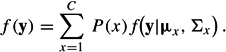
The equation states that the joint density of the L indicators, f(y), is a mixture of class-specific densities. Each latent class x has its own mean vector μx and covariance matrix Σx. The proportion of persons in each of the components is denoted by P(x). It should be noted that the model structures resembles quadratic discriminant analysis, with the important difference, of course, that the classes (groups) are unknown.
Several special cases are obtained by restricting the covariance matrix x. Common restrictions are equal covariance matrices across classes, diagonal covariance matrices, and both equal and diagonal covariance matrices. The assumption of equal covariance matrices is similar to the basic assumption of linear discriminant analysis. Specifying the covariance matrices to be diagonal amounts to assuming local independence. Such a model can also be formulated as follows:

Assuming local independence and equal error variances, σ2lx=σ2l, yields a specification similar to K-means clustering. In most applications, however, this local independence specification is much too restrictive.
Recently, various methods have been proposed for structuring the class-specific covariance matrices. A relatively simple one, which is a compromise between a full and a diagonal covariance matrix, is the use of block-diagonal matrices. This amounts to relaxing the local independence assumption for subsets of indicators. More sophisticated methods make use of principal component and factor analysis decompositions of the covariance matrix, as well as structural equation model-type restrictions on theΣ x.
Another recent development is a model for combinations of continuous and categorical indicators. This is actually a combination of the classical latent class model with the latent profile model. Another recent extension is the inclusion of covariates to predict class membership.
...
- Analysis of Variance
- Association and Correlation
- Association
- Association Model
- Asymmetric Measures
- Biserial Correlation
- Canonical Correlation Analysis
- Correlation
- Correspondence Analysis
- Intraclass Correlation
- Multiple Correlation
- Part Correlation
- Partial Correlation
- Pearson's Correlation Coefficient
- Semipartial Correlation
- Simple Correlation (Regression)
- Spearman Correlation Coefficient
- Strength of Association
- Symmetric Measures
- Basic Qualitative Research
- Basic Statistics
- F Ratio
- N(n)
- t-Test
- X¯
- Y Variable
- z-Test
- Alternative Hypothesis
- Average
- Bar Graph
- Bell-Shaped Curve
- Bimodal
- Case
- Causal Modeling
- Cell
- Covariance
- Cumulative Frequency Polygon
- Data
- Dependent Variable
- Dispersion
- Exploratory Data Analysis
- Frequency Distribution
- Histogram
- Hypothesis
- Independent Variable
- Measures of Central Tendency
- Median
- Null Hypothesis
- Pie Chart
- Regression
- Standard Deviation
- Statistic
- Causal Modeling
- Discourse/Conversation Analysis
- Econometrics
- Epistemology
- Ethnography
- Evaluation
- Event History Analysis
- Experimental Design
- Factor Analysis and Related Techniques
- Feminist Methodology
- Generalized Linear Models
- Historical/Comparative
- Interviewing in Qualitative Research
- Latent Variable Model
- Life History/Biography
- Log-Linear Models (Categorical Dependent Variables)
- Longitudinal Analysis
- Mathematics and Formal Models
- Measurement Level
- Measurement Testing and Classification
- Multilevel Analysis
- Multiple Regression
- Qualitative Data Analysis
- Sampling in Qualitative Research
- Sampling in Surveys
- Scaling
- Significance Testing
- Simple Regression
- Survey Design
- Time Series
- ARIMA
- Box-Jenkins Modeling
- Cointegration
- Detrending
- Durbin-Watson Statistic
- Error Correction Models
- Forecasting
- Granger Causality
- Interrupted Time-Series Design
- Intervention Analysis
- Lag Structure
- Moving Average
- Periodicity
- Serial Correlation
- Spectral Analysis
- Time-Series Cross-Section (TSCS) Models
- Time-Series Data (Analysis/Design)
- Trend Analysis
- Loading...
Get a 30 day FREE TRIAL
-
 Watch videos from a variety of sources bringing classroom topics to life
 -
Read modern, diverse business cases
-
Explore hundreds of books and reference titles

Read next

More like this
Sage Recommends
We found other relevant content for you on other Sage platforms.
Have you created a personal profile? Login or create a profile so that you can save clips, playlists and searches