
Entry
Reader's guide
Entries A-Z
Subject index
Bell-Shaped Curve
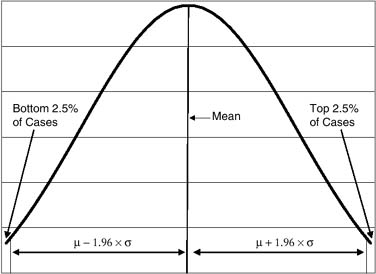
The bell-shaped curve is the term used to describe the shape of a normal distribution when it is plotted with the x-axis showing the different values in the distribution and the y-axis showing the frequency of their occurrence. The bell-shaped curve is a symmetric distribution such that the highest frequencies cluster around the midpoint of the distribution with a gradual tailing off toward 0 at an equal rate on either side in the frequency of values as they move away from the center of the distribution. In effect, it resembles a church bell, hence the name. Figure 1 illustrates such a bell-shaped curve. As can be seen from the symmetry and shape of the curve, all three MEASURES OF CENTRAL TENDENCY—the mean, the mode, and the median—coincide at the highest point of the curve.
The bell-shaped curve is described by its mean, μ, and its STANDARD DEVIATION, σ. Each bell-shaped curve with a particular μ and σ will represent a unique distribution. As the frequency of distributions is greater toward the middle of the curve and around the mean, the probability that any single observation from a bell-shaped distribution will fall near to the mean is much greater than that it will fall in one of the tails. As a result, we know, from normal probabilities, that in the bell-shaped curve, 68% of values will fall within 1 standard deviation of the mean, 95% will fall within roughly 2 standard deviations of the mean, and nearly all will fall within 3 standard deviations of the mean. The remaining observations will be shared between the two tails of the distribution. This is illustrated in Figure 1, where we can see that 2.5% of cases fall into the tails beyond the range represented by μ ± 1.96 × σ. This gives us the probability that in an approximately bell-shaped sampling distribution, any case will fall with 95% probability within this range, and thus, by statistical extrapolation, the population parameter can be predicted as falling within such a range with 95% confidence. (See also CENTRAL LIMIT THEOREM, NORMAL DISTRIBUTION.)
Figure 1 Example of a Bell-Shaped Curve
A particular form of the bell-shaped curve has its mean at 0 and a standard deviation of 1. This is known as the standard normal distribution, and for such a distribution the distribution probabilities represented by the equation μ ± z*σ simplify to the value of the multiple of σ (or Z-score) itself. Thus, for a standard normal distribution, the 95% probabilities lie within the range ±1.96.
Bell-shaped distributions, then, clearly have particular qualities deriving from their symmetry, such that it is possible to make statistical inferences for any distributions that approximate this shape. By extrapolation, they also form the basis of statistical inference even when distributions are not bell-shaped. In addition, distributions that are not bell-shaped can often be transformed to create an approximately bell-shaped curve. Thus, for example, income distributions, which show a skew to the right, can be transformed into an approximately symmetrical distribution by taking the log of the values. Conversely, distributions with a skew to the left, such as examination scores or life expectancy, can be transformed to approximate a bell shape by squaring or cubing the values.
...
- Analysis of Variance
- Association and Correlation
- Association
- Association Model
- Asymmetric Measures
- Biserial Correlation
- Canonical Correlation Analysis
- Correlation
- Correspondence Analysis
- Intraclass Correlation
- Multiple Correlation
- Part Correlation
- Partial Correlation
- Pearson's Correlation Coefficient
- Semipartial Correlation
- Simple Correlation (Regression)
- Spearman Correlation Coefficient
- Strength of Association
- Symmetric Measures
- Basic Qualitative Research
- Basic Statistics
- F Ratio
- N(n)
- t-Test
- X¯
- Y Variable
- z-Test
- Alternative Hypothesis
- Average
- Bar Graph
- Bell-Shaped Curve
- Bimodal
- Case
- Causal Modeling
- Cell
- Covariance
- Cumulative Frequency Polygon
- Data
- Dependent Variable
- Dispersion
- Exploratory Data Analysis
- Frequency Distribution
- Histogram
- Hypothesis
- Independent Variable
- Measures of Central Tendency
- Median
- Null Hypothesis
- Pie Chart
- Regression
- Standard Deviation
- Statistic
- Causal Modeling
- Discourse/Conversation Analysis
- Econometrics
- Epistemology
- Ethnography
- Evaluation
- Event History Analysis
- Experimental Design
- Factor Analysis and Related Techniques
- Feminist Methodology
- Generalized Linear Models
- Historical/Comparative
- Interviewing in Qualitative Research
- Latent Variable Model
- Life History/Biography
- Log-Linear Models (Categorical Dependent Variables)
- Longitudinal Analysis
- Mathematics and Formal Models
- Measurement Level
- Measurement Testing and Classification
- Multilevel Analysis
- Multiple Regression
- Qualitative Data Analysis
- Sampling in Qualitative Research
- Sampling in Surveys
- Scaling
- Significance Testing
- Simple Regression
- Survey Design
- Time Series
- ARIMA
- Box-Jenkins Modeling
- Cointegration
- Detrending
- Durbin-Watson Statistic
- Error Correction Models
- Forecasting
- Granger Causality
- Interrupted Time-Series Design
- Intervention Analysis
- Lag Structure
- Moving Average
- Periodicity
- Serial Correlation
- Spectral Analysis
- Time-Series Cross-Section (TSCS) Models
- Time-Series Data (Analysis/Design)
- Trend Analysis
- Loading...
Get a 30 day FREE TRIAL
-
 Watch videos from a variety of sources bringing classroom topics to life
 -
Read modern, diverse business cases
-
Explore hundreds of books and reference titles

Read next

More like this
Sage Recommends
We found other relevant content for you on other Sage platforms.
Have you created a personal profile? Login or create a profile so that you can save clips, playlists and searches