
Entry
Reader's guide
Entries A-Z
Subject index
Equity Theory
Definition
Equity theory posits that when it comes to relationships, two concerns stand out: (1) How rewarding are their societal, family, and work relationships? (2) How fair and equitable are those relationships? According to equity theory, people feel most comfortable when they are getting exactly what they deserve from their relationships—no more and certainly no less.
Equity theory consists of four propositions:
Proposition I. Men and women are “wired up” to try to maximize pleasure and minimize pain.
Proposition II. Society, however, has a vested interest in persuading people to behave fairly and equitably. Groups will generally reward members who treat others equitably and punish those who treat others inequitably.
Proposition III. Given societal pressures, people are most comfortable when they perceive that they are getting roughly what they deserve from life and love. If people feel overbenefited, they may experience pity, guilt, and shame; if underbenefited, they may experience anger, sadness, and resentment.
Proposition IV. People in inequitable relationships will attempt to reduce their distress via a variety of techniques: by restoring psychological equity, actual equity, or leaving the relationship.
Context and Importance
People everywhere are concerned with justice. “What's fair is fair!” “She deserves better.” “It's just not right.” “He can't get away with that: It's illegal.” “It's unethical!” “It's immoral.” Yet, historically, societies have had very different visions as to what constitutes social justice and fairness. Some dominant views include the following:
- All men are created equal.
- The more you invest in a project, the more profit you deserve to reap (American capitalism).
- Each according to his need (Communism).
- Winner take all (dog-eat-dog capitalism).
Figure 1 The Impact of Equity on Contentment With the Relationship
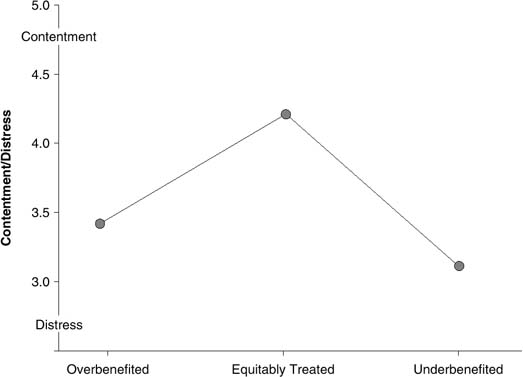
Nonetheless, in all societies, fairness and justice are deemed important. This entry will consider the consequences for men and women when they feel fairly or unfairly treated. Although equity has been found to be important in a wide variety of relationships—societal relationships, romantic and family relationships, helping relationships, exploitative relationships, and work relationships—this entry will focus on the research in one area: romantic and marital relationships.
Measuring Equity
Although (technically) equity is defined by a complex formula, in practice, in love relationships, equity has been assessed by a simple measure:
Considering what you put into your (dating relationship) (marriage), compared to what you get out of it… and what your partner puts in compared to what he or she gets out of it, how does your (dating relationship) (marriage) “stack up”?
- +3: I am getting a much better deal than my partner.
- +2: I am getting a somewhat better deal.
- +1: I am getting a slightly better deal.
- 0: We are both getting an equally good, or bad, deal.
- –1: My partner is getting a slightly better deal.
- –2: My partner is getting a somewhat better deal.
- –3: My partner is getting a much better deal than I am.
On the basis of their answers, persons can be classified as overbenefited (receiving more than they deserve), equitably treated, or underbenefited (receiving less than they deserve).
Equity in Love Relationships: The Research
There is considerable evidence that in love relationships, equity matters. Specifically, researchers find that the more socially desirable people are (the more attractive, personable, famous, rich, or considerate they are), the more socially desirable they will expect a mate to be. Also, dating couples are more likely to fall in love if they perceive their relationships to be equitable. Couples are likely to end up with someone fairly close to themselves in social desirability. They are also likely to be matched on the basis of selfesteem, looks, intelligence, education, mental and physical health (or disability). In addition, couples who perceive their relationships to be equitable are more likely to get involved sexually. For example, couples were asked how intimate their relationships were—whether they involved necking, petting, genital play, intercourse, cunnilingus, or fellatio. Couples in equitable relationships generally were having sexual relations. Couples in inequitable relationships tended to stop before going all the way. Couples were also asked why they'd made love. Those in equitable affairs were most likely to say that both of them wanted to have sex. Couples in inequitable relationships were less likely to claim that sex had been a mutual decision. Dating and married couples in equitable relationships also had more satisfying sexual lives than their peers. Equitable relationships are comfortable relationships. Researchers have interviewed dating couples, newlyweds, couples married for various lengths of time, including couples married 50+ years. Equitable relationships were found to be happier, most contented, and most comfortable at all ages and all stages of a relationship.
...
- Action Control
- Action Identification Theory
- Adaptive Unconscious
- Apparent Mental Causation
- Approach-Avoidance Conflict
- Authenticity
- Auto-Motive Model
- Autonomy
- Behavioral Contagion
- Choking Under Pressure
- Control
- Controlled Processes
- Decision Making
- Delay of Gratification
- Drive Theory
- Ego Depletion
- Excitation-Transfer Theory
- Extrinsic Motivation
- Feedback Loop
- Free Will, Study of
- Goals
- Grim Necessities
- Guilty Pleasures
- Habits
- Helplessness, Learned
- Home-Field Advantage and Disadvantage
- Hormones and Behavior
- Implementation Intentions
- Intrinsic Motivation
- Ironic Processes
- Learned Helplessness
- Learning Theory
- Locus of Control
- Mental Control
- Meta-Awareness
- Mindfulness and Mindlessness
- Modeling of Behavior
- Nonconscious Processes
- Overjustification Effect
- Procrastination
- Reasoned Action Theory
- Regulatory Focus Theory
- Risk Taking
- Rubicon Model of Action Phases
- Scripts
- Self-Awareness
- Self-Control Measures
- Self-Defeating Behavior
- Self-Determination Theory
- Self-Discrepancy Theory
- Self-Efficacy
- Self-Handicapping
- Self-Regulation
- Social Facilitation
- Social Learning
- Social Loafing
- Stereotype Threat
- Stress Appraisal Theory (Primary and Secondary Appraisal)
- Temporal Construal Theory
- Theory of Planned Behavior
- Zeal
- Antisocial Behaviors
- Aggression
- Antisocial Behavior
- Aversive Racism
- Betrayal
- Bobo Doll Studies
- Bullying
- Catharsis of Aggression
- Cheater-Detection Mechanism
- Conflict Resolution
- Date Rape
- Deception (Lying)
- Displaced Aggression
- Frustration–Aggression Hypothesis
- GRIT Tension Reduction Strategy
- Hostile Masculinity Syndrome
- Intimate Partner Violence
- Media Violence and Aggression
- Milgram's Obedience to Authority Studies
- Moral Hypocrisy
- Narcissistic Reactance Theory of Sexual Coercion
- Ostracism
- Rape
- Rejection
- Sexual Harassment
- Social Exclusion
- Stanford Prison Experiment
- Terrorism, Psychology of
- Threatened Egotism Theory of Aggression
- Attitude
- Anticipatory Attitude Change
- Attitude Change
- Attitude Formation
- Attitude Strength
- Attitude–Behavior Consistency
- Attitudes
- Balance Theory
- Beliefs
- Brainwashing
- Cognitive Consistency
- Cognitive Dissonance Theory
- Dual Attitudes
- Effort Justification
- Elaboration Likelihood Model
- Forced Compliance Technique
- Forewarning
- Heuristic-Systematic Model of Persuasion
- Implicit Attitudes
- MODE Model
- Motivated Reasoning
- Polarization Processes
- Satisficing
- Theory of Planned Behavior
- Values
- Culture
- Collective Self
- Collectivistic Cultures
- Cultural Animal
- Cultural Differences
- Culture
- Culture of Honor
- Erotic Plasticity
- Ethnocentrism
- Ideology
- Independent Self-Construals
- Interdependent Self-Construals
- Moral Development
- Mortality Salience
- Objectification Theory
- Pornography
- Relational Models Theory
- Sexual Economics Theory
- Terror Management Theory
- Emotions
- Affect
- Affect Heuristic
- Affect Infusion
- Affect-as-Information
- Ambivalence
- Anger
- Anxiety
- Arousal
- Awe
- Broaden-and-Build Theory of Positive Affect
- Buffering Effect
- Companionate Love
- Decision and Commitment in Love
- Disgust
- Elevation
- Embarrassment
- Emotion
- Emotional Contagion
- Emotional Intelligence
- Empathy
- Envy
- Facial Expression of Emotion
- Facial-Feedback Hypothesis
- Fear Appeals
- Forgiveness
- Gratitude
- Guilt
- Happiness
- Hedonic Treadmill
- Hope
- Independence of Positive and Negative Affect
- Intergroup Anxiety
- Intergroup Emotions
- Jealousy
- Loneliness
- Love
- Mere Exposure Effect
- Moral Emotions
- Nonconscious Emotion
- Opponent Process Theory of Emotions
- Positive Affect
- Regret
- Romantic Love
- Shame
- Social Anxiety
- Stress and Coping
- Surprise
- Unrequited Love
- Visceral Influences
- Evolution
- Affordances
- Cheater-Detection Mechanism
- Cultural Animal
- Dominance, Evolutionary
- Ecological Rationality
- Error Management Theory
- Ethology
- Evolutionary Psychology
- Fight-or-Flight Response
- Genetic Influences on Social Behavior
- Kin Selection
- Sexual Selection
- Sexual Strategies Theory
- Sociobiological Theory
- Sociobiology
- Groups
- Brainstorming
- Bystander Effect
- Close Relationships
- Cohesiveness, Group
- Collective Self
- Communal Relationships
- Conformity
- Contact Hypothesis
- Contingency Model of Leadership
- Crowding
- Deindividuation
- Deviance
- Diffusion of Responsibility
- Discontinuity Effect
- Distributive Justice
- Entitativity
- Gossip
- Group Cohesiveness
- Group Decision Making
- Group Dynamics
- Group Identity
- Group Performance and Group Productivity
- Group Polarization
- Groups, Characteristics of
- Groupthink
- Ingroup-Outgroup Bias
- Intergroup Anxiety
- Intergroup Emotions
- Intergroup Relations
- Jigsaw Classroom
- Leadership
- Minimal Group Paradigm
- Minority Social Influence
- Optimal Distinctiveness Theory
- Organizational Behavior
- Other–Total Ratio
- Outgroup Homogeneity
- Polarization Processes
- Power
- Procedural Justice
- Realistic Group Conflict Theory
- Ringelmann Effect
- Risky Shift
- Robbers Cave Experiment
- Roles and Role Theory
- Rumor Transmission
- Scapegoat Theory
- Self-Categorization Theory
- Self-Stereotyping
- Sex Roles
- Social Compensation
- Social Dominance Orientation
- Social Identity Theory
- Social Impact Theory
- Social Justice Orientation
- Social Loafing
- Social Power
- Socioeconomic Status
- Subtyping
- System Justification
- Territoriality
- Token Effects
- Health
- History
- Influence
- Compliance
- Conformity
- Debiasing
- Door-in-the-Face Technique
- Fear Appeals
- Foot-in-the-Door Technique
- Forced Compliance
- Forewarning
- Heuristic-Systematic Model of Persuasion
- Influence
- Informational Influence
- Ingratiation
- Ingratiator's Dilemma
- Inoculation Theory
- Mere Exposure Effect
- Milgram's Obedience to Authority Studies
- Minority Social Influence
- Normative Influence
- Norms, Prescriptive and Descriptive
- Persuasion
- Reactance
- Reciprocity Norm
- Reference Group
- Resisting Persuasion
- Scarcity Principle
- Self-Fulfilling Prophecy
- Sleeper Effect
- Social Power
- Stealing Thunder
- Supplication
- Interpersonal Relationships
- Attachment Theory
- Betrayal
- Close Relationships
- Communal Relationships
- Companionate Love
- Complementarity, of Relationship Partners
- Decision and Commitment in Love
- Dependence Regulation
- Empathic Accuracy
- Equity Theory
- Exchange Relationships
- Forgiveness
- Gossip
- Interdependence Theory
- Interpersonal Cognition
- Intimacy
- Intimate Partner Violence
- Loneliness
- Love
- Marital Satisfaction
- Matching Hypothesis
- Mimicry
- Need to Belong
- Nonverbal Cues and Communication
- Ostracism
- Pornography
- Propinquity
- Rejection
- Romantic Love
- Romantic Secrecy
- Self-Disclosure
- Self-Evaluation Maintenance
- Self-Expansion Theory
- Self-Fulfilling Prophecy
- Sex Drive
- Sexual Desire
- Sexual Economics Theory
- Similarity-Attraction Effect
- Social Exchange Theory
- Social Exclusion
- Social Support
- Social Value Orientation
- Teasing
- Transactive Memory
- Triangular Theory of Love
- Trust
- Unrequited Love
- Judgment and Decision Making
- Behavioral Economics
- Decision Making
- Fast and Frugal Heuristics
- Free Will, Study of
- Grim Necessities
- Group Decision Making
- Group Polarization
- Hindsight Bias
- Hot Hand Effect
- Hyperbolic Discounting
- Illusion of Transparency
- Illusory Correlation
- Ingroup-Outgroup Bias
- Integrative Complexity
- Law of Small Numbers
- Loss Aversion
- Mental Accounting
- Mere Ownership Effect
- Naive Cynicism
- Naive Realism
- Omission Neglect
- Overconfidence
- Planning Fallacy
- Pluralistic Ignorance
- Preference Reversals
- Prisoner's Dilemma
- Prospect Theory
- Public Goods Dilemma
- Recency Effect
- Representativeness Heuristic
- Risk Taking
- Risky Shift
- Satisficing
- Sequential Choice
- Simulation Heuristic
- Simultaneous Choice
- Social Dilemmas
- Spreading of Alternatives
- Sunk Cost
- Visceral Influences
- Methods
- Autobiographical Narratives
- Behavioral Economics
- Bennington College Study
- Big Five Personality Traits
- Bobo Doll Studies
- Bogus Pipeline
- Content Analysis
- Control Condition
- Critical Social Psychology
- Cross-Lagged Panel Correlation
- Deception (Methodological Technique)
- Demand Characteristics
- Discursive Psychology
- Dynamical Systems Theory
- Ecological Validity
- Ethnocentrism
- Experimental Condition
- Experimental Realism
- Experimentation
- Experimenter Effects
- Falsification
- Forced Compliance Technique
- Identity Status
- Implicit Association Test
- Individual Differences
- LISREL
- Logical Positivism
- Lost Letter Technique
- Meta-Analysis
- Mundane Realism
- Nonexperimental Designs
- Operationalization
- Order Effects
- Path Analysis
- Placebo Effect
- Quasi-Experimental Designs
- Reductionism
- Research Methods
- Self-Reports
- Semantic Differential
- Social Desirability Bias
- Social Relations Model
- Sociometric Status
- Structural Equation Modeling
- Thematic Apperception Test
- Twin Studies
- Personality
- Achievement Motivation
- Agreeableness
- Androgyny
- Attachment Styles
- Authoritarian Personality
- Babyfaceness
- Big Five Personality Traits
- Central Traits Versus Peripheral Traits
- Control Motivation
- Curiosity
- Defensive Pessimism
- Depression
- Expertise
- Extraversion
- Gender Differences
- Genetic Influences on Social Behavior
- Hardiness
- Hostile Masculinity Syndrome
- Identity Status
- Implicit Personality Theory
- Individual Differences
- Introversion
- Locus of Control
- Masculinity/Femininity
- Metatraits
- Narcissism
- Narcissistic Entitlement
- Need for Affiliation
- Need for Closure
- Need for Cognition
- Need for Power
- Neuroticism
- Personalities and Behavior Patterns, Type A and Type B
- Personality and Social Behavior
- Power Motive
- Rejection Sensitivity
- Self-Complexity
- Self-Concept Clarity
- Self-Control Measures
- Self-Esteem
- Self-Esteem Stability
- Self-Monitoring
- Sensation Seeking
- Sex Drive
- Sex Roles
- Shyness
- Social Desirability Bias
- Testosterone
- Thematic Apperception Test
- Traits
- Uniqueness
- Prejudice
- Problem Behaviors
- Prosocial Behaviors
- Altruism
- Altruistic Punishment
- Attraction
- Bystander Effect
- Compassion
- Cooperation
- Decision Model of Helping
- Distributive Justice
- Empathic Accuracy
- Empathy
- Empathy–Altruism Hypothesis
- Gratitude
- GRIT Tension Reduction Strategy
- Helping Behavior
- Negative-State Relief Model
- Positive Psychology
- Prisoner's Dilemma
- Prosocial Behavior
- Public Goods Dilemma
- Reciprocal Altruism
- Religion and Spirituality
- Search for Meaning in Life
- Volunteerism
- Self
- Actor–Observer Asymmetries
- Apparent Mental Causation
- Barnum Effect
- Basking in Reflected Glory (BIRGing)
- Brainwashing
- Close Relationships
- Collective Self
- Contingencies of Self-Worth
- Deindividuation
- Downward Social Comparison
- Ego Shock
- Egocentric Bias
- Escape Theory
- Executive Function of Self
- Exemplification
- Facial-Feedback Hypothesis
- Identity Crisis
- Illusion of Control
- Illusion of Transparency
- Impression Management
- Independent Self-Construals
- Ingratiator's Dilemma
- Interdependent Self-Construals
- Introspection
- Looking-Glass Self
- Mental Control
- Mere Ownership Effect
- Misattribution of Arousal
- Moral Development
- Mortality Salience
- Name Letter Effect
- Objectification Theory
- Optimal Distinctiveness Theory
- Overjustification Effect
- Personal Space
- Phenomenal Self
- Positive Illusions
- Procrastination
- Projection
- Psychological Entitlement
- Reactance
- Regulatory Focus Theory
- Roles and Role Theory
- Schemas
- Self
- Self-Affirmation Theory
- Self-Attribution Process
- Self-Awareness
- Self-Categorization Theory
- Self-Complexity
- Self-Concept
- Self-Concept Clarity
- Self-Control Measures
- Self-Deception
- Self-Defeating Behavior
- Self-Determination Theory
- Self-Disclosure
- Self-Discrepancy Theory
- Self-Efficacy
- Self-Enhancement
- Self-Esteem
- Self-Esteem Stability
- Self-Evaluation Maintenance
- Self-Expansion Theory
- Self-Fulfilling Prophecy
- Self-Handicapping
- Self-Monitoring
- Self-Perception Theory
- Self-Presentation
- Self-Promotion
- Self-Reference Effect
- Self-Regulation
- Self-Reports
- Self-Serving Bias
- Self-Stereotyping
- Self-Verification Theory
- Social Comparison
- Social Identity Theory
- Spotlight Effect
- Stigma
- Symbolic Self-Completion
- Terror Management Theory
- Threatened Egotism Theory of Aggression
- Uniqueness
- Value Priorities
- Zeal
- Social Cognition
- Accessibility
- Accountability
- Action Identification Theory
- Actor–Observer Asymmetries
- Adaptive Unconscious
- Alcohol Myopia Effect
- Anchoring and Adjustment Heuristic
- Assimilation Processes
- Associative Networks
- Attention
- Attribution Theory
- Attributional Ambiguity
- Attributions
- Automatic Processes
- Availability Heuristic
- Bad Is Stronger Than Good
- Barnum Effect
- Base Rate Fallacy
- Basking in Reflected Glory (BIRGing)
- Belief Perseverance
- Blaming the Victim
- Central Traits Versus Peripheral Traits
- Confirmation Bias
- Consciousness
- Contrast Effects
- Controlled Processes
- Correspondence Bias
- Correspondent Inference Theory
- Counterfactual Thinking
- Creativity
- Curiosity
- Debiasing
- Defensive Attribution
- Depressive Realism
- Diagnosticity
- Dilution Effect
- Discounting, in Attribution
- Distinctiveness, in Attribution
- Downward Social Comparison
- Dual Process Theories
- Egocentric Bias
- Emotional Intelligence
- Encoding
- Excuse
- Expectancy Effects
- Expectations
- Eyewitness Testimony, Accuracy of
- False Consciousness
- False Consensus Effect
- False Uniqueness Bias
- Focalism
- Fundamental Attribution Error
- Gain–Loss Framing
- Gambler's Fallacy
- Halo Effect
- Heuristic Processing
- Heuristic-Systematic Model of Persuasion
- Hostile Attribution Bias
- Hostile Media Bias
- Hot Hand Effect
- Illusory Correlation
- Implicit Personality Theory
- Inference
- Integrative Complexity
- Interpersonal Cognition
- Just-World Hypothesis
- Justice Motive
- Kelley's Covariation Model
- Lay Epistemics
- Lowballing
- Matching Hypothesis
- Meaning Maintenance Model
- Memory
- Metacognition
- Mimicry
- Mind-Wandering
- Misattribution of Arousal
- Moral Emotions
- Moral Reasoning
- Motivated Cognition
- Motivated Reasoning
- MUM Effect
- Nonconscious Processes
- Norms, Prescriptive and Descriptive
- Omission Neglect
- Person Perception
- Person-Positivity Heuristic
- Personality Judgments, Accuracy of
- Positive–Negative Asymmetry
- Primacy Effect, Attribution
- Primacy Effect, Memory
- Priming
- Projection
- Prototypes
- Recency Effect
- Responsibility Attribution
- Risk Appraisal
- Salience
- Satisficing
- Schemas
- Scripts
- Self-Fulfilling Prophecy
- Self-Reference Effect
- Self-Serving Bias
- Self-Verification Theory
- Shifting Standards
- Similarity-Attraction Effect
- Social Categorization
- Social Cognition
- Social Cognitive Neuroscience
- Social Comparison
- Social Impact Theory
- Social Projection
- Spontaneous Trait Inferences
- Spreading of Alternatives
- Subliminal Perception
- Subtyping
- Symbolic Interactionism
- Theory of Mind
- Thin Slices of Behavior
- Three-Dimensional Model of Attribution
- Transactive Memory
- Value Pluralism Model
- Subdisciplines
- Applied Social Psychology
- Consumer Behavior
- Critical Social Psychology
- Discursive Psychology
- Environmental Psychology
- Ethology
- Evolutionary Psychology
- Eyewitness Testimony, Accuracy of
- Forensic Psychology
- Health Psychology
- History of Social Psychology
- Organizational Behavior
- Peace Psychology
- Personality and Social Behavior
- Political Psychology
- Positive Psychology
- Religion and Spirituality
- Social Cognitive Neuroscience
- Social Neuroscience
- Social Psychophysiology
- Sociobiology
- Sociological Social Psychology
- Loading...
Get a 30 day FREE TRIAL
-
 Watch videos from a variety of sources bringing classroom topics to life
 -
Read modern, diverse business cases
-
Explore hundreds of books and reference titles

Read next

More like this
Sage Recommends
We found other relevant content for you on other Sage platforms.
Have you created a personal profile? Login or create a profile so that you can save clips, playlists and searches