
Entry
Reader's guide
Entries A-Z
Subject index
Current Account Deficit
The current account deficit is broader than the generally well-known trade deficit because it includes the deficit (or surplus) on investments and both personal (think foreigners sending money home) and government (think foreign aid or military assistance) transfer payments. A current account is the difference between exports and imports plus the difference between interest and dividends received from foreigners or paid to foreigners plus the difference in transfer payments paid or received. It is a current account deficit when the total amount of money leaving a country across these three categories exceeds the amount coming in; most commonly this occurs when imports exceed exports. The current account deficit and the federal budget deficit are often erroneously linked in discussions of the “twin deficits.”
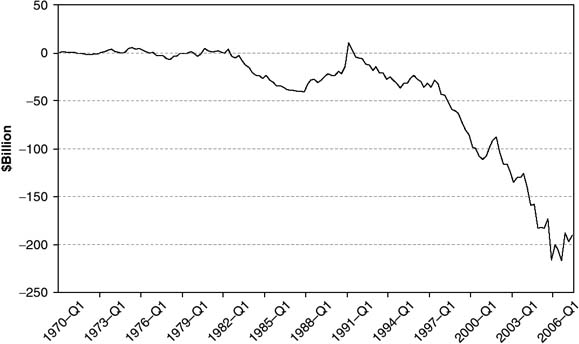
As Figure 1 shows, the United States has experienced a current account deficit for all but one quarter (the first quarter of 1991) over the past 25 years. Virtually all forecasters expect this deficit to continue for years to come.
The one positive number came about when several countries (most notably Germany, Japan, and Saudi Arabia) offered to contribute billions to the United States to pay for the cost of the Persian Gulf War on the condition that the contributions be used solely for the defense budget and not in any way to reduce the overall federal budget deficit. Then Defense Secretary Dick Cheney discovered that the Feed and Foraging Act of 1864 was still the law governing such contributions and that it allowed donations of money or goods and services to be used only for defense (or war) purposes. So much money came in that it gave the United States a one-quarter surplus on the current account. It also meant the United States made a profit on that war.
Figure 1 The Current Account Deficit
The basic economic principle to keep in mind is that the balance of payments for every country in the world is identical, namely, zero. This is an iron law of international accounting and has nothing to do with any theory.
This simply means that every country that has a current account deficit has a capital account surplus (an inflow of foreign money) of exactly the same amount. Any country with a current account surplus (such as China, Germany, or Japan) has a capital account deficit (an outflow of money to other countries) that exactly offsets the current account surplus.
The data do not provide any way to separate which side is driving the situation. Some commentators argue that because the return on investment that foreigners expect to earn by investing in the United States is so attractive, they continue to pour money into the United States at a rapid rate. So much of this has gone into direct investment that the Bureau of Labor Statistics now estimates as many as one out of every six employed people in the United States works for a foreign company such as BMW, British Petroleum, Four Seasons, Nissan, Shell, or Toyota.
If these people are correct, then the U.S. current account deficit will remain huge. Of course, trends that become unsustainable must stop and turn around, so sooner or later this will change.
...
- Aging and the Life Course
- Community, Culture, and Change
- Communitarianism
- Community
- Cults
- Cultural Capital
- Cultural Diffusion
- Cultural Imperialism
- Cultural Lag
- Cultural Relativism
- Cultural Values
- Culture of Dependency
- Culture of Poverty
- Culture Shock
- Culture Wars
- Cyberspace
- Digital Divide
- Faith-Based Social Initiatives
- Focus Groups
- Fundamentalism
- Gambling
- Gangsta Rap
- Institutional Ethnography
- Islam and Modernity
- Latent Functions
- Manifest Functions
- Mass Media
- Media
- Norms
- Obscenity
- Prestige
- Privacy
- Role Conflict
- Role Strain
- Secularization
- Social Change
- Social Conflict
- Social Disorganization
- Social Institutions
- Social Mobility
- Social Networks
- Subcultures
- Values
- Crime and Deviance
- Abuse, Child Sexual
- Abuse, Elderly
- Abuse, Intimate Partner
- Abuse, Sibling
- Addiction
- Alcoholism
- Arson
- Assault
- Binge Drinking
- Bullying
- Capital Punishment
- Child Abduction
- Community Corrections
- Community Crime Control
- Community Service
- Corporate Crime
- Corruption
- Crime
- Crime Rates
- Crime Waves
- Crime, Fear of
- Cultural Criminology
- Decriminalization
- Deviance
- Differential Association
- Domestic Violence
- Drug Abuse
- Drug Abuse, Crime
- Drug Abuse, Prescription Narcotics
- Drug Abuse, Sports
- Drunk Driving
- Eating Disorders
- Entrapment
- Environmental Crime
- Environmental Justice
- Ethnic Cleansing
- Extramarital Sex
- Felony
- Female Genital Cutting
- Gangs
- Genocide
- Gun Control
- Hate Crimes
- Hate Groups
- Hate Speech
- Holocaust
- Human Trafficking
- Identity Theft
- Illegitimate Opportunity Structures
- Incarceration, Societal Implications
- Incest
- Innocence Project
- Judicial Discretion
- Justice
- Juvenile Delinquency
- Juvenile Institutionalization, Effects of
- Juvenile Justice System
- Labor Racketeering
- Lynching
- Mass Murder
- Misdemeanor
- Murder
- Neighborhood Watch
- Obscenity
- Organized Crime
- Parole
- PATRIOT Act
- Pedophilia
- Piracy, Intellectual Property
- Plagiarism
- Plea Bargaining
- Police
- Police Stress
- Policing, Community
- Policing, Strategic
- Pornography
- Pornography and the Internet
- Pornography, Child
- Prison
- Prison, Convict Criminology
- Prisons, Gangs
- Prisons, Overcrowding
- Prisons, Pregnancy and Parenting
- Prisons, Privatization
- Prisons, Riots
- Prisons, Violence
- Probation
- Property Crime
- Prostitution
- Prostitution, Child
- Psychopath
- Racial Profiling
- Rape
- Rape, Acquaintance or Date
- Rape, Marital
- Rape, Statutory
- Reasonable Suspicion
- Recidivism
- Restorative Justice
- Riots
- Road Rage
- School Violence
- Sentencing Disparities
- Serial Murder
- Sex Trafficking
- Shoplifting
- Sociopath
- Stalking
- State Crimes
- Status Offenses
- Subculture of Violence Hypothesis
- Sweatshop
- Terrorism
- Terrorism, Counterterrorism Approaches
- Terrorism, Domestic Spying
- Theft
- Three Strikes Laws
- Torture
- Total Institution
- Twelve-Step Programs
- Uniform Crime Report
- Victim-Offender Mediation Model
- Victimization
- Victimless Crimes
- Vigilantism
- Violence
- Violence, Collective
- Violence, Sexual
- Violent Crime
- War Crimes
- Zero-Tolerance Policies
- Economics and Work
- Alienation
- Anomie
- Anti-Globalization Movement
- Automation
- Bankruptcy, Business
- Bankruptcy, Personal
- Budget Deficits, U.S.
- Bureaucracy
- Burnout
- Capital Flight
- Conglomerates
- Conspicuous Consumption
- Contingent Work
- Corporate State
- Culture of Dependency
- Culture of Poverty
- Current Account Deficit
- Debt Service
- Deindustrialization
- Dependency Ratio
- Deregulation
- Downsizing
- Economic Development
- Economic Restructuring
- Evaluation Research
- Gini Coefficient
- Global Economy
- Globalization
- Income Disparity
- Inflation
- Intergenerational Mobility
- Interlocking Directorates
- Job Satisfaction
- Labor Force Participation Rate
- Labor Market
- Labor Movement
- Labor Sectors
- Labor Unions
- Labor, Child
- Labor, Division of
- Literacy, Economic
- Living Wage
- Megamergers
- Military-Industrial Complex
- Mixed Economy
- Mommy Track
- Monopolies
- Multinational Corporations
- Occupational Safety and Health
- Oligarchy
- Oligopoly
- Outsourcing
- Pensions and Social Security
- Pink-Collar Occupations
- Postindustrialism
- Scientific Management
- Second Shift
- Segregation, Occupational
- Service Economy
- Skills Mismatch
- Social Capital
- Socialism
- Split Labor Market
- Sweatshop
- Taylorism
- Trickle-Down Economics
- Underclass Debate
- Underemployment
- Underground Economy
- Unemployment
- Wage Gap
- Wealth Disparities
- Wealth, U.S. Consumer
- World-Systems Analysis
- Education
- Brown v. Board of Education
- Ability Grouping
- Academic Standards
- Attention Deficit Hyperactivity Disorder
- Basic Skills Testing
- Bilingual Education
- Bullying
- Charter Schools
- Class
- Digital Divide
- Disability and Disabled
- Education, Academic Performance
- Education, Inner-City Schools
- Education, Policy and Politics
- Education, School Privatization
- Education, Silencing
- Education, Special Needs Children
- Educational Equity
- English as a Second Language
- Evaluation Research
- Grade Inflation
- Hidden Curriculum
- Illiteracy, Adult in Developed Nations
- Illiteracy, Adult in Developing Nations
- IQ Testing
- Labeling Theory
- Learning Disorders
- Life Chances
- Literacy, Adult
- Magnet Schools
- Minimum Competency Test
- Nature-Nurture Debate
- No Child Left Behind Act
- Oppositional Culture Theory
- Plagiarism
- Redistricting, School Districts
- School Dropouts
- School Funding
- School Prayer
- School Segregation
- School Violence
- School Vouchers
- Segregation, De Facto
- Sex Education
- Social Promotions
- Standardized Testing
- Stereotyping
- Title IX
- Family
- Adoption
- Adoption, Gay and Lesbian
- Adoption, Transracial
- Boomerang Generation
- Child Care Safety
- Child Neglect
- Cohabitation
- Divorce
- Domestic Partnerships
- Domestic Violence
- Dual-Income Families
- Extramarital Sex
- Family
- Family Leave Act
- Family Reunification
- Family, Blended
- Family, Dysfunctional
- Family, Extended
- Family, Nuclear
- Fathers' Rights Movement
- Foster Care
- Foster Children, Aging Out
- Intermarriage
- Missing Children
- Mommy Track
- Premarital Sex
- Runaways
- Same-Sex Marriage
- Sandwich Generation
- Second Shift
- Single Mothers
- Teenage Pregnancy and Parenting
- Transition Living
- Transnational Families
- Gender Inequality and Sexual Orientation
- Adoption, Gay and Lesbian
- Bisexuality
- Body Image
- Comparable Worth
- Feminism
- Feminist Theory
- Feminization of Poverty
- Gender Identity and Socialization
- Gini Coefficient
- Glass Ceiling
- Homophobia
- Homosexuality
- Hostile Environment
- Income Disparity
- Inequality
- Mommy Track
- Same-Sex Marriage
- Second Shift
- Segregation, Gender
- Standpoint Theory
- Stratification, Gender
- Transgender and Transsexuality
- Wage Gap
- Women's Rights Movement
- Health
- Accidents, Automobile
- Alcoholism
- Attention Deficit Hyperactivity Disorder
- Bioethics
- Chronic Diseases
- Codependency
- Deinstitutionalization
- Dementia
- Disability and Disabled
- Eating Disorders
- Epidemics, Management of
- Eugenics
- Euthanasia
- Famine
- Genetic Engineering
- Genetic Theories
- Genetically Altered Foods
- Health Care, Access
- Health Care, Costs
- Health Care, Ideological Barriers to Change
- Health Care, Insurance
- Hospices
- Learning Disorders
- Life Expectancy
- Managed Care
- Medicaid
- Medical Malpractice
- Medical-Industrial Complex
- Medicalization
- Medicare
- Mental Depression
- Mental Health
- Neuroses
- Nursing Home Care
- Obesity
- Pandemics
- Post-Traumatic Stress Disorder
- Psychopath
- Psychoses
- Secondhand Smoke
- Sexually Transmitted Diseases
- Smoking
- Socialized Medicine
- Sociopath
- Stressors
- Suicide
- Total Institution
- Twelve-Step Programs
- Vegetarian Movement
- Housing and Urbanization
- Capital Flight
- Economic Restructuring
- Edge Cities
- Gentrification
- Housing
- Inner City
- Inner-Ring Suburb
- Invasion-Succession
- Mass Transit
- Megacities
- Megalopolis
- Political Fragmentation
- Postindustrialism
- Segregation, Residential
- Service Economy
- Traffic Congestion
- Urban Decline
- Urban Infrastructure
- Urban Renewal
- Urban Sprawl
- Urban Underclass
- Urbanization
- White Flight
- Politics, Power, and War
- Arms Control
- Citizen Militias
- Citizenship
- Civil Rights
- Claims Making
- Collateral Damage
- Collective Consciousness
- Colonialism
- Conflict Resolution
- Conservative Approaches
- Corruption
- Culture Wars
- Demilitarization
- Democracy
- Eminent Domain
- False Consciousness
- Gerrymandering
- Groupthink
- Hegemony
- Human Rights
- Identity Politics
- Imperialism
- Mediation
- Militarism
- Moral Entrepreneurs
- Nation Building
- Nuclear Proliferation
- PATRIOT Act
- Peacekeeping
- Political Action Committees
- Political Fragmentation
- Politics and Christianity
- Power
- Power Elite
- Propaganda
- Public Opinion
- Public-Private Dichotomy
- Redistricting, Congressional Districts
- Segregation, De Jure
- Situation Ethics
- Social Control
- Special Interest Groups
- Surveillance
- Terrorism
- Terrorism, Counterterrorism Approaches
- Terrorism, Domestic Spying
- Think Tanks
- Totalitarianism
- Voter Apathy
- War
- War Crimes
- Population and Environment
- Acid Rain
- Baby Boomers
- Birth Rate
- Contraception
- Deforestation
- Demographic Transition Theory
- Desertification
- Disasters
- Ecosystem
- Environment, Eco-Warriors
- Environment, Hazardous Waste
- Environment, Pollution
- Environment, Runoff and Eutrophication
- Environment, Sewage Disposal
- Environmental Crime
- Environmental Degradation
- Environmental Hazards
- Environmental Justice
- Environmental Movement
- Environmental Racism
- Erosion
- Extinction
- Fertility
- Global Warming
- Infant Mortality
- Mortality Rate
- Neo-Malthusians
- NIMBYism
- Nonrenewable Resources
- Ozone
- Population Growth
- Population, Graying of
- Social Movements
- Sustainable Development
- Total Fertility Rate
- Toxic Waste
- Urbanization
- Water Organization
- Water Quality
- Water Resources
- Zero Population Growth
- Poverty and Social Class
- Aid to Families with Dependent Children
- Class
- Class Consciousness
- Codependency
- Evaluation Research
- Feminization of Poverty
- Food Insecurity and Hunger
- Gini Coefficient
- Hierarchy of Needs
- Homelessness
- Homelessness, Youth
- Housing
- Income Disparity
- Inequality
- Living Wage
- Means-Tested Programs
- Medicaid
- Personal Responsibility and Work Opportunity Reconciliation Act
- Poverty
- Poverty, Children Worldwide
- Relative Deprivation
- Single Mothers
- Socioeconomic Status
- Stratification, Social
- Temporary Assistance for Needy Families
- Trickle-Down Economics
- Underclass Debate
- Underemployment
- Unemployment
- Wealth Disparities
- Welfare
- Welfare Capitalism
- Welfare States
- Working Poor
- Race and Ethnic Relations
- Brown v. Board of Education
- Plessy v. Ferguson
- Acculturation
- Adoption, Transracial
- Affirmative Action
- Afrocentricity
- American Dream
- Americanization
- Anti-Semitism
- Apartheid
- Assimilation
- Asylum
- Backlash
- Bereavement, Effect by Race
- Bilingual Education
- Biracial
- Black Codes
- Black Nationalism
- Black Power Movement
- Blaming the Victim
- Bootstrap Theory
- Bracero Program
- Chicano Movement
- Cultural Capital
- Cultural Diffusion
- Cultural Imperialism
- Cultural Relativism
- Cultural Values
- Culture Shock
- Deportation
- Dillingham Flaw
- Discrimination
- Discrimination, Institutional
- English as a Second Language
- English-Only Movement
- Equal Protection
- Ethnic Cleansing
- Ethnic Group
- Ethnicity
- Ethnocentrism
- Ethnomethodology
- Genocide
- Hate Crimes
- Hate Groups
- Hate Speech
- HIV/AIDS, Reaching High-Risk Populations
- Holocaust
- Hypersegregation
- Identity Politics
- Immigration
- Immigration, United States
- Income Disparity
- Index of Dissimilarity
- Inequality
- Infant Mortality
- Intermarriage
- Internal Colonialism
- Islam and Modernity
- Jim Crow
- Labeling Theory
- Labor, Migrant
- Life Chances
- Lynching
- Marginality
- Melting Pot
- Middleman Minority
- Migration, Global
- Minority Group
- Miscegenation
- Multiculturalism
- Multiracial Identity
- Native Americans, Cultural Degradation
- Native Americans, Reservation Life
- Nativism
- Nature-Nurture Debate
- One-Drop Rule
- Oppositional Culture Theory
- Personal Responsibility and Work Opportunity Reconciliation Act
- Personhood, Evolving Notions of
- Pluralism
- Politics and Christianity
- Prejudice
- Race
- Race-Blind Policies
- Racial Formation Theory
- Racial Profiling
- Racism
- Redlining
- Refugees
- Religion and Conflict
- Religion and Politics
- Religion, Civil
- Religious Extremism
- Religious Holidays as Social Problems
- Religious Prejudice
- Reparations
- Repatriation
- Resettlement
- Sanctuary Movement
- Scapegoating
- Segmented Assimilation
- Segregation
- Segregation, De Facto
- Segregation, De Jure
- Segregation, Residential
- Slavery
- Social Distance
- Social Exclusion
- Split Labor Market
- Stereotyping
- Stratification, Gender
- Stratification, Race
- Stratification, Social
- Transnational Families
- Underground Economy
- Undocumented Immigrants
- White Flight
- White Supremacy
- Xenophobia
- Social Movements
- Anti-Globalization Movement
- Black Power Movement
- Chicano Movement
- Countermovements
- Environmental Movement
- Fathers'Rights Movement
- Labor Movement
- Prohibition
- Resource Mobilization
- Sanctuary Movement
- Social Movements
- Social Revolutions
- Temperance Movement
- Transnational Activism
- Transnational Social Movement
- Vegetarian Movement
- Women's Rights Movement
- Social Theory
- Activity Theory
- Bootstrap Theory
- Conflict Perspective
- Demographic Transition Theory
- Differential Association
- Disengagement Theory
- False Consciousness
- Feminist Theory
- Labeling Theory
- Modernization Theory
- Oppositional Culture Theory
- Postmodernism
- Queer Theory
- Racial Formation Theory
- Rational Choice Theory
- Self-Fulfilling Prophecy
- Social Bond Theory
- Social Constructionist Theory
- Split Labor Market
- Standpoint Theory
- Strain Theory
- Theory
- Substance Abuse
- Accidents, Automobile
- Addiction
- Alcoholism
- Anti-Drug Abuse Act of 1986
- Binge Drinking
- Club Drugs
- Cocaine and Crack
- Codependency
- Decriminalization
- Deterrence Programs
- Deviance
- Drug Abuse
- Drug Abuse, Crime
- Drug Abuse, Prescription Narcotics
- Drug Abuse, Sports
- Drug Subculture
- Drunk Driving
- Evaluation Research
- Fetal Alcohol Syndrome
- Fetal Narcotic Syndrome
- Gateway Drugs
- Harm Reduction Drug Policy
- Heroin
- Labeling Theory
- Marijuana
- Methadone
- Prohibition
- Psychoactive Drugs, Misuse of
- Rehabilitation
- Stigma
- Temperance Movement
- Therapeutic Communities
- Twelve-Step Programs
- Zero-Tolerance Policies
- Loading...
Get a 30 day FREE TRIAL
-
 Watch videos from a variety of sources bringing classroom topics to life
 -
Read modern, diverse business cases
-
Explore hundreds of books and reference titles

Read next

More like this
Sage Recommends
We found other relevant content for you on other Sage platforms.
Have you created a personal profile? Login or create a profile so that you can save clips, playlists and searches