
Entry
Reader's guide
Entries A-Z
Subject index
Structural Equivalence
Structural equivalence (sometimes called streq) is one of the most important concepts in social network analysis and is related to a broader theoretical context in the field. It has faced some criticisms, which has stirred up some recurring debates. The concept of structural equivalence was first proposed by sociologists François Lorrain and Harrison White in 1971, even though they both recognized that the concept was already present, at least implicitly, in pre-existing mathematical literature. In short, structural equivalence can be defined in the following way: two actors in a network are considered structurally equivalent if they share the exact same set of ties to third-party actors. In other words, two actors are structurally equivalent if they are connected, and not connected, to the same actors.
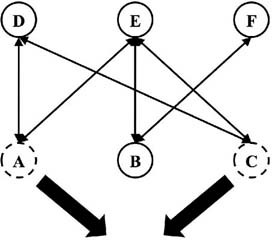
For example, consider a network constituted of six actors, A, B, C, D, E, and F (see Figure 1). In this network, exclusively constituted of undirected ties—which are reciprocal—A is connected to D and E. B is connected to E and F. C is connected to D and E. A and C are thus structurally equivalent because they are both connected to D and E and not connected to the other actors. However, A and B are not structurally equivalent because while they are both connected to E, B is connected to F, while A is not. A similar reasoning can be made for directed, that is, nonreciprocal, ties. In other words, two actors are structurally equivalent if they share the exact same profile of ties to others. Structurally equivalent actors need not be connected to each other.
Figure 1 Illustration of Structural Equivalence for Six Actors: A and C Are Structurally Equivalent
Structural equivalence is more than an abstract concept and can be grasped intuitively. It can be found in many everyday life settings, such as in kinship, at work, or in markets. Siblings of the same gender can, to some extent, be considered structurally equivalent. Employees of a given firm who perform the same tasks or occupy the same hierarchical position with the same subordinates and the same managers can be considered approximately structurally equivalent. Firms that share suppliers and sell to the same customers are structurally equivalent. An important idea is that even though two actors are structurally equivalent, it does not mean they are equivalent in other ways. Consider two brothers, who share the same set of relations to their kin. These brothers are structurally equivalent as far as their kinship relationships are concerned. However, they can have different attributes, such as different academic degrees or tastes. In this regard, they are structurally equivalent, but not socially equivalent. Structural equivalence is concerned with the overall structure of a network, not the attributes of the actors. In concrete empirical contexts, however, perfect structural equivalence is hard to find, and actors can be considered structurally equivalent if they share similar but not identical patterns of ties. This looser definition of structural equivalence is used when measuring the concept and identifying structurally equivalent actors in a network.
Measuring Structural Equivalence
Several ways of measuring structural equivalence have been suggested across the literature. For example, sociologist Ronald Burt has used Euclidean distance as a measure of structural equivalence. To understand this measure, consider a network of n actors. Each Actor i is characterized by a set of ties to the other n-1 actors. Take another Actor, j, which is also characterized by a set of ties to third-party actors. Thus, for each Actor k, distinct from i and j, both i and j are characterized by a certain value that represents the value (or absence of value) of their tie to k. The Euclidean distance will thus be the square root of the squared differences between all the ties of i and j to the other n-2 nodes. Thus, if for every Actor k, i and j present identical ties, then the Euclidean distance between i and j is zero. If two actors have exactly the same profile, their Euclidean distance is zero, and they are structurally equivalent.
...
- History of Social Networking
- American Revolutionary War
- Ancient China
- Ancient Egypt
- Ancient Greece
- Ancient India
- Ancient Rome
- Civil War, U.S.
- Colonial America
- Earliest Civilizations
- History of Social Networks 1865–1899
- History of Social Networks 1900–1929
- History of Social Networks 1930–1940
- History of Social Networks 1941–1945
- History of Social Networks 1946–1959
- History of Social Networks 1960–1975
- History of Social Networks 1976–1999
- History of Social Networks 2000–Present
- Industrial Revolution
- Internet History and Networks
- Middle Ages
- Native Americans
- Renaissance
- World-Systems Networks
- Local U.S. Social Networks by State
- Alabama
- Alaska
- Arizona
- Arkansas
- California
- Colorado
- Connecticut
- Delaware
- District of Columbia
- Florida
- Georgia (State)
- Hawaii
- Idaho
- Illinois
- Indiana
- Iowa
- Kansas
- Kentucky
- Louisiana
- Maine
- Maryland
- Massachusetts
- Michigan
- Minnesota
- Mississippi
- Missouri
- Montana
- Nebraska
- Nevada
- New Hampshire
- New Jersey
- New Mexico
- New York
- North Carolina
- North Dakota
- Ohio
- Oklahoma
- Oregon
- Pennsylvania
- Rhode Island
- South Carolina
- South Dakota
- Tennessee
- Texas
- Utah
- Vermont
- Virginia
- Washington
- West Virginia
- Wisconsin
- Wyoming
- Privacy and Rights in Social Networks
- Social Network Analysis and Issues
- Affiliation Networks
- Agent-Based Models
- Bipartite networks
- Blockmodeling
- Cohesion Networks
- Complexity
- Cooperation/Coordination
- Dating
- Egocentric Networks
- Embeddedness
- Exchange Networks
- Exponential Randon Graph Models (ERGM/p*)
- Graph Theory
- Homophily
- Longitudinal Networks
- Multiplexed Networks
- Network Analysis Software
- Network Evolution
- Network Indicators
- Network Simulations
- Network Theory
- Network Visualization
- Paths/Walks/Cycles
- Pornography Networks
- Power Law Networks
- Preferential Attachment
- Prominence
- Proximity/Space
- Q-Analysis
- Random Graph Models
- Reciprocity
- Self-Organizing Networks
- Semantic Networks
- Small World
- Social Capital
- Social Influence
- Social Support
- Stalking
- Structural Equivalence
- Structural Holes
- Structural Theory
- Tie Length
- Tie Strength
- Tie Utility
- Tipping Point
- Triads
- Trust and Networks
- Two-Mode Networks
- Word Networks
- Social Networking around the World
- Afghanistan
- Algeria
- Angola
- Argentina
- Armenia
- Australia
- Austria
- Azerbaijan
- Bangladesh
- Belarus
- Belgium
- Benin
- Bolivia
- Brazil
- Bulgaria
- Burkina Faso
- Burundi
- Côte d'Ivoire
- Cambodia
- Cameroon
- Canada
- Central African Republic
- Chad, Republic of
- Chile
- China
- Colombia
- Congo, Democratic Republic of the
- Costa Rica
- Croatia
- Cuba
- Czech Republic
- Denmark
- Dominican Republic
- Ecuador
- Egypt
- El Salvador
- Eritrea
- Estonia
- Ethiopia
- Finland
- France
- Georgia (Country)
- Germany
- Ghana
- Greece
- Guatemala
- Guinea
- Haiti
- Honduras
- Hungary
- India
- Indonesia
- Iran
- Iraq
- Ireland
- Israel
- Italy
- Japan
- Jordan
- Kazakhstan
- Kenya
- Kurdistan
- Kyrgyzstan
- Laos
- Latvia
- Libya
- Lithuania
- Malawi
- Malaysia
- Mali
- Mexico
- Morocco
- Mozambique
- Myanmar
- Nepal
- Netherlands
- New Zealand
- Nicaragua
- Niger
- Nigeria
- North Korea
- Norway
- Pakistan
- Papua New Guinea
- Paraguay
- Peru
- Philippines
- Poland
- Portugal
- Romania
- Russia
- Rwanda
- Saudi Arabia
- Senegal
- Serbia
- Sierra Leone
- Singapore
- Slovakia
- Somalia
- South Africa
- South Korea
- Spain
- Sri Lanka
- Sudan
- Sweden
- Switzerland
- Syria
- Tajikistan
- Tanzania
- Thailand
- Togo
- Tunisia
- Turkey
- Turkmenistan
- Uganda
- Ukraine
- United Arab Emirates
- United Kingdom
- United States
- Uzbekistan
- Venezuela
- Vietnam
- Yemen
- Zambia
- Zimbabwe
- Social Networking Communities
- Adults-Only Communities
- Artists Communities
- Blogs and Networks
- Books Communities
- Classmates
- College Students Communities
- CouchSurfing
- Deviant Communities
- Elitist Communities
- Games Communities
- Investing Communities
- Local Political Activism Communities
- Mothers Communities
- Movie and TV Series Communities
- Music Communities
- MySpace
- Newsgroups
- People with Disabilities Communities
- Religious Communities
- Scientific Communities
- Teen Communities
- Wikipedia
- Yahoo!
- YouTube and Video Exchange
- Social Networking Organizations
- AARP (American Association of Retired Persons)
- Alcoholics Anonymous (AA)
- American Civil Liberties Union (ACLU)
- Charity Organizations
- Conservative Organizations
- Government Networks
- Greenpeace
- International Network for Social Network Analysis (INSNA)
- Liberal Organizations
- National Association for the Advancement of Colored People (NAACP)
- Neighborhood Organizations
- Nongovernmental Organizations (NGOs)
- Unions
- United Nations
- United Service Organizations (USO)
- Social Science of Networking
- Alumni Networks
- Anthropological Networks
- Bibliometrics/Citation Networks
- Cancer Networks
- Children's Networks
- Cognitive Networks
- Communication Networks
- Conspiracy Theory and Gossip Networks
- Corporate Networking
- Diet Networks
- Diffusion/Contagion Networks
- Economic Networks
- Educational Networks
- Employment Networks
- Entrepreneurial Networks
- Environmental Activism
- Ethnicity and Networks
- Fan Networks
- Fraternities
- Game Theory and Networks
- Gangs
- Gender and Networks
- Health Networks
- Hobby Networks
- Human Rights Networks
- Infectious Disease Networks
- Innovation Networks
- Interdepartmental Networks
- International Networks
- Interorganizational/Interlocks
- Kinship Networks
- Knowledge Networks
- Leadership Networks
- Letter-Writing
- Military Networks
- Neighborhood Organizations
- Network Psychology
- Network Visualization
- Organizational Networks
- Policy Networks
- Religious Communities
- Scholar Networks
- Senior Networks
- Small Group Networks
- Sororities
- Sports Networks
- Telecommunication Networks
- Twelve-Step Programs
- Urban Networks
- War and Networks
- Women's Networks
- Technology and Social Networking
- Loading...
Get a 30 day FREE TRIAL
-
 Watch videos from a variety of sources bringing classroom topics to life
 -
Read modern, diverse business cases
-
Explore hundreds of books and reference titles

Read next

More like this
Sage Recommends
We found other relevant content for you on other Sage platforms.
Have you created a personal profile? Login or create a profile so that you can save clips, playlists and searches