
Entry
Reader's guide
Entries A-Z
Subject index
Niger
Niger's social networks are characterized by indigenous, ethnic networks. The Niger of today evolved geographically from large African kingdom states, with overlapping territory into surrounding countries like Mali and Burkina Faso. Niger shares history and social networks with Nigeria and Benin to the south, Burkina Faso and Mali to the west, Chad to the east, and Algeria and Libya to the north. Some of the ethnic groups that covered Niger territory included the Fulani, Tuareg, Songhai, Hausa, Mali, Dendi, Gao, and Kanem-Bornu. Today, the major ethnic groups are Hausa (55 percent), Djerma Sonrai (21 percent), and Tuareg (9 percent). On the whole, the communities are rural, with only 16 percent urbanization in 2008.
Niger has served as part of the trade route across the Sahara to the Mediterranean for centuries. Merchants relied upon social networks to navigate across the Sahara and profitably trade goods such as salt and gold. This trade route and the social networks created by it, as well as the Songhai, Tuareg, and Fulani Empires, were all significant in spreading Islam in Niger. Today, around 80 percent of Nigeriens identify with the Islamic faith.
It was not until the 19th century that Niger had direct contact with Europeans. The first contact came from European explorers like Heinrich Barth of Germany. However, it was at the Berlin Conference of 1884–85 that the French were given rights to Niger and surrounding countries. The French were unable to colonize Niger until the 1920s. In this period, Niger was centrally administered from the French government in Dakar, the capital of Senegal, and had a local governor.
Niger achieved citizenship with the French constitution of 1946, and administration was shifted to Niger from Senegal. However, Nigeriens did not have full autonomy with restrictions on local assemblies. Some of the Nigerien political parties during this period were the Nigerien Progressive Party–African Democratic Rally (PPN-RDA), Union of Popular Forces for Democracy, and Progress–Sawaba (UDFP–Sawaba), and Niger Action Bloc.
After Independence in 1960
When Niger gained independence from France in 1960, the stage for its modern political history and networks was set. The heritage of the independent states, or separate ethnic identities, over the short history of a single nation might explain the turbulent political history of Niger, which has had five constitutions and more than three military coups and periods of rule in the last 50 years. The dominant political parties that arose include the Rally for Democracy and Progress (RDP–Jama'a), Nigerien Party for Democracy and Socialism (PNDS–Tarayya), National Movement for the Development of Society (MNSD–Nassara), and Democratic and Social Convention (CDS–Rahama).
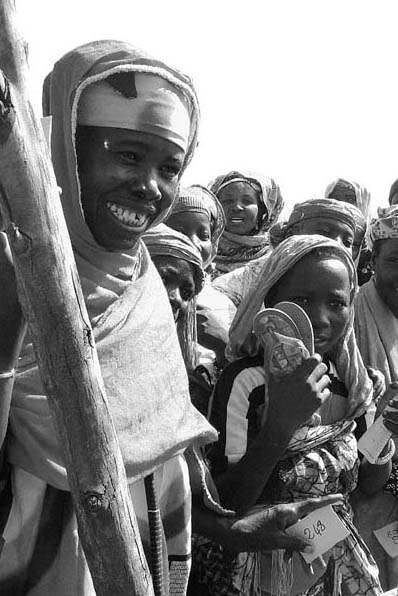
Drought-stricken villagers wait to receive food distributed by nongovernmental organizations and a government committee.
The last military coup occurred in February 2010, when then-president Mamadou Tandja tried to change the constitution in order to campaign for a third term. The military transition government set up democratic elections for January 2011.
Niger's migrant network was estimated at 437,000 in 2005, according to the World Bank. The top migration locations are nearby countries of Côte d'Ivoire, Burkina Faso, Nigeria, Chad, Benin, and Togo. Many male Nigeriens seasonally migrate between January and April after harvest to supplement subsistence livelihoods. This migration, which has existed for centuries, is called Exode and relies upon the creation and maintenance of international social networks between the migrant Nigeriens and their seasonal employers. The largest migration networks of Nigeriens outside Africa are found in France, Italy, Germany, and the United States. These migrants create new social networks in their host countries and maintain social networks with friends and family in Niger.
...
- History of Social Networking
- American Revolutionary War
- Ancient China
- Ancient Egypt
- Ancient Greece
- Ancient India
- Ancient Rome
- Civil War, U.S.
- Colonial America
- Earliest Civilizations
- History of Social Networks 1865–1899
- History of Social Networks 1900–1929
- History of Social Networks 1930–1940
- History of Social Networks 1941–1945
- History of Social Networks 1946–1959
- History of Social Networks 1960–1975
- History of Social Networks 1976–1999
- History of Social Networks 2000–Present
- Industrial Revolution
- Internet History and Networks
- Middle Ages
- Native Americans
- Renaissance
- World-Systems Networks
- Local U.S. Social Networks by State
- Alabama
- Alaska
- Arizona
- Arkansas
- California
- Colorado
- Connecticut
- Delaware
- District of Columbia
- Florida
- Georgia (State)
- Hawaii
- Idaho
- Illinois
- Indiana
- Iowa
- Kansas
- Kentucky
- Louisiana
- Maine
- Maryland
- Massachusetts
- Michigan
- Minnesota
- Mississippi
- Missouri
- Montana
- Nebraska
- Nevada
- New Hampshire
- New Jersey
- New Mexico
- New York
- North Carolina
- North Dakota
- Ohio
- Oklahoma
- Oregon
- Pennsylvania
- Rhode Island
- South Carolina
- South Dakota
- Tennessee
- Texas
- Utah
- Vermont
- Virginia
- Washington
- West Virginia
- Wisconsin
- Wyoming
- Privacy and Rights in Social Networks
- Social Network Analysis and Issues
- Affiliation Networks
- Agent-Based Models
- Bipartite networks
- Blockmodeling
- Cohesion Networks
- Complexity
- Cooperation/Coordination
- Dating
- Egocentric Networks
- Embeddedness
- Exchange Networks
- Exponential Randon Graph Models (ERGM/p*)
- Graph Theory
- Homophily
- Longitudinal Networks
- Multiplexed Networks
- Network Analysis Software
- Network Evolution
- Network Indicators
- Network Simulations
- Network Theory
- Network Visualization
- Paths/Walks/Cycles
- Pornography Networks
- Power Law Networks
- Preferential Attachment
- Prominence
- Proximity/Space
- Q-Analysis
- Random Graph Models
- Reciprocity
- Self-Organizing Networks
- Semantic Networks
- Small World
- Social Capital
- Social Influence
- Social Support
- Stalking
- Structural Equivalence
- Structural Holes
- Structural Theory
- Tie Length
- Tie Strength
- Tie Utility
- Tipping Point
- Triads
- Trust and Networks
- Two-Mode Networks
- Word Networks
- Social Networking around the World
- Afghanistan
- Algeria
- Angola
- Argentina
- Armenia
- Australia
- Austria
- Azerbaijan
- Bangladesh
- Belarus
- Belgium
- Benin
- Bolivia
- Brazil
- Bulgaria
- Burkina Faso
- Burundi
- Côte d'Ivoire
- Cambodia
- Cameroon
- Canada
- Central African Republic
- Chad, Republic of
- Chile
- China
- Colombia
- Congo, Democratic Republic of the
- Costa Rica
- Croatia
- Cuba
- Czech Republic
- Denmark
- Dominican Republic
- Ecuador
- Egypt
- El Salvador
- Eritrea
- Estonia
- Ethiopia
- Finland
- France
- Georgia (Country)
- Germany
- Ghana
- Greece
- Guatemala
- Guinea
- Haiti
- Honduras
- Hungary
- India
- Indonesia
- Iran
- Iraq
- Ireland
- Israel
- Italy
- Japan
- Jordan
- Kazakhstan
- Kenya
- Kurdistan
- Kyrgyzstan
- Laos
- Latvia
- Libya
- Lithuania
- Malawi
- Malaysia
- Mali
- Mexico
- Morocco
- Mozambique
- Myanmar
- Nepal
- Netherlands
- New Zealand
- Nicaragua
- Niger
- Nigeria
- North Korea
- Norway
- Pakistan
- Papua New Guinea
- Paraguay
- Peru
- Philippines
- Poland
- Portugal
- Romania
- Russia
- Rwanda
- Saudi Arabia
- Senegal
- Serbia
- Sierra Leone
- Singapore
- Slovakia
- Somalia
- South Africa
- South Korea
- Spain
- Sri Lanka
- Sudan
- Sweden
- Switzerland
- Syria
- Tajikistan
- Tanzania
- Thailand
- Togo
- Tunisia
- Turkey
- Turkmenistan
- Uganda
- Ukraine
- United Arab Emirates
- United Kingdom
- United States
- Uzbekistan
- Venezuela
- Vietnam
- Yemen
- Zambia
- Zimbabwe
- Social Networking Communities
- Adults-Only Communities
- Artists Communities
- Blogs and Networks
- Books Communities
- Classmates
- College Students Communities
- CouchSurfing
- Deviant Communities
- Elitist Communities
- Games Communities
- Investing Communities
- Local Political Activism Communities
- Mothers Communities
- Movie and TV Series Communities
- Music Communities
- MySpace
- Newsgroups
- People with Disabilities Communities
- Religious Communities
- Scientific Communities
- Teen Communities
- Wikipedia
- Yahoo!
- YouTube and Video Exchange
- Social Networking Organizations
- AARP (American Association of Retired Persons)
- Alcoholics Anonymous (AA)
- American Civil Liberties Union (ACLU)
- Charity Organizations
- Conservative Organizations
- Government Networks
- Greenpeace
- International Network for Social Network Analysis (INSNA)
- Liberal Organizations
- National Association for the Advancement of Colored People (NAACP)
- Neighborhood Organizations
- Nongovernmental Organizations (NGOs)
- Unions
- United Nations
- United Service Organizations (USO)
- Social Science of Networking
- Alumni Networks
- Anthropological Networks
- Bibliometrics/Citation Networks
- Cancer Networks
- Children's Networks
- Cognitive Networks
- Communication Networks
- Conspiracy Theory and Gossip Networks
- Corporate Networking
- Diet Networks
- Diffusion/Contagion Networks
- Economic Networks
- Educational Networks
- Employment Networks
- Entrepreneurial Networks
- Environmental Activism
- Ethnicity and Networks
- Fan Networks
- Fraternities
- Game Theory and Networks
- Gangs
- Gender and Networks
- Health Networks
- Hobby Networks
- Human Rights Networks
- Infectious Disease Networks
- Innovation Networks
- Interdepartmental Networks
- International Networks
- Interorganizational/Interlocks
- Kinship Networks
- Knowledge Networks
- Leadership Networks
- Letter-Writing
- Military Networks
- Neighborhood Organizations
- Network Psychology
- Network Visualization
- Organizational Networks
- Policy Networks
- Religious Communities
- Scholar Networks
- Senior Networks
- Small Group Networks
- Sororities
- Sports Networks
- Telecommunication Networks
- Twelve-Step Programs
- Urban Networks
- War and Networks
- Women's Networks
- Technology and Social Networking
- Loading...
Get a 30 day FREE TRIAL
-
 Watch videos from a variety of sources bringing classroom topics to life
 -
Read modern, diverse business cases
-
Explore hundreds of books and reference titles

Read next

More like this
Sage Recommends
We found other relevant content for you on other Sage platforms.
Have you created a personal profile? Login or create a profile so that you can save clips, playlists and searches