
Entry
Reader's guide
Entries A-Z
Subject index
Leadership Networks
Leadership is one of the most examined concepts in the social science literature. While the study of social networks has also gained interest in recent years, the intersection between leadership and social networks has received limited attention. However, some interesting work has been conducted to date in linking leadership and social networks.
The key notion underlying most leadership research is that the behaviors or attributes of a leader, typically a person in a formal position, matter for a variety of outcomes. While offering valuable insights into the role of an individual leader in enhancing outcomes, this dominant view of leadership behavior and attributes underestimates the impact of social network position and ties. Scholars who examine leadership are increasingly recognizing the importance of social processes and relational linkages involved in leading. Leadership in its broadest sense has often been conceptualized as a process of influence toward an outcome. Social relationships therefore may provide leaders with the necessary infrastructure to exert social influence in achieving individual and organizational goals. A social network perspective brings to the fore the dependencies of actors within a social system, shifting the perspective away from individual attributes toward a focus on relational linkages, thereby placing leadership directly in the role of a social undertaking. Leadership from a network perspective emphasizes that the organizational interdependence of action that is reflected by a network of ties ultimately moderates, influences, and even determines the direction, speed, and depth of a planned activity. Research on the intersection of social networks and leadership supplements the knowledge of leadership as a complex and dynamic social process.
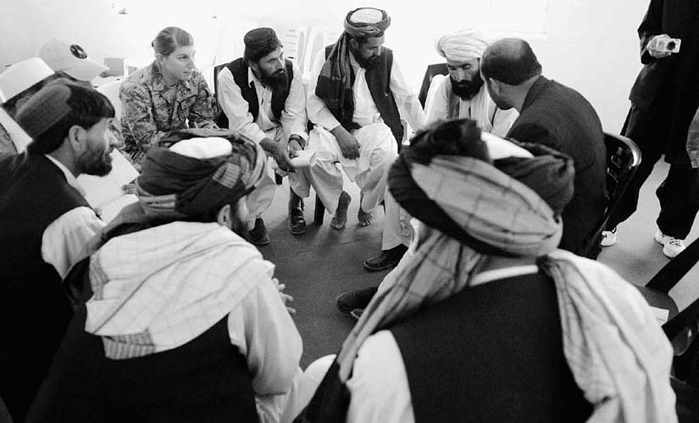
Afghan officials discuss leadership techniques with a U.S. reconstruction team and the Department of State during a leadership conference in Qalat City on October 9, 2010. Local leaders can leverage their existing social capital to influence good actors.
Leadership, Social Capital, and Ties
Often, organizational resources such as information, expertise, and innovation that reside in a system are a result of building human capital, which comprises the knowledge, skills, and abilities of individual actors in an organization. In addition to the resources that stem from human capital, organizational capacities can also be derived from the social relationships among organizational members. Social capital is concerned with the resources that exist in relations between individuals, often referred to as ties. In essence, social capital theorists argue that the ties between individuals create a social network structure, which in turn supports or constrains the distribution of resources. Connections and access, or a lack thereof, to available resources situates leaders in structural positions that enable more or less power, influence, and access to resources than other positions in the social network.
The transfer of resources in any system may be influenced by the quality of ties between actors. The content of the network creates a structure that defines the purpose of the network and, in turn, how well the resources flow between actors. For example, the social structure of a work-related knowledge network may differ significantly from the structure of a more normative social network, such as friendship. In both examples, resources flow through ties (the first being knowledge, the second friendship), but the overall structure of the network may look quite different. A number of studies have indicated that leaders who have strong ties across an entire organization, often measured by quantity (how frequently the interaction occurs) or quality (the “strength” of the interaction), have been found to be able to better transfer tacit, nonroutine, or complex knowledge; facilitate joint problem solving; and stimulate the development of coordinated and innovative solutions. In contrast, through weak ties, a leader may provide for brokering opportunities between actors and access to nonredundant, novel information.
...
- History of Social Networking
- American Revolutionary War
- Ancient China
- Ancient Egypt
- Ancient Greece
- Ancient India
- Ancient Rome
- Civil War, U.S.
- Colonial America
- Earliest Civilizations
- History of Social Networks 1865–1899
- History of Social Networks 1900–1929
- History of Social Networks 1930–1940
- History of Social Networks 1941–1945
- History of Social Networks 1946–1959
- History of Social Networks 1960–1975
- History of Social Networks 1976–1999
- History of Social Networks 2000–Present
- Industrial Revolution
- Internet History and Networks
- Middle Ages
- Native Americans
- Renaissance
- World-Systems Networks
- Local U.S. Social Networks by State
- Alabama
- Alaska
- Arizona
- Arkansas
- California
- Colorado
- Connecticut
- Delaware
- District of Columbia
- Florida
- Georgia (State)
- Hawaii
- Idaho
- Illinois
- Indiana
- Iowa
- Kansas
- Kentucky
- Louisiana
- Maine
- Maryland
- Massachusetts
- Michigan
- Minnesota
- Mississippi
- Missouri
- Montana
- Nebraska
- Nevada
- New Hampshire
- New Jersey
- New Mexico
- New York
- North Carolina
- North Dakota
- Ohio
- Oklahoma
- Oregon
- Pennsylvania
- Rhode Island
- South Carolina
- South Dakota
- Tennessee
- Texas
- Utah
- Vermont
- Virginia
- Washington
- West Virginia
- Wisconsin
- Wyoming
- Privacy and Rights in Social Networks
- Social Network Analysis and Issues
- Affiliation Networks
- Agent-Based Models
- Bipartite networks
- Blockmodeling
- Cohesion Networks
- Complexity
- Cooperation/Coordination
- Dating
- Egocentric Networks
- Embeddedness
- Exchange Networks
- Exponential Randon Graph Models (ERGM/p*)
- Graph Theory
- Homophily
- Longitudinal Networks
- Multiplexed Networks
- Network Analysis Software
- Network Evolution
- Network Indicators
- Network Simulations
- Network Theory
- Network Visualization
- Paths/Walks/Cycles
- Pornography Networks
- Power Law Networks
- Preferential Attachment
- Prominence
- Proximity/Space
- Q-Analysis
- Random Graph Models
- Reciprocity
- Self-Organizing Networks
- Semantic Networks
- Small World
- Social Capital
- Social Influence
- Social Support
- Stalking
- Structural Equivalence
- Structural Holes
- Structural Theory
- Tie Length
- Tie Strength
- Tie Utility
- Tipping Point
- Triads
- Trust and Networks
- Two-Mode Networks
- Word Networks
- Social Networking around the World
- Afghanistan
- Algeria
- Angola
- Argentina
- Armenia
- Australia
- Austria
- Azerbaijan
- Bangladesh
- Belarus
- Belgium
- Benin
- Bolivia
- Brazil
- Bulgaria
- Burkina Faso
- Burundi
- Côte d'Ivoire
- Cambodia
- Cameroon
- Canada
- Central African Republic
- Chad, Republic of
- Chile
- China
- Colombia
- Congo, Democratic Republic of the
- Costa Rica
- Croatia
- Cuba
- Czech Republic
- Denmark
- Dominican Republic
- Ecuador
- Egypt
- El Salvador
- Eritrea
- Estonia
- Ethiopia
- Finland
- France
- Georgia (Country)
- Germany
- Ghana
- Greece
- Guatemala
- Guinea
- Haiti
- Honduras
- Hungary
- India
- Indonesia
- Iran
- Iraq
- Ireland
- Israel
- Italy
- Japan
- Jordan
- Kazakhstan
- Kenya
- Kurdistan
- Kyrgyzstan
- Laos
- Latvia
- Libya
- Lithuania
- Malawi
- Malaysia
- Mali
- Mexico
- Morocco
- Mozambique
- Myanmar
- Nepal
- Netherlands
- New Zealand
- Nicaragua
- Niger
- Nigeria
- North Korea
- Norway
- Pakistan
- Papua New Guinea
- Paraguay
- Peru
- Philippines
- Poland
- Portugal
- Romania
- Russia
- Rwanda
- Saudi Arabia
- Senegal
- Serbia
- Sierra Leone
- Singapore
- Slovakia
- Somalia
- South Africa
- South Korea
- Spain
- Sri Lanka
- Sudan
- Sweden
- Switzerland
- Syria
- Tajikistan
- Tanzania
- Thailand
- Togo
- Tunisia
- Turkey
- Turkmenistan
- Uganda
- Ukraine
- United Arab Emirates
- United Kingdom
- United States
- Uzbekistan
- Venezuela
- Vietnam
- Yemen
- Zambia
- Zimbabwe
- Social Networking Communities
- Adults-Only Communities
- Artists Communities
- Blogs and Networks
- Books Communities
- Classmates
- College Students Communities
- CouchSurfing
- Deviant Communities
- Elitist Communities
- Games Communities
- Investing Communities
- Local Political Activism Communities
- Mothers Communities
- Movie and TV Series Communities
- Music Communities
- MySpace
- Newsgroups
- People with Disabilities Communities
- Religious Communities
- Scientific Communities
- Teen Communities
- Wikipedia
- Yahoo!
- YouTube and Video Exchange
- Social Networking Organizations
- AARP (American Association of Retired Persons)
- Alcoholics Anonymous (AA)
- American Civil Liberties Union (ACLU)
- Charity Organizations
- Conservative Organizations
- Government Networks
- Greenpeace
- International Network for Social Network Analysis (INSNA)
- Liberal Organizations
- National Association for the Advancement of Colored People (NAACP)
- Neighborhood Organizations
- Nongovernmental Organizations (NGOs)
- Unions
- United Nations
- United Service Organizations (USO)
- Social Science of Networking
- Alumni Networks
- Anthropological Networks
- Bibliometrics/Citation Networks
- Cancer Networks
- Children's Networks
- Cognitive Networks
- Communication Networks
- Conspiracy Theory and Gossip Networks
- Corporate Networking
- Diet Networks
- Diffusion/Contagion Networks
- Economic Networks
- Educational Networks
- Employment Networks
- Entrepreneurial Networks
- Environmental Activism
- Ethnicity and Networks
- Fan Networks
- Fraternities
- Game Theory and Networks
- Gangs
- Gender and Networks
- Health Networks
- Hobby Networks
- Human Rights Networks
- Infectious Disease Networks
- Innovation Networks
- Interdepartmental Networks
- International Networks
- Interorganizational/Interlocks
- Kinship Networks
- Knowledge Networks
- Leadership Networks
- Letter-Writing
- Military Networks
- Neighborhood Organizations
- Network Psychology
- Network Visualization
- Organizational Networks
- Policy Networks
- Religious Communities
- Scholar Networks
- Senior Networks
- Small Group Networks
- Sororities
- Sports Networks
- Telecommunication Networks
- Twelve-Step Programs
- Urban Networks
- War and Networks
- Women's Networks
- Technology and Social Networking
- Loading...
Get a 30 day FREE TRIAL
-
 Watch videos from a variety of sources bringing classroom topics to life
 -
Read modern, diverse business cases
-
Explore hundreds of books and reference titles

Read next

More like this
Sage Recommends
We found other relevant content for you on other Sage platforms.
Have you created a personal profile? Login or create a profile so that you can save clips, playlists and searches