
Entry
Reader's guide
Entries A-Z
Subject index
Bolivia
Bolivia, located in South America, features a blended national culture based on its indigenous and Spanish heritages. Bolivians share a sense of national identity as well as regional and ethnic identities. The Hispanic culture is dominant, although other cultures include the Quechua/Aymara indigenous peoples, who celebrate their descent from the ancient Incas and Amazonian ethnic groups. Although regional ethnic tensions exist, there is little ethnic conflict at the national level. Society is centered on social class standing and family, while social support comes from extended family networks and nongovernmental organizations (NGOs). Bolivians also enjoy many communal cultural and recreational activities.
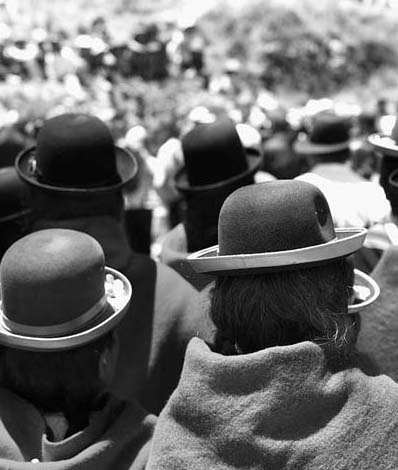
Bolivians attend the indigenous party at La Isla del Sol. There are over 30 groups that make up the indigenous population.
Family and Social Structures
Bolivian society is stratified along social class lines, although social mobility is possible. Ethnicity and culture have historically been key determinants of class standing, especially for those of Andean background or appearance. The lower classes are largely rural indigenous and peasant groups and urban poor and unskilled workers. Mestizos, disparagingly called cholos, form the middle group while a small, largely white elite forms the top group. Markers of elite status include residential area, Western clothing, housing, material goods, and high occupational and educational levels.
Nuclear household units and extended families are the main social components of Bolivian society. Kin networks and their social obligations are extended through marriage and fictive kin such as godparents. An inadequate government social welfare system and the large percentage of the population who work within informal economic networks mean that most Bolivians rely on kinship networks for economic assistance. Kinship networks are also crucial in the maintenance of social control. In some rural communities, land is communally owned and worked by kin groups. NGOS are also active in Bolivia, working in the areas of poverty, unemployment, agriculture, and coca leaf crop substitution programs.
Bolivians place a cultural emphasis on generosity and enjoy socializing on large and small scales. Villages, towns, and cities are situated around a central plaza that also serves as a communal social and entertainment space. Communal secular celebrations include Independence Day (August 6) and Labor Day (May 1), as well as national and regional festivals. Soccer is the dominant national sport, as it is in many Latin American countries. Other popular sports include basketball and volleyball. Vibrant literary, artistic, and cultural scenes receive support from the Bolivian Institute of Culture. La Paz and Sucre are known for their textiles, and many indigenous women pass on their culture's heritage through weaving, songs, and language.
Urban areas feature cinemas, theaters, and discos. Bolivia, like other Latin American countries, has seen a recent expansion in Internet use as personal computers become more affordable and broadband networks are increasingly available. Internet cafés are available in urban areas. According to Internet World Stats, 10.7 percent of the population has Internet access. E-mail and social networking sites such as Sonico, Hi5, Facebook, and MySpace are the most popular online activities, supporting the strong social emphasis on family ties.
Religious and Spiritual Components
Most Bolivians belong to the historically influential Roman Catholic Church. Protestantism and indigenous Andean beliefs are also practiced. Popular religious followings include that of the Virgin Mary; the national patron saint, the Virgin of Copacabana; and the Andean earth mother, known as Pachamama. Many social celebrations have a Catholic or Andean religious component, such as the Night of Saint John/summer solstice (June 21), All Souls and All Saints Days (November 1 and 2), Christmas, and carnival festivals prior to the Lenten season. Andean religion includes key social rituals such as coca chewing that maintain social and spiritual networks. Traditional medical practices include the use of divination and rituals and the belief that certain illnesses can be attributed to witchcraft or social conflicts.
...
- History of Social Networking
- American Revolutionary War
- Ancient China
- Ancient Egypt
- Ancient Greece
- Ancient India
- Ancient Rome
- Civil War, U.S.
- Colonial America
- Earliest Civilizations
- History of Social Networks 1865–1899
- History of Social Networks 1900–1929
- History of Social Networks 1930–1940
- History of Social Networks 1941–1945
- History of Social Networks 1946–1959
- History of Social Networks 1960–1975
- History of Social Networks 1976–1999
- History of Social Networks 2000–Present
- Industrial Revolution
- Internet History and Networks
- Middle Ages
- Native Americans
- Renaissance
- World-Systems Networks
- Local U.S. Social Networks by State
- Alabama
- Alaska
- Arizona
- Arkansas
- California
- Colorado
- Connecticut
- Delaware
- District of Columbia
- Florida
- Georgia (State)
- Hawaii
- Idaho
- Illinois
- Indiana
- Iowa
- Kansas
- Kentucky
- Louisiana
- Maine
- Maryland
- Massachusetts
- Michigan
- Minnesota
- Mississippi
- Missouri
- Montana
- Nebraska
- Nevada
- New Hampshire
- New Jersey
- New Mexico
- New York
- North Carolina
- North Dakota
- Ohio
- Oklahoma
- Oregon
- Pennsylvania
- Rhode Island
- South Carolina
- South Dakota
- Tennessee
- Texas
- Utah
- Vermont
- Virginia
- Washington
- West Virginia
- Wisconsin
- Wyoming
- Privacy and Rights in Social Networks
- Social Network Analysis and Issues
- Affiliation Networks
- Agent-Based Models
- Bipartite networks
- Blockmodeling
- Cohesion Networks
- Complexity
- Cooperation/Coordination
- Dating
- Egocentric Networks
- Embeddedness
- Exchange Networks
- Exponential Randon Graph Models (ERGM/p*)
- Graph Theory
- Homophily
- Longitudinal Networks
- Multiplexed Networks
- Network Analysis Software
- Network Evolution
- Network Indicators
- Network Simulations
- Network Theory
- Network Visualization
- Paths/Walks/Cycles
- Pornography Networks
- Power Law Networks
- Preferential Attachment
- Prominence
- Proximity/Space
- Q-Analysis
- Random Graph Models
- Reciprocity
- Self-Organizing Networks
- Semantic Networks
- Small World
- Social Capital
- Social Influence
- Social Support
- Stalking
- Structural Equivalence
- Structural Holes
- Structural Theory
- Tie Length
- Tie Strength
- Tie Utility
- Tipping Point
- Triads
- Trust and Networks
- Two-Mode Networks
- Word Networks
- Social Networking around the World
- Afghanistan
- Algeria
- Angola
- Argentina
- Armenia
- Australia
- Austria
- Azerbaijan
- Bangladesh
- Belarus
- Belgium
- Benin
- Bolivia
- Brazil
- Bulgaria
- Burkina Faso
- Burundi
- Côte d'Ivoire
- Cambodia
- Cameroon
- Canada
- Central African Republic
- Chad, Republic of
- Chile
- China
- Colombia
- Congo, Democratic Republic of the
- Costa Rica
- Croatia
- Cuba
- Czech Republic
- Denmark
- Dominican Republic
- Ecuador
- Egypt
- El Salvador
- Eritrea
- Estonia
- Ethiopia
- Finland
- France
- Georgia (Country)
- Germany
- Ghana
- Greece
- Guatemala
- Guinea
- Haiti
- Honduras
- Hungary
- India
- Indonesia
- Iran
- Iraq
- Ireland
- Israel
- Italy
- Japan
- Jordan
- Kazakhstan
- Kenya
- Kurdistan
- Kyrgyzstan
- Laos
- Latvia
- Libya
- Lithuania
- Malawi
- Malaysia
- Mali
- Mexico
- Morocco
- Mozambique
- Myanmar
- Nepal
- Netherlands
- New Zealand
- Nicaragua
- Niger
- Nigeria
- North Korea
- Norway
- Pakistan
- Papua New Guinea
- Paraguay
- Peru
- Philippines
- Poland
- Portugal
- Romania
- Russia
- Rwanda
- Saudi Arabia
- Senegal
- Serbia
- Sierra Leone
- Singapore
- Slovakia
- Somalia
- South Africa
- South Korea
- Spain
- Sri Lanka
- Sudan
- Sweden
- Switzerland
- Syria
- Tajikistan
- Tanzania
- Thailand
- Togo
- Tunisia
- Turkey
- Turkmenistan
- Uganda
- Ukraine
- United Arab Emirates
- United Kingdom
- United States
- Uzbekistan
- Venezuela
- Vietnam
- Yemen
- Zambia
- Zimbabwe
- Social Networking Communities
- Adults-Only Communities
- Artists Communities
- Blogs and Networks
- Books Communities
- Classmates
- College Students Communities
- CouchSurfing
- Deviant Communities
- Elitist Communities
- Games Communities
- Investing Communities
- Local Political Activism Communities
- Mothers Communities
- Movie and TV Series Communities
- Music Communities
- MySpace
- Newsgroups
- People with Disabilities Communities
- Religious Communities
- Scientific Communities
- Teen Communities
- Wikipedia
- Yahoo!
- YouTube and Video Exchange
- Social Networking Organizations
- AARP (American Association of Retired Persons)
- Alcoholics Anonymous (AA)
- American Civil Liberties Union (ACLU)
- Charity Organizations
- Conservative Organizations
- Government Networks
- Greenpeace
- International Network for Social Network Analysis (INSNA)
- Liberal Organizations
- National Association for the Advancement of Colored People (NAACP)
- Neighborhood Organizations
- Nongovernmental Organizations (NGOs)
- Unions
- United Nations
- United Service Organizations (USO)
- Social Science of Networking
- Alumni Networks
- Anthropological Networks
- Bibliometrics/Citation Networks
- Cancer Networks
- Children's Networks
- Cognitive Networks
- Communication Networks
- Conspiracy Theory and Gossip Networks
- Corporate Networking
- Diet Networks
- Diffusion/Contagion Networks
- Economic Networks
- Educational Networks
- Employment Networks
- Entrepreneurial Networks
- Environmental Activism
- Ethnicity and Networks
- Fan Networks
- Fraternities
- Game Theory and Networks
- Gangs
- Gender and Networks
- Health Networks
- Hobby Networks
- Human Rights Networks
- Infectious Disease Networks
- Innovation Networks
- Interdepartmental Networks
- International Networks
- Interorganizational/Interlocks
- Kinship Networks
- Knowledge Networks
- Leadership Networks
- Letter-Writing
- Military Networks
- Neighborhood Organizations
- Network Psychology
- Network Visualization
- Organizational Networks
- Policy Networks
- Religious Communities
- Scholar Networks
- Senior Networks
- Small Group Networks
- Sororities
- Sports Networks
- Telecommunication Networks
- Twelve-Step Programs
- Urban Networks
- War and Networks
- Women's Networks
- Technology and Social Networking
- Loading...
Get a 30 day FREE TRIAL
-
 Watch videos from a variety of sources bringing classroom topics to life
 -
Read modern, diverse business cases
-
Explore hundreds of books and reference titles

Read next

More like this
Sage Recommends
We found other relevant content for you on other Sage platforms.
Have you created a personal profile? Login or create a profile so that you can save clips, playlists and searches