
Entry
Reader's guide
Entries A-Z
Subject index
Azerbaijan
Azerbaijan is a former Soviet republic. Networks include family, clan, region, ethnic group, religion, and republic levels, with a remnant of Soviet influence. The population is overwhelmingly Muslim, but the nation does not regard Islam as a major source of identity. Azerbaijan's principal identity is ethnic nationalism. This nationalism contains seeds of dislocation for those not sharing it, the Armenians.
In traditional society, the hoj, or clan, shared work and land, creating a tightly knit group of up to 40 members. Modern families are nuclear, sometimes including grandparents, but the family is still a unit that shares financial and emotional support. The man is still more likely to be the wage earner, while the woman tends to the home. Hierarchy still matters. Law is commonly second to tradition, family, and religion.
The loss of the Soviet state prompted traditional networks to resume state functions. Family networks and others have allowed for a relatively easy transition to the market economy and have provided a substitute for the social safety net the Soviets formerly provided. The family network has served as a contact between government and the larger public and reduced the amount of violence during the dislocations of political change. Family ties, which are often political ties as well, promote attachment to the state and to family members in neighboring states such as Iran; and in 1989, these ties even led Azerbaijanis to attempt to dissolve their border between their ethnic brothers in Iran.
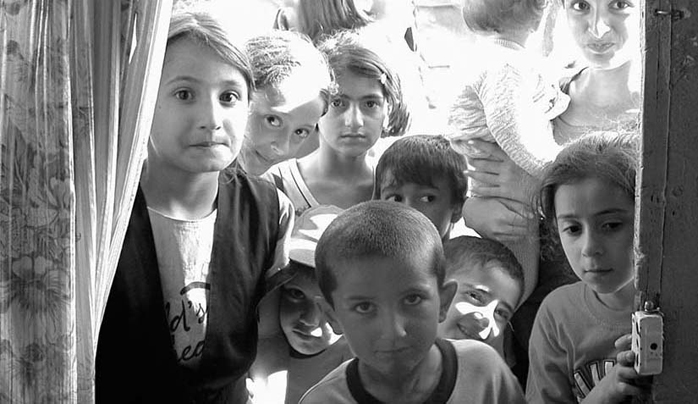
Children in Yeni Karki, Nakhchivan, Azerbaijan, peek into a local health clinic in anticipation of receiving vaccinations. Azerbaijan family and kinship networks have suffered through a post-Soviet economic downturn, an Armenian conflict, and a refugee crisis.
The primacy of family reduces the attraction of other potential ties such as Islam, but that does not eliminate religion as an influence. In conjunction with the Azeri preference for local culture and customs, it does keep Islamic nationalism and radicalism from becoming strong in Azerbaijan and other family-dominated countries. The Shi'i-Sunni split is insignificant when religion is not a major driver of politics. However, it does influence morality and mores, defining birth, marriage, death, and other passages. Officially, Azerbaijan practices church-state separation as a secular state, a legacy of its Soviet-era removal of most power from the Muslim hierarchy. This allows for greater toleration in its conflict with Christian Armenia and also allows for lax-to-nonexistent observance of the dietary laws and other Islamic rules. Conservative practices are more a product of tradition and habit than of religious belief.
Family ties weaken state building and national identity, potentially destabilizing the state. The president of Azerbaijan may call on the agh sakkal, or white beards (the heads of families), to resolve problems.
Armenian and Refugee Networks
The society is not homogeneous, and minority Armenian networks are a dysfunctional result. Azerbaijan, and Armenians in the ethnic enclave of Nagorno-Karabakh fought between 1988 and 1994. The conflict displaced more than a million people, many of whom still lived 15 years later in refugee camps, dependent on humanitarian organizations. Refugees, aside from insufficient water and housing and the other problems of refugee status, were either underemployed or unemployed; women and children, in particular, were under stress due to loss of self-esteem and dignity. The post-Soviet economic downturn only exacerbated these conditions. The longer they remained in the camps, the greater their chance of being excluded socially. Even those with work tended to be underemployed. Some local officials closed off their cities to the refugees, using roadblocks and prohibitions of transients in their cities. Refugees and aliens were barred from buying property in Azerbaijan. Mandatory registration with the local police was in conflict with national law.
...
- History of Social Networking
- American Revolutionary War
- Ancient China
- Ancient Egypt
- Ancient Greece
- Ancient India
- Ancient Rome
- Civil War, U.S.
- Colonial America
- Earliest Civilizations
- History of Social Networks 1865–1899
- History of Social Networks 1900–1929
- History of Social Networks 1930–1940
- History of Social Networks 1941–1945
- History of Social Networks 1946–1959
- History of Social Networks 1960–1975
- History of Social Networks 1976–1999
- History of Social Networks 2000–Present
- Industrial Revolution
- Internet History and Networks
- Middle Ages
- Native Americans
- Renaissance
- World-Systems Networks
- Local U.S. Social Networks by State
- Alabama
- Alaska
- Arizona
- Arkansas
- California
- Colorado
- Connecticut
- Delaware
- District of Columbia
- Florida
- Georgia (State)
- Hawaii
- Idaho
- Illinois
- Indiana
- Iowa
- Kansas
- Kentucky
- Louisiana
- Maine
- Maryland
- Massachusetts
- Michigan
- Minnesota
- Mississippi
- Missouri
- Montana
- Nebraska
- Nevada
- New Hampshire
- New Jersey
- New Mexico
- New York
- North Carolina
- North Dakota
- Ohio
- Oklahoma
- Oregon
- Pennsylvania
- Rhode Island
- South Carolina
- South Dakota
- Tennessee
- Texas
- Utah
- Vermont
- Virginia
- Washington
- West Virginia
- Wisconsin
- Wyoming
- Privacy and Rights in Social Networks
- Social Network Analysis and Issues
- Affiliation Networks
- Agent-Based Models
- Bipartite networks
- Blockmodeling
- Cohesion Networks
- Complexity
- Cooperation/Coordination
- Dating
- Egocentric Networks
- Embeddedness
- Exchange Networks
- Exponential Randon Graph Models (ERGM/p*)
- Graph Theory
- Homophily
- Longitudinal Networks
- Multiplexed Networks
- Network Analysis Software
- Network Evolution
- Network Indicators
- Network Simulations
- Network Theory
- Network Visualization
- Paths/Walks/Cycles
- Pornography Networks
- Power Law Networks
- Preferential Attachment
- Prominence
- Proximity/Space
- Q-Analysis
- Random Graph Models
- Reciprocity
- Self-Organizing Networks
- Semantic Networks
- Small World
- Social Capital
- Social Influence
- Social Support
- Stalking
- Structural Equivalence
- Structural Holes
- Structural Theory
- Tie Length
- Tie Strength
- Tie Utility
- Tipping Point
- Triads
- Trust and Networks
- Two-Mode Networks
- Word Networks
- Social Networking around the World
- Afghanistan
- Algeria
- Angola
- Argentina
- Armenia
- Australia
- Austria
- Azerbaijan
- Bangladesh
- Belarus
- Belgium
- Benin
- Bolivia
- Brazil
- Bulgaria
- Burkina Faso
- Burundi
- Côte d'Ivoire
- Cambodia
- Cameroon
- Canada
- Central African Republic
- Chad, Republic of
- Chile
- China
- Colombia
- Congo, Democratic Republic of the
- Costa Rica
- Croatia
- Cuba
- Czech Republic
- Denmark
- Dominican Republic
- Ecuador
- Egypt
- El Salvador
- Eritrea
- Estonia
- Ethiopia
- Finland
- France
- Georgia (Country)
- Germany
- Ghana
- Greece
- Guatemala
- Guinea
- Haiti
- Honduras
- Hungary
- India
- Indonesia
- Iran
- Iraq
- Ireland
- Israel
- Italy
- Japan
- Jordan
- Kazakhstan
- Kenya
- Kurdistan
- Kyrgyzstan
- Laos
- Latvia
- Libya
- Lithuania
- Malawi
- Malaysia
- Mali
- Mexico
- Morocco
- Mozambique
- Myanmar
- Nepal
- Netherlands
- New Zealand
- Nicaragua
- Niger
- Nigeria
- North Korea
- Norway
- Pakistan
- Papua New Guinea
- Paraguay
- Peru
- Philippines
- Poland
- Portugal
- Romania
- Russia
- Rwanda
- Saudi Arabia
- Senegal
- Serbia
- Sierra Leone
- Singapore
- Slovakia
- Somalia
- South Africa
- South Korea
- Spain
- Sri Lanka
- Sudan
- Sweden
- Switzerland
- Syria
- Tajikistan
- Tanzania
- Thailand
- Togo
- Tunisia
- Turkey
- Turkmenistan
- Uganda
- Ukraine
- United Arab Emirates
- United Kingdom
- United States
- Uzbekistan
- Venezuela
- Vietnam
- Yemen
- Zambia
- Zimbabwe
- Social Networking Communities
- Adults-Only Communities
- Artists Communities
- Blogs and Networks
- Books Communities
- Classmates
- College Students Communities
- CouchSurfing
- Deviant Communities
- Elitist Communities
- Games Communities
- Investing Communities
- Local Political Activism Communities
- Mothers Communities
- Movie and TV Series Communities
- Music Communities
- MySpace
- Newsgroups
- People with Disabilities Communities
- Religious Communities
- Scientific Communities
- Teen Communities
- Wikipedia
- Yahoo!
- YouTube and Video Exchange
- Social Networking Organizations
- AARP (American Association of Retired Persons)
- Alcoholics Anonymous (AA)
- American Civil Liberties Union (ACLU)
- Charity Organizations
- Conservative Organizations
- Government Networks
- Greenpeace
- International Network for Social Network Analysis (INSNA)
- Liberal Organizations
- National Association for the Advancement of Colored People (NAACP)
- Neighborhood Organizations
- Nongovernmental Organizations (NGOs)
- Unions
- United Nations
- United Service Organizations (USO)
- Social Science of Networking
- Alumni Networks
- Anthropological Networks
- Bibliometrics/Citation Networks
- Cancer Networks
- Children's Networks
- Cognitive Networks
- Communication Networks
- Conspiracy Theory and Gossip Networks
- Corporate Networking
- Diet Networks
- Diffusion/Contagion Networks
- Economic Networks
- Educational Networks
- Employment Networks
- Entrepreneurial Networks
- Environmental Activism
- Ethnicity and Networks
- Fan Networks
- Fraternities
- Game Theory and Networks
- Gangs
- Gender and Networks
- Health Networks
- Hobby Networks
- Human Rights Networks
- Infectious Disease Networks
- Innovation Networks
- Interdepartmental Networks
- International Networks
- Interorganizational/Interlocks
- Kinship Networks
- Knowledge Networks
- Leadership Networks
- Letter-Writing
- Military Networks
- Neighborhood Organizations
- Network Psychology
- Network Visualization
- Organizational Networks
- Policy Networks
- Religious Communities
- Scholar Networks
- Senior Networks
- Small Group Networks
- Sororities
- Sports Networks
- Telecommunication Networks
- Twelve-Step Programs
- Urban Networks
- War and Networks
- Women's Networks
- Technology and Social Networking
- Loading...
Get a 30 day FREE TRIAL
-
 Watch videos from a variety of sources bringing classroom topics to life
 -
Read modern, diverse business cases
-
Explore hundreds of books and reference titles

Read next

More like this
Sage Recommends
We found other relevant content for you on other Sage platforms.
Have you created a personal profile? Login or create a profile so that you can save clips, playlists and searches