
Entry
Reader's guide
Entries A-Z
Subject index
Due Process
Underlying and protecting the principle of fairness in crime and punishment is the constitutional protection of due process. Due process protects against arbitrary deprivation of life, liberty, or property. Therefore, due process requires that before the government deprives people of their life, liberty, or property, the applicable law is publicly accessible, the person is notified of the action and reasons for the action, he or she is allowed a trial in accordance with legal principles at which he or she can present evidence and witnesses in his or her defense, and he or she is not subjected to any punishment unless and until he or she is found guilty. Due process appears in two places in the U.S. Constitution, each having a different impact on crime and punishment. As it appears in the Fifth Amendment, due process protects against the arbitrary actions of the federal government. Due process in the Fourteenth Amendment is used to incorporate, or apply, the federal constitutional rights to the states.
Historical Perspective
The concept of due process, or not arbitrarily depriving people of life, liberty, or property, can be traced back to the Magna Carta. Chapter 39 of the Magna Carta requires a trial by peers according to the law before punishment can be taken against a person. These provisions were further clarified by Sir Edmund Coke in 1628 in the Petition of Right. Coke expanded and clarified the protections in the Magna Carta by protecting against deprivation of life, liberty, and property without either parliamentary action or due process of law. Therefore, in the English context, due process protected against arbitrary action by the Crown.
As the American constitution was being drafted, the framers included the concept of due process to protect against arbitrary action by all branches and actors of the federal government. Due process is part of the Fifth Amendment, which also protects against self-incrimination, double jeopardy, and taking of property without compensation. In the context of the Fifth Amendment, the federal government is prevented from prosecuting and punishing criminal activity without fair proceedings that are in accordance with established legal practice. The U.S. Supreme Court has consistently applied the Fifth Amendment due process guarantees to actions by the federal, not state, government.
With its inclusion in the Fourteenth Amendment, due process, and through its interpretation other rights, were applied to actions by the state governments. As worded, the Fourteenth Amendment specifically requires states to follow the principles of fairness and legal process in the deprivation of life, liberty, or property. Thus, while the Fifth Amendment protects against arbitrary federal action, the Fourteenth Amendment protects against arbitrary state action. Yet the power of the Fourteenth Amendment's due process clause has been in its interpretation. The U.S. Supreme Court has interpreted due process in the Fourteenth Amendment to extend the protections in the Bill of Rights to actions by state governments.
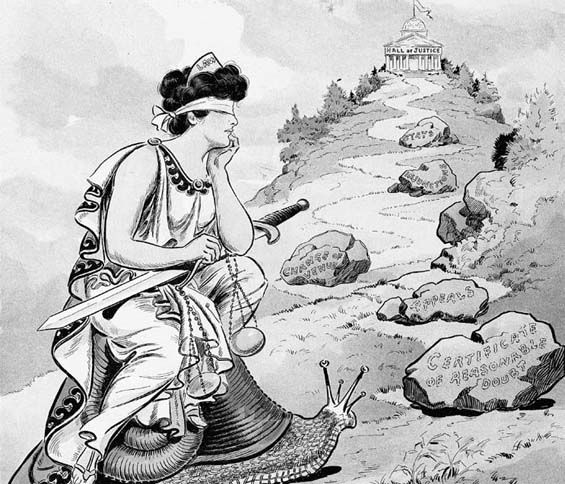
This 1903 illustration titled “Due Process of Law” uses a figure representing justice riding a snail up a winding path to comment on the perceived slowness of the legal system caused by due process. The path is strewn with boulders labeled “certificate of reasonable doubt,” “appeals,” “change of venue,” “injunctions,” and “stays,” and ends at the “Hall of Justice” at the top of the hill.
...
- Arpaio, Joseph M.
- Augustus, John
- Beaumont, Gustave de
- Blackstone, William
- Brennan, William J., Jr.
- Brockway, Zebulon
- Burger, Warren
- Bush, George H. W. (Administration of)
- Bush, George W. (Administration of)
- Byrnes, Thomas
- Cummings, Homer
- Darrow, Clarence
- Devery, William
- Dewey, Thomas E.
- Douglas, William O.
- Garfield, James
- Giuliani, Rudolph
- Hamilton, Alexander
- Holmes, Oliver Wendell, Jr.
- Hoover, J. Edgar
- Jefferson, Thomas
- Kennedy, Robert F.
- King, Martin Luther, Jr.
- Kunstler, William
- La Guardia, Fiorello
- Leopold and Loeb
- Livingston, Edward
- Marshall, John
- McCarthy, Joseph
- Ness, Eliot
- Paine, Thomas
- Parker, William
- Penn, William
- Percival, Robert V.
- Ragen, Joseph
- Rockefeller, Nelson
- Roosevelt, Theodore (Administration of)
- Snyder, Ruth
- Steenburgh, Sam
- Sutherland, Edwin
- Thaw, Harry K.
- Thoreau, Henry David
- Tocqueville, Alexis de
- Vollmer, August
- Walling, George
- Warren, Earl
- Wickersham, George
- Wilson, James Q.
- Wilson, O. W.
- Zeisel, Hans
- Adversarial Justice
- Alcatraz Island Prison
- American Law Institute
- Antitrust Law
- Appeals
- Appellate Courts
- Attica
- Bail and Bond
- Bedford Hills Correctional Facility
- Capital Punishment
- Chain Gangs and Prison Labor
- Chillicothe Correctional Institution
- Citizen Participation on Juries
- Civil Rights Laws
- Clemency
- Clinton Correctional Facility
- Codification of Laws
- Colonial Courts
- Common Law Origins of Criminal Law
- Community Service
- Comstock Law
- Confession
- Convict Lease System
- Corporal Punishment
- Corrections
- Courts
- Critical Legal Studies Movement
- Cruel and Unusual Punishment
- Death Row
- Defendant's Rights
- Deportation
- Deterrence, Theory of
- Discretionary Decision Making
- District Attorney
- Due Process
- Eastern State Penitentiary
- Electric Chair, History of
- Electronic Surveillance
- Elmira Prison
- Executions
- Famous Trials
- Federal Prisons
- Fingerprinting
- Fish and Game Laws
- Fornication Laws
- Gender and Criminal Law
- Habeas Corpus, Writ of
- Hanging
- Judges and Magistrates
- Juries
- Jurisdiction
- Justice, Department of
- Leavenworth Federal Penitentiary
- Legal Counsel
- Matteawan State Hospital
- Military Courts
- “New Punitiveness”
- Parole
- Penitentiaries
- Petty Courts
- Plea
- Prison Privatization
- Prison Riots
- Prisoner's Rights
- Probation
- Punishment Within Prison
- Race, Class, and Criminal Law
- Reform Movements in Justice
- Rehabilitation
- Rule of Law
- San Quentin State Prison
- Segregation Laws
- Sentencing
- Sentencing: Indeterminate Versus Fixed
- Sex Offender Laws
- Shaming and Shunning
- Sing Sing Correctional Facility
- Slavery, Law of
- Supreme Court, U.S.
- Suspect's Rights
- Torture
- Trials
- Victim Rights and Restitution
- Witness Testimony
- Women in Prison
- An American Tragedy
- Autobiographies, Criminals'
- Buntline, Ned
- Christie, Agatha
- Dime Novels, Pulps, Thrillers
- Film, Crime in
- Film, Police in
- Film, Punishment in
- Grafton, Sue
- Green, Anna K.
- Hammett, Dashiell
- Hillerman, Tony
- Literature and Theater, Crime in
- Literature and Theater, Police in
- Literature and Theater, Punishment in
- Memoirs, Police and Prosecutors
- Music and Crime
- News Media, Crime in
- News Media, Police in
- News Media, Punishment in
- Poe, Edgar Allen
- Spillane, Mickey
- Television, Crime in
- Television, Police in
- Television, Punishment in
- To Kill a Mockingbird
- Wambaugh, Joseph
- Abortion
- Adultery
- Bigamy/Polygamy
- Blood Sports
- Bootlegging
- Burglary, Contemporary
- Burglary, History of
- Burglary, Sociology of
- Computer Crime
- Confidence Games and Frauds
- Corruption, Contemporary
- Corruption, History of
- Corruption, Sociology of
- Counterfeiting
- Crime and Arrest Statistics Analysis
- Crime in America, Causes
- Crime in America, Distribution
- Crime in America, Types
- Crime Rates
- Criminology
- Domestic Violence, Contemporary
- Domestic Violence, History of
- Domestic Violence, Sociology of
- Drinking and Crime
- Drug Abuse and Addiction, Contemporary
- Drug Abuse and Addiction, History of
- Drug Abuse and Addiction, Sociology of
- Embezzlement
- Environmental Crimes
- Espionage
- Felonies
- Fornication Laws
- Fraud
- Frontier Crime
- Gambling
- Gangs, Contemporary
- Gangs, History of
- Gangs, Sociology of
- Guns and Violent Crime
- Hereditary Crime
- Identity Theft
- Immigration Crimes
- Incest
- Indecent Exposure
- Infanticide
- Kidnapping
- Larceny
- Livestock and Cattle Crimes
- Lynchings
- Moonshine
- Murder, Contemporary
- Murder, History of
- Murder, Sociology of
- Murders, Unsolved
- Obscenity
- Organized Crime, Contemporary
- Organized Crime, History of
- Organized Crime, Sociology of
- Pickpockets
- Political Crimes, Contemporary
- Political Crimes, History of
- Political Crimes, Sociology of
- Pornography
- Prostitution, Contemporary
- Prostitution, History of
- Prostitution, Sociology of
- Race-Based Crimes
- Rape, Contemporary
- Rape, History of
- Rape, Sociology of
- Religion and Crime, Contemporary
- Religion and Crime, History of
- Religion and Crime, Sociology of
- Riots
- Robbery, Contemporary
- Robbery, History of
- Robbery, Sociology of
- Serial and Mass Killers
- Sex Offenders
- Sexual Harassment
- Smuggling
- Sodomy
- Tax Crimes
- Terrorism
- Theories of Crime
- Traffic Crimes
- Vagrancy
- Victimless Crime
- Violent Crimes
- White-Collar Crime, Contemporary
- White-Collar Crime, History of
- White-Collar Crime, Sociology of
- Women Criminals, Contemporary
- Women Criminals, History of
- Women Criminals, Sociology of
- Anarchists
- Bakker, Jim
- Berkowitz, David
- Billy the Kid
- Bodine, Polly
- Boles, Charles
- Bonnie and Clyde
- Booth, John Wilkes
- Borden, Lizzie
- Brocius, William
- Bundy, Ted
- Capone, Al
- Chapman, Mark David
- Cunningham, Emma
- Czolgosz, Leon
- Dahmer, Jeffrey
- DeSalvo, Albert
- Dillinger, John
- Everleigh Sisters
- Ferguson, Colin
- Floyd, Charles Arthur
- Gacy, John Wayne
- Genovese, Vito
- Gotti, John
- Guiteau, Charles
- Hauptmann, Bruno
- James, Jesse
- Kaczynski, Ted
- Kevorkian, Jack
- Klebold, Dylan, and Eric Harris
- Leopold and Loeb
- Luciano, “Lucky”
- Manson, Charles
- Menendez, Lyle and Erik
- Mudgett, Herman
- Muhammad, John Allen
- Nelson, “Baby Face”
- Nitti, Frank
- Oswald, Lee Harvey
- Peterson, Scott
- Rader, Dennis
- Ramirez, Richard
- Ray, James Earl
- Rothstein, Arnold
- Sacco and Vanzetti
- Schultz, “Dutch”
- Sheppard, Sam
- Simpson, O. J.
- Sirhan Sirhan
- Smith, Susan
- Torrio, John
- Wuornos, Aileen
- Yates, Andrea
- Zodiac Killer
- Alien and Sedition Acts of 1798
- Anti-Federalist Papers
- Articles of Confederation
- Bail Reform Act
- Bible
- Bill of Rights
- Bodie of Liberties
- Book of the General Lawes & Libertyes
- Chinese Exclusion Act of 1882
- Civil Rights Act of 1866
- Civil Rights Act of 1875
- Clayton Anti-Trust Act of 1914
- Colonial Charters and Grants
- Constitution of the United States of America
- Declaration of Independence
- Dyer Act
- Elkins Act of 1903
- Emergency Quota Act of 1921
- Enforcement Acts of 1870–1871
- English Charter of Liberties of 1100
- Espionage Act of 1917
- Ethics in Government Act of 1978
- Federalist Papers
- Federal Rules of Criminal Procedure
- Freedom of Information Act of 1966
- Fugitive Slave Act of 1793
- Fugitive Slave Act of 1850
- Habeas Corpus Act of 1679
- Habeas Corpus Act of 1863
- Harrison Act of 1914
- Homestead Act of 1862
- Independent Treasury Act
- Indian Civil Rights Act
- Indian Removal Act
- Internal Security Act of 1950
- Interstate Commerce Act of 1887
- Intolerable Acts of 1774
- Judiciary Act of 1789
- Landrum-Griffin Act of 1859
- Law Enforcement Assistance Act
- Laws and Liberties of Massachusetts
- Lindbergh Law
- Magna Carta
- Mann Act
- Maryland Toleration Act of 1649
- Mayflower Compact
- National Security Act of 1947
- Northwest Ordinance of 1787
- Omnibus Crime Control and Safe Streets Act of 1968
- Pendleton Act of 1883
- Presidential Proclamations
- Proclamation for Suppressing Rebellion and Sedition of 1775
- Pure Food and Drug Act of 1906
- Reports on Prison Conditions
- Sedition Act of 1918
- Selective Service Act of 1967
- Sherman Anti-Trust Act of 1890
- Smith Act
- Stamp Act of 1765
- State Blue Laws
- State Slave Codes
- Tea Act of 1773
- Townshend Acts of 1767
- USA PATRIOT Act of 2001
- Vice Commission
- Violence Against Women Act of 1994
- Volstead Act
- Chicago, Illinois
- Las Vegas, Nevada
- Los Angeles, California
- Miami, Florida
- New York City
- Newark, New Jersey
- Pittsburgh, Pennsylvania
- San Francisco, California
- Alabama
- Alaska
- Arizona
- Arkansas
- California
- Colorado
- Connecticut
- Delaware
- Florida
- Georgia
- Hawai'i
- Idaho
- Illinois
- Indiana
- Iowa
- Kansas
- Kentucky
- Louisiana
- Maine
- Maryland
- Massachusetts
- Michigan
- Minnesota
- Mississippi
- Missouri
- Montana
- Nebraska
- Nevada
- New Hampshire
- New Jersey
- New Mexico
- New York
- North Carolina
- North Dakota
- Ohio
- Oklahoma
- Oregon
- Pennsylvania
- Rhode Island
- South Carolina
- South Dakota
- Tennessee
- Texas
- Utah
- Vermont
- Virginia
- Washington
- West Virginia
- Wisconsin
- Wyoming
- American Revolution and Criminal Justice
- Court of Common Pleas
- Court of Oyer and Terminer
- Court of Quarter Sessions
- Courts of Indian Offenses
- Coverture, doctrine of
- Equality, Concept of
- Great Depression
- History of Crime and Punishment in America: Colonial
- History of Crime and Punishment in America: 1783–1850
- History of Crime and Punishment in America: 1850–1900
- History of Crime and Punishment in America: 1900–1950
- History of Crime and Punishment in America: 1950–1970
- History of Crime and Punishment in America: 1970-Present
- Homeland Security
- Prohibition
- Puritans
- Salem Witch Trials
- Victorian Compromise
- Child Abuse, Contemporary
- Child Abuse, History of
- Child Abuse, Sociology of
- Child Murderers, History of
- Children, Abandoned
- Children's Rights
- Juvenile Corrections, Contemporary
- Juvenile Corrections, History of
- Juvenile Corrections, Sociology of
- Juvenile Courts, Contemporary
- Juvenile Courts, History of
- Juvenile Delinquency, History of
- Juvenile Delinquency, Sociology of
- Juvenile Justice, History of
- Juvenile Offenders, Prevention and Education
- Juvenile Offenders in Adult Courts
- School Shootings
- Lindsey, Ben
- Atlanta, Georgia
- Baltimore, Maryland
- Birmingham, Alabama
- Camden, New Jersey
- Cincinnati, Ohio
- Cleveland, Ohio
- Compton, California
- Dayton, Ohio
- Detroit, Michigan
- Jackson, Mississippi
- Kansas City, Missouri
- Memphis, Tennessee
- New Orleans, Louisiana
- Oakland, California
- St. Louis, Missouri
- Washington, D.C.
- American Bar Association
- American Civil Liberties Union
- Knapp Commission
- Ku Klux Klan
- Law Enforcement Assistance Administration
- Lawyers Guild
- National Association for the Advancement of Colored People
- National Commission on Law Observance and Enforcement
- National Congress on Penitentiary and Reformatory Discipline
- National Organization for Women
- National Prison Association
- Penitentiary Study Commission
- President's Commission on Law Enforcement and the Administration of Justice
- Securities and Exchange Commission
- Students for a Democratic Society and the Weathermen
- Wickersham Commission
- Automobile and the Police
- Ballistics
- Bertillon System
- Border Patrol
- Bounty Hunters
- Bureau of Alcohol, Tobacco, Firearms and Explosives
- Code of Silence
- Community Policing and Relations
- Corruption, Contemporary
- Corruption, History of
- Corruption, Sociology of
- Crime Prevention
- Crime Scene Investigation
- Customs Service as Police
- Detection and Detectives
- Drug Enforcement Administration
- Federal Bureau of Investigation
- Federal Policing
- Forensic Science
- Incapacitation, Theory of
- Internal Revenue Service
- Interrogation Practices
- Military Police
- Miranda v. Arizona
- M'Naghten Test
- Mug Shots
- Narcotics Laws
- National Police Gazette
- Native American Tribal Police
- Police, Women as
- Police Abuse
- Political Policing
- Posses
- Private Detectives
- Private Police
- Private Security Services
- Professionalization of Police
- Reform, Police and Enforcement
- Rural Police
- Secret Service
- Sheriffs
- State Police
- Strikes
- Technology, Police
- Texas Rangers
- Training Police
- Uniform Crime Reporting Program
- Vice Reformers
- Vigilantism
- Adams, John (Administration of)
- Adams, John Quincy (Administration of)
- Arthur, Chester (Administration of)
- Buchanan, James (Administration of)
- Buren, Martin Van (Administration of)
- Bush, George H. W. (Administration of)
- Bush, George W. (Administration of)
- Carter, Jimmy (Administration of)
- Cleveland, Grover (Administration of)
- Clinton, William (Administration of)
- Coolidge, Calvin (Administration of)
- Eisenhower, Dwight D. (Administration of)
- Fillmore, Millard (Administration of)
- Ford, Gerald (Administration of)
- Grant, Ulysses S. (Administration of)
- Harding, Warren G. (Administration of)
- Harrison, Benjamin (Administration of)
- Hayes, Rutherford B. (Administration of)
- Hoover, Herbert (Administration of)
- Jackson, Andrew (Administration of)
- Jefferson, Thomas (Administration of)
- Johnson, Andrew (Administration of)
- Kennedy, John F. (Administration of)
- Lincoln, Abraham (Administration of)
- Madison, James (Administration of)
- McKinley, William (Administration of)
- Monroe, James (Administration of)
- Nixon, Richard (Administration of)
- Obama, Barack (Administration of)
- Pierce, Franklin (Administration of)
- Polk, James K. (Administration of)
- Reagan, Ronald (Administration of)
- Roosevelt, Franklin D. (Administration of)
- Roosevelt, Theodore (Administration of)
- Taft, William Howard (Administration of)
- Taylor, Zachary (Administration of)
- Truman, Harry S. (Administration of)
- Tyler, John (Administration of)
- Washington, George (Administration of)
- Wilson, Woodrow (Administration of)
- African Americans
- Chinese Americans
- Civil Disobedience
- Civil Rights Laws
- Codification of Laws
- Criminalization and Decriminalization
- Fear of Crime
- Gun Control
- Hispanic Americans
- Insanity Defense
- Irish Americans
- Italian Americans
- Japanese Americans
- Jewish Americans
- Libertarianism
- Morality
- Native Americans
- Obscenity Laws
- Political Dissidents
- Quakers
- Racism
- Sin
- Slavery
- Urbanization
- Xenophobia
- Ableman v. Booth
- Abrams v. United States
- Adair v. United States
- Barron v. Mayor of Baltimore
- Bowers v. Hardwick
- Brandenburg v. Ohio
- Brown v. Board of Education
- Brown v. Mississippi
- Buck v. Bell
- Caminetti v. United States
- Chandler v. Florida
- Chisholm v. Georgia
- Cohens v. Virginia
- Coker v. Georgia
- Crabtree v. State
- Davis v. State
- Dennis v. United States
- Dillard v. the State of Georgia
- Dred Scott v. Sandford
- Duren v. Missouri
- Eisenstadt v. Baird
- Estes v. Texas
- Fletcher v. Peck
- Frontiero v. Richardson
- Furman v. Georgia
- Gates v. Collier
- Gibbons v. Ogden
- Gideon v. Wainwright
- Glidewell v. State
- Gregg v. Georgia
- Griffin v. California
- Griswold v. Connecticut
- Grutter v. Bollinger
- Holden v. Hardy
- Holt v. Sarver
- Hurtado v. California
- Johnson v. Avery
- Korematsu v. United States
- Lochner v. New York
- Loving v. Virginia
- Mapp v. Ohio
- Marbury v. Madison
- Martin v. Hunter's Lessee
- McCleskey v. Kemp
- McCulloch v. Maryland
- McNabb v. United States
- Minor v. Happersett
- Miranda v. Arizona
- Mississippi v. Johnson
- Muller v. Oregon
- Munn v. Illinois
- Olmstead v. United States
- Padilla v. Kentucky
- People v. Pinnell
- People v. Superior Court of Santa Clara County
- Plessy v. Ferguson
- Procunier v. Martinez
- Reynolds v. United States
- Ricci v. DeStefano
- Roberts v. Louisiana
- Roe v. Wade
- Romer v. Evans
- Roth v. United States
- Santobello v. New York
- Schenck v. United States
- Sheppard v. Maxwell
- Standard Oil Co. of New Jersey v. United States
- State v. Heitman
- Strauder v. West Virginia
- Taylor v. State
- Terry v. Ohio
- Texas v. White
- Twining v. New Jersey
- United States v. Ballard
- United States v. E. C. Knight Company
- United States v. Hudson and Goodwin
- United States v. Nixon
- United States v. One Book Called Ulysses
- Webb v. United States
- Weeks v. United States
- Whitney v. California
- Wolf v. Colorado
- Yates v. United States
- Loading...
Get a 30 day FREE TRIAL
-
 Watch videos from a variety of sources bringing classroom topics to life
 -
Read modern, diverse business cases
-
Explore hundreds of books and reference titles

Read next

More like this
Sage Recommends
We found other relevant content for you on other Sage platforms.
Have you created a personal profile? Login or create a profile so that you can save clips, playlists and searches