
Entry
Reader's guide
Entries A-Z
Subject index
Clarke, Arthur C. (1917–2008)
Arthur Charles Clarke has been described in many ways: as a “true Renaissance person,” a scientist and inventor, a cosmic dreamer, and the father of satellite communications. During his 90-year lifetime and 70-year career, he wrote nearly 100 books, both fiction and nonfiction. Always, his prime mission was to explore the mysteries of the world and the cosmos. In his scientific and engineering writings, he opened many new doors, most notably in the fields of radar and satellite communications. He not only inspired generations through his writing but also first envisioned the geosynchronous satellite system on which today's global electronic communication system is based.
Clarke is most celebrated for his science fiction, which won every top honor in the field. In fact, Rendezvous With Rama alone won the Hugo, the Nebula, the Jupiter, and the Campbell Memorial awards. He later earned the Edgar Award, named in honor of Edgar Allan Poe.
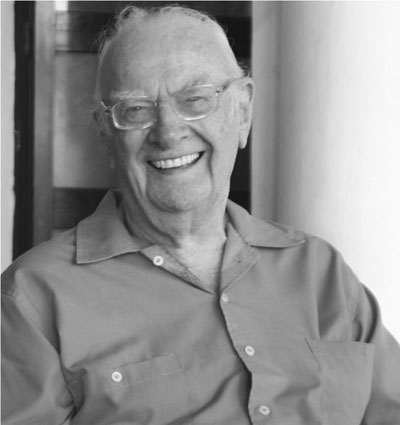
Arthur C. Clarke
Clarke's fiction classics include Childhood's End, Fountains of Paradise, and 3001: The Final Space Odyssey. (Both of these books anticipate the creation of a so-called space elevator—a futuristic device that might one day lift cargo and humans to “Clarke orbit.” This is one of his many predictions that has yet to be realized.)
His books and almost countless short stories have now been translated into many languages. Yet it was the screenplay that he cowrote with Stanley Kubrick for the movie 2001: A Space Odyssey— based on Clarke's short story “The Sentinel”—that best explains how he became a household name around the globe. The American Film Institute ranks 2001: A Space Odyssey as one of the top 10 movies of all time. Ironically, only after the film was released did Clarke actually go back and finish writing the book that made him so famous.
Clarke's compelling science fiction would have brought him fame, but this was only one of his talents. His scientific writings, inventions, and predictions led to his recognition as a “true Renaissance man.” His writings spanned science, energy, the oceans, the environment, mathematics, computers, and communications as well as world peace, futurism, and politics—always with a hint of his wry British humor. His famous “Arthur C. Clarke's Three Laws” from his 1962 Profiles of the Future captures the spirit of this much beloved guru:
- When a distinguished but elderly scientist states that something is possible, he is almost certainly right. When he states that something is impossible, he is very probably wrong.
- The only way of discovering the limits of the possible is to venture a little way past them into the impossible.
- Any sufficiently advanced technology is indistinguishable from magic.
It was Clarke's technical writings that most won him respect and admiration in the scientific world. Many astronauts, including John Glenn, have indicated that Clarke first inspired them. In the spring of 1945, Clarke circulated a paper outlining a radical new idea. It explained how three rocket-launched communications satellites positioned in geosynchronous orbit could provide a global network using earth stations that did not have to track across the sky. Later that year, Clarke published his full landmark paper “ExtraTerrestrial Relays” in Wireless World. It explained in detail the orbital mechanics of the geosynchronous orbit. Clarke showed that a satellite traveling in circular orbit some 22,230 miles (35,870 kilometers) above the earth's surface would appear stationary in this sky. This is because this “magic” orbit at this precise altitude would have precisely the right velocity to travel around the globe once a day, and this velocity would generate sufficient centrifugal force to exactly overcome the gravitational pull at this height. Only one unique solution to this particular set of conditions applies—no other orbit can meet these special conditions.
...
- Associations and Organizations
- Agricultural Communicators of Tomorrow
- American Association for Public Opinion Research
- American Association for the Advancement of Science (AAAS)
- American Medical Association
- American Medical Writers Association
- Association for Communication Excellence
- Center for Science in the Public Interest
- Council for the Advancement of Science Writing
- Environmental Defense Fund
- ETC Group
- Greenpeace
- International Science Journalism Associations
- National Association of Science Writers
- Physicians for Social Responsibility
- Public Communication of Science and Technology
- Royal Society
- SciDev.Net
- Scientists' Institute for Public Information
- Search for Extraterrestrial Intelligence
- Sigma Xi
- Society for Risk Analysis
- Society for Technical Communication
- Society of Environmental Journalists
- Union of Concerned Scientists
- Audiences, Opinions, and Effects
- Active Audiences and Science
- Attentive Public
- Audiences for Science
- Children's Television and Science
- Communicating Science to Children
- Gender Representations of Scientists
- Health Literacy
- Interpretive Communities
- Knowledge Gap Hypothesis
- Popular Science and Formal Education
- Public Understanding of Research
- Public Understanding of Science
- Role Models in Science
- Science Indicators, History of the NSB Project on
- Science Literacy
- Scientist—Journalist Relations
- Surveys
- Technological Literacy
- Trust and Attitudes
- Challenges, Issues, and Controversies
- Abortion
- Alien Abduction
- Alternative Medicine
- Asteroid Impacts
- Bioterrorism
- Climate Change, Communicating
- Cloning
- Colonizing Other Worlds
- Creationism
- Digital Divide
- Drug Advertising
- Food Irradiation
- Intelligent Design in Public Discourse
- Invasive Species
- Maverick Science and Journalism
- NIMBY (“Not In My Back Yard”)
- Nuclear Power
- Nuclear Waste
- Nuclear Weapons
- Pseudoscience
- Scientist—Journalist Conflicts
- Skepticism
- Stem Cell Controversy
- UFOlogy
- Vaccines, Fear of
- Changing Awareness, Opinion, and Behavior
- Alcohol, Risk Communication for
- Anti-Drug Campaigns
- Anti-Smoking Campaigns
- Breast Cancer Communication
- Cancer Prevention and Risk Communication
- Communication Campaigns in Health and Environment
- Computer-Tailored Messages
- Evidence-Based Medicine
- Fear Appeals
- Food Safety
- Health Communication and the Internet
- Health Communication, Overview
- Highway Safety
- HIV/AIDS Prevention and Communication
- Resource Mobilization
- Social Marketing
- Critical Influences and Events
- Global and International Aspects
- Africa, Science in
- Australia, Science in
- Canada, Science Communication in
- East Asia, Science Communication in
- Europe, Research System in
- European Space Agency
- India, Science and Science Communication in
- Latin America, Science Communication in
- Mexico, Science Communication in
- National Development, Science and Technology in
- Government Agencies (U.S.)
- Centers for Disease Control and Prevention, U.S.
- Department of Agriculture, U.S.
- Department of Energy, U.S.
- Environmental Protection Agency, U.S.
- Food and Drug Administration, U.S.
- House Science Committee, U.S.
- National Academies, U.S.
- National Aeronautics and Space Administration, U.S.
- National Institutes of Health, U.S.
- National Science Foundation, U.S.
- Occupational Safety and Health Administration, U.S.
- Office of Science and Technology Policy, U.S.
- Office of Technology Assessment, U.S.
- Public Health Service, U.S.
- Senate Committee on Commerce, Science, and Transportation, U.S.
- Senate Committee on Environment and Public Works, U.S.
- Surgeon General, U.S.
- History, Philosophy, and Sociology of Science
- Actor-Network Theory
- Deductive Logic
- Inductive Logic
- Invisible College
- Land Grant System, U.S.
- Logical Positivism
- Peer Review
- Postmodernism and Science
- Science and Politics
- Science, Technology, and Society Studies
- Scientific Consensus
- Scientific Ethos
- Scientific Journal, History of
- Scientific Method
- Scientific Societies
- Technological Determinism
- Tenure System
- Two Cultures
- Understanding Expertise
- Visible Scientist
- Important Figures
- Asimov, Isaac
- Attenborough, David
- Carson, Rachel
- Carver, George Washington
- Clarke, Arthur C.
- Crick, Francis
- Darwin, Charles
- Dawkins, Richard
- Dewey, John
- Einstein, Albert
- Feynman, Richard
- Franklin, Benjamin
- Galilei, Galileo
- Gould, Stephen Jay
- Hawking, Stephen
- Kuhn, Thomas
- Latour, Bruno
- McClintock, Barbara
- Mead, Margaret
- Mendel, Gregor
- Merton, Robert K.
- Muir, John
- Nelkin, Dorothy
- Nye, Bill
- Oppenheimer, J. Robert
- Popper, Karl
- Sagan, Carl
- Snow, C. P.
- Teller, Edward
- Venter, J. Craig
- Watson, James D.
- Journal Publications
- Key Cases and Current Trends
- Agricultural Biotechnology
- Alternative Energy, Overview
- Architecture, Sustainable
- Astrobiology
- Astronomy, Public Communication of
- Avian Flu
- Biofuels
- Bioinformatics
- Bovine Somatotropin (BST or BGH)
- Fuel Cell Technology
- Gene
- Gene Therapy
- Holography
- Low-Level Radiation
- Nanotechnology
- Nutrigenomics
- Nutrition and Media
- Obesity Epidemic
- Pandemics, Origins of
- Recombinant DNA
- Reproductive Medicine
- Satellites, Science of
- Severe Acute Respiratory Syndrome
- Solar Energy
- String Theory
- Sustainability
- Synthetic Biology and Genomics
- Toxicogenomics
- Wind Power
- Law, Policy, Ethics, and Beliefs
- Big Science
- Bioethicists as Sources
- Censorship in Science
- Clean Air Act
- Clean Water Act
- Community “Right to Know”
- Conflicts of Interest in Science
- Embargo System
- Endangered Species Act
- Environmental Impact Statements
- Environmental Justice
- Ethical, Legal, and Social Issues (ELSI)
- Eugenics
- Food Libel Laws
- Gene Patenting
- Institutional Review Board
- Nanotechnology, Regulation of
- Planetary Protection
- Precautionary Principle
- Religion, Science, and Media
- Research Ethics, Overview
- Risk Analysis
- Risks and Benefits
- Science Communication and Indigenous North America
- Social Justice
- Technology Assessment
- Toxic Substances Regulation
- Major Infrastructural Initiatives
- Practices, Strategies, and Tools
- Professional Roles and Careers
- Agricultural Journalism
- Beat Reporting
- Career Paths, Medical Writing/Medical Journalism
- Career Paths, Science/Environmental Journalism
- Crisis Communication
- Disaster Coverage
- Environmental Journalism
- Freelancing
- Government Public Information
- Medical Journalism
- Public Relations and Science
- Scientist—Journalist Relations
- Social and Behavioral Science Reporting
- Technical Communication
- Weather Reporting
- Public Engagement Approaches
- Theory and Research
- Agenda Setting and Science
- Conversation and Science Communication
- Cultivation Theory and Science
- Deficit Model
- Diffusion of Innovations
- Digital Rhetoric and Science
- Discourse Analysis and Science
- Evaluation of Science Communication
- Framing and Priming in Science Communication
- Information Seeking and Processing
- Information Society
- Information Subsidies
- Opinion Leaders and Opinion Leadership
- Optimistic Bias
- Planned Behavior, Theory of
- Psychometric Paradigm
- Rhetoric of Medicine
- Rhetoric of Science
- Social Amplification of Risk Framework
- Social Epistemology
- Spiral of Silence and Science
- Third-Person Effect
- Uncertainty in Science Communication
- Venues and Channels
- Internet, History of
- Media Convergence
- Newspaper Science Pages
- Online Media and the Sciences
- Popular Science, Overview
- Science and the Giant Screen
- Science Centers and Science Museums
- Science Circus
- Science Documentaries
- Science Fiction
- Science in Advertising
- Science in Magazines
- Science in the Movies
- Science in Virtual Worlds
- Science Magazines
- Science on Radio
- Science Shops
- Science Theater
- Scientific Publishing, Overview
- Television Science
- Loading...
Get a 30 day FREE TRIAL
-
 Watch videos from a variety of sources bringing classroom topics to life
 -
Read modern, diverse business cases
-
Explore hundreds of books and reference titles

Read next

More like this
Sage Recommends
We found other relevant content for you on other Sage platforms.
Have you created a personal profile? Login or create a profile so that you can save clips, playlists and searches