
Entry
Reader's guide
Entries A-Z
Subject index
Token Economy
A token economy is a system that provides teachers with efficient ways to reinforce appropriate student behavior frequently and immediately without disruption to the classroom or school routine. Token economies have been effective in changing school behavior such as homework completion, noncompliance, aggression, tardies, talkouts, and completing functional skills routines such as food preparation. They are implemented similar to the way our monetary system is run. Students are given tokens for engaging in expected behavior (e.g., completing work, keeping hands and feet to self, using appropriate language, etc.) similar to the way individuals in our society are paid to complete work. These tokens can then be later exchanged for items the student desires such as free time, a piece of candy, extra recess, or other small rewards such as pencils or erasers.
Developing and Implementing a Token Economy
Developing and implementing a token economy system involves the following five steps. First, the behavior targeted for change should be well-defined in positive and observable terms. For example, if a student is noncompliant this could be further defined as “not following directions first time asked within 10 seconds.” In the second step, teachers decide what will be used as tokens. Tokens can be anything from points on a point card, fake money, poker chips, or marbles. The goal is for the tokens to be easy for the teacher to dispense and difficult for the students to copy or counterfeit. The third step in implementing a token economy is to develop a reinforcer menu (reinforcers included on the menu are sometimes referred to as “backup reinforcers”), which involves listing items students would like to earn and setting prices for those items. When setting the price of each item, teachers should take into account the amount of effort the student must engage in to earn the item, how much the student desires the item, the amount of time it takes to deliver the item, and whether the item costs money. Figure 1 contains a sample reinforcer menu.
Figure 1 Sample Reinforcer Menu for Mark—A Student With a Severe Disability
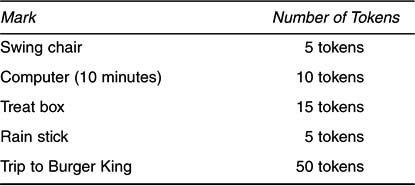
The fourth step involves determining when and how frequently tokens will be administered. Initially, tokens should be delivered immediately following the desired behavior, but over time teachers will need to reward behavior on a more intermittent basis. Teachers should always deliver tokens with social praise (e.g., “good job completing your assignment”) so that over time the tokens can be faded and more natural forms of reinforcement can serve as the reward. The fifth step in developing a token economy involves determining when students will be allowed to exchange their tokens for items on the reinforcer menu. Students who are younger, have severe disabilities, or who have emotional and behavior disabilities may need to exchange tokens more frequently (e.g., hourly or daily) than students with mild or no disabilities (who might exchange tokens daily or weekly).
Example of a Token Economy
Token economies can be implemented with an individual student, classroom, or entire school. For example, at the individual student level, a teacher decides to implement a token economy with Donita, a third-grade student with a learning disability in reading, to increase her rate of work completion and the amount of time spent reading independently. Donita receives tokens for completing reading comprehension problems with 90% accuracy or better, and for each five minutes spent reading out loud with audio tapes. Figure 2 provides a sample reinforcer menu for Donita.
...
- Assessment
- Academic Achievement
- Adaptive Behavior Assessment
- Applied Behavior Analysis
- Authentic Assessment
- Behavioral Assessment
- Bias (Testing)
- Buros Mental Measurements Yearbook
- Career Assessment
- Classroom Observation
- Criterion-Referenced Assessment
- Curriculum-Based Assessment
- Fluid Intelligence
- Functional Behavioral Assessment
- Infant Assessment
- Intelligence
- Interviewing
- Mental Age
- Motor Assessment
- Neuropsychological Assessment
- Outcomes-Based Assessment
- Performance-Based Assessment
- Personality Assessment
- Portfolio Assessment
- Preschool Assessment
- Projective Testing
- Psychometric G
- Reports (Psychological)
- Responsiveness to Intervention Model
- Social–Emotional Assessment
- Sociometric Assessment
- Written Language Assessment
- Behavior
- Consultation
- Demographic Variables
- Development
- Diagnosis
- Disorders
- DSM-IV
- Adjustment Disorder
- Attention Deficit Hyperactivity Disorder
- Autism Spectrum Disorders
- Bipolar Disorder (Childhood Onset)
- Communication Disorders
- Conduct Disorder
- Depression
- Dyslexia
- Echolalia
- Fears
- Generalized Anxiety Disorder
- Learning Disabilities
- Mental Retardation
- Obsessive–Compulsive Disorder
- Oppositional Defiant Disorder
- Pedophilia
- Posttraumatic Stress Disorder
- Psychopathology in Children
- Reactive Attachment Disorder of Infancy and Early Childhood
- Selective Mutism
- Separation Anxiety Disorder
- Somatoform Disorders
- Stuttering
- Ethical/Legal Issues in School Psychology
- Family and Parenting
- Interventions
- Issues Students Face
- Learning and Motivation
- Legislation
- Medical Conditions
- Multicultural Issues
- Peers
- Prevention
- Reading
- Research
- School Actions
- School Personnel
- School Psychologist Roles
- Careers in School Psychology
- Consultation: Behavioral
- Consultation: Conjoint Behavioral
- Consultation: Ecobehavioral
- Consultation: Mental Health
- Counseling
- Diagnosis and Labeling
- Home–School Collaboration
- Multidisciplinary Teams
- Parent Education and Parent Training
- Program Evaluation
- Reports (Psychological)
- Research
- Responsiveness to Intervention Model
- School Reform
- School Psychology Organizations
- American Board of Professional Psychology
- American Psychological Association
- Council of Directors of School Psychology Programs
- Division of School Psychology (Division 16)
- International School Psychology Association
- Licensing and Certification in School Psychology
- National Association of School Psychologists
- School-Related Terms
- School Types
- Schools as Organizations
- Special Education
- Statistical and Measurement Terms
- Student Problematic Behavior
- Technology
- Loading...
Get a 30 day FREE TRIAL
-
 Watch videos from a variety of sources bringing classroom topics to life
 -
Read modern, diverse business cases
-
Explore hundreds of books and reference titles

Read next

More like this
Sage Recommends
We found other relevant content for you on other Sage platforms.
Have you created a personal profile? Login or create a profile so that you can save clips, playlists and searches