
Entry
Reader's guide
Entries A-Z
Subject index
Suicide
The issue of suicide and suicidal behavior in children and adolescents is a significant mental health issue. Using the most current data from 2001, suicide is currently the third leading cause of death in the United States for youths between the ages of 10 and 19 (after automobile accidents and homicide); and in some states suicide is ranked second with homicide ranked third as the leading cause of death in 15- to 19-year-old adolescents.
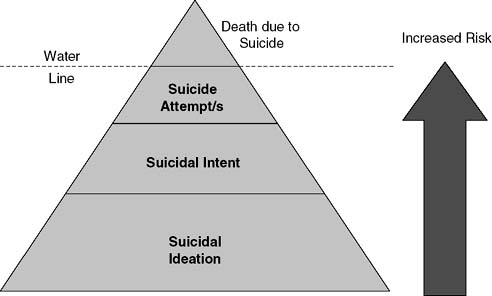
Suicide, however, is only one behavior among a spectrum of behaviors that represent the suicidal behavior continuum (Reynolds & Mazza, 1994). The suicidal behavior continuum consists of suicidal ideation, suicidal intent, suicide attempt(s), and death caused by suicide, with suicidal ideation at the beginning of the continuum and suicide itself at the other end. Unfortunately, much of the attention regarding child and adolescent suicide focuses only on suicide itself, which is the rarest, missing the other more prevalent, but less lethal behaviors (Anderson, 2002). In fact, according to the Youth Risk Behavior Survey (YRBS) conducted by the Centers for Disease Control and Prevention (CDC) (2004) during the year 2003, 16.9% of high school students stated they had thought seriously of attempting suicide, 16.5% made a plan to attempt suicide, 8.5% actually attempted suicide, and 2.9% made a serious attempt that required medical attention. The analogy of an iceberg works well to represent the suicidal behavior continuum, with suicide being the tip of the iceberg and above the water, while the other behaviors are below the water but represent a greater proportion of the suicidal spectrum (Figure 1).
Figure 1 Suicide Behavior Continuum
Descriptive Information
The suicide rate for adolescents from 1955 to 1994 more than tripled to a rate of 11.2 per 100,000, but the rate has declined over the past 10 years and currently stands at 7.9 per 100,000 (National Center of Health Statistics [NCHS], 2003). Although the suicide rate for middle school students, ages 10 to 14 years, is significantly lower compared to high school age adolescents, it has continued to increase and is currently 1.3 per 100,000. According to the NCHS, the 10- to 14-year-old adolescents' suicide rate increased 109% from 1980 to 1997 compared to 11% for youths 15 to 19 years old during the same period (NCHS, 2003).
Gender Differences
There are important gender differences in adolescent suicidal behavior. Females attempt suicide approximately two to three times more often than males (CDC, 2004; Reynolds & Mazza, 1993). According to the recent YRBS data, incidence rate of suicide attempts for females was 11.5% compared to 5.2% for males, a 2:1 ratio. Similarly, Reynolds and Mazza, who sampled more than 3,400 adolescents across eight states, also reported a 2:1 female-to-male attempt ratio.
In examining suicidal ideation, defined as “the thoughts and cognitions about taking one's life as well as thoughts specific to the act of suicide” (Reynolds & Mazza, 1994, p. 533), females are more likely to be thinking about suicide than males (CDC, 2004; Reynolds, 1988). The YRBS data showed that approximately 23% of high school females had seriously thought about attempting suicide during 2003 compared to 14% of males. Using the Suicidal Ideation Questionnaire (Reynolds, 1988), Mazza and Reynolds identified 16% of females in their sample who scored above the clinical cutoff score, compared to 7% of males.
...
- Assessment
- Academic Achievement
- Adaptive Behavior Assessment
- Applied Behavior Analysis
- Authentic Assessment
- Behavioral Assessment
- Bias (Testing)
- Buros Mental Measurements Yearbook
- Career Assessment
- Classroom Observation
- Criterion-Referenced Assessment
- Curriculum-Based Assessment
- Fluid Intelligence
- Functional Behavioral Assessment
- Infant Assessment
- Intelligence
- Interviewing
- Mental Age
- Motor Assessment
- Neuropsychological Assessment
- Outcomes-Based Assessment
- Performance-Based Assessment
- Personality Assessment
- Portfolio Assessment
- Preschool Assessment
- Projective Testing
- Psychometric G
- Reports (Psychological)
- Responsiveness to Intervention Model
- Social–Emotional Assessment
- Sociometric Assessment
- Written Language Assessment
- Behavior
- Consultation
- Demographic Variables
- Development
- Diagnosis
- Disorders
- DSM-IV
- Adjustment Disorder
- Attention Deficit Hyperactivity Disorder
- Autism Spectrum Disorders
- Bipolar Disorder (Childhood Onset)
- Communication Disorders
- Conduct Disorder
- Depression
- Dyslexia
- Echolalia
- Fears
- Generalized Anxiety Disorder
- Learning Disabilities
- Mental Retardation
- Obsessive–Compulsive Disorder
- Oppositional Defiant Disorder
- Pedophilia
- Posttraumatic Stress Disorder
- Psychopathology in Children
- Reactive Attachment Disorder of Infancy and Early Childhood
- Selective Mutism
- Separation Anxiety Disorder
- Somatoform Disorders
- Stuttering
- Ethical/Legal Issues in School Psychology
- Family and Parenting
- Interventions
- Issues Students Face
- Learning and Motivation
- Legislation
- Medical Conditions
- Multicultural Issues
- Peers
- Prevention
- Reading
- Research
- School Actions
- School Personnel
- School Psychologist Roles
- Careers in School Psychology
- Consultation: Behavioral
- Consultation: Conjoint Behavioral
- Consultation: Ecobehavioral
- Consultation: Mental Health
- Counseling
- Diagnosis and Labeling
- Home–School Collaboration
- Multidisciplinary Teams
- Parent Education and Parent Training
- Program Evaluation
- Reports (Psychological)
- Research
- Responsiveness to Intervention Model
- School Reform
- School Psychology Organizations
- American Board of Professional Psychology
- American Psychological Association
- Council of Directors of School Psychology Programs
- Division of School Psychology (Division 16)
- International School Psychology Association
- Licensing and Certification in School Psychology
- National Association of School Psychologists
- School-Related Terms
- School Types
- Schools as Organizations
- Special Education
- Statistical and Measurement Terms
- Student Problematic Behavior
- Technology
- Loading...
Get a 30 day FREE TRIAL
-
 Watch videos from a variety of sources bringing classroom topics to life
 -
Read modern, diverse business cases
-
Explore hundreds of books and reference titles

Read next

More like this
Sage Recommends
We found other relevant content for you on other Sage platforms.
Have you created a personal profile? Login or create a profile so that you can save clips, playlists and searches