
Entry
Reader's guide
Entries A-Z
Subject index
Normal Distribution
The normal distribution is a hypothetical distribution of individual scores on any test. The normal distribution is a symmetrically shaped bell curve with the largest number of scores in the middle of the distribution and the smallest number of scores in the tails of the distribution (Figure 1). Because the normal curve is symmetrical, the measures of central tendency (i.e., the mean, median, and mode) will be the same. The mode is the most frequent score in the distribution, the mean is the average score in the distribution, and the median is the middlemost score or the midpoint of the distribution (Cohen & Swerdlik, 1999).
Figure 1 Normal Curve
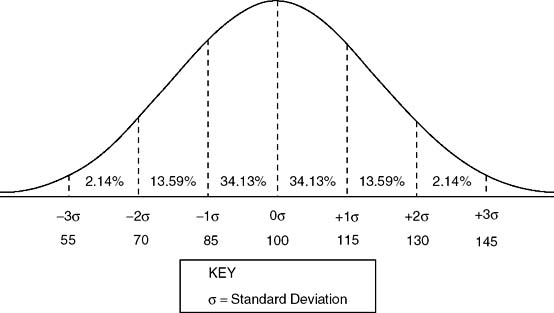
The normal distribution can be “divided into areas defined in standard deviation units” (Cohen & Swerdlik, 1999, p. 107). Figure 1 shows a hypothetical distribution of mathematics achievement test scores with a mean of 100 and a standard deviation of 15. In this example, 34.13% of all scores will fall between the mean and 1 standard deviation above or below the mean. Stated another way, approximately 34% of all mathematics achievement test scores will lie between the scores of 85 and 100, or 100 and 115. Continuing with this example, 13.59% and 2.14% of all scores will lie between 1 and 2, and 2 and 3 standard deviations above or below the mean, respectively. In other words, approximately 14% of all scores will fall between 70 and 85, or 115 and 130, and approximately 2% of all scores will lie between 55 and 70, or 130 and 145. These relationships between the percentages of test scores and standard deviation units are important when discussing test score interpretations.
References and Further Readings
- Assessment
- Academic Achievement
- Adaptive Behavior Assessment
- Applied Behavior Analysis
- Authentic Assessment
- Behavioral Assessment
- Bias (Testing)
- Buros Mental Measurements Yearbook
- Career Assessment
- Classroom Observation
- Criterion-Referenced Assessment
- Curriculum-Based Assessment
- Fluid Intelligence
- Functional Behavioral Assessment
- Infant Assessment
- Intelligence
- Interviewing
- Mental Age
- Motor Assessment
- Neuropsychological Assessment
- Outcomes-Based Assessment
- Performance-Based Assessment
- Personality Assessment
- Portfolio Assessment
- Preschool Assessment
- Projective Testing
- Psychometric G
- Reports (Psychological)
- Responsiveness to Intervention Model
- Social–Emotional Assessment
- Sociometric Assessment
- Written Language Assessment
- Behavior
- Consultation
- Demographic Variables
- Development
- Diagnosis
- Disorders
- DSM-IV
- Adjustment Disorder
- Attention Deficit Hyperactivity Disorder
- Autism Spectrum Disorders
- Bipolar Disorder (Childhood Onset)
- Communication Disorders
- Conduct Disorder
- Depression
- Dyslexia
- Echolalia
- Fears
- Generalized Anxiety Disorder
- Learning Disabilities
- Mental Retardation
- Obsessive–Compulsive Disorder
- Oppositional Defiant Disorder
- Pedophilia
- Posttraumatic Stress Disorder
- Psychopathology in Children
- Reactive Attachment Disorder of Infancy and Early Childhood
- Selective Mutism
- Separation Anxiety Disorder
- Somatoform Disorders
- Stuttering
- Ethical/Legal Issues in School Psychology
- Family and Parenting
- Interventions
- Issues Students Face
- Learning and Motivation
- Legislation
- Medical Conditions
- Multicultural Issues
- Peers
- Prevention
- Reading
- Research
- School Actions
- School Personnel
- School Psychologist Roles
- Careers in School Psychology
- Consultation: Behavioral
- Consultation: Conjoint Behavioral
- Consultation: Ecobehavioral
- Consultation: Mental Health
- Counseling
- Diagnosis and Labeling
- Home–School Collaboration
- Multidisciplinary Teams
- Parent Education and Parent Training
- Program Evaluation
- Reports (Psychological)
- Research
- Responsiveness to Intervention Model
- School Reform
- School Psychology Organizations
- American Board of Professional Psychology
- American Psychological Association
- Council of Directors of School Psychology Programs
- Division of School Psychology (Division 16)
- International School Psychology Association
- Licensing and Certification in School Psychology
- National Association of School Psychologists
- School-Related Terms
- School Types
- Schools as Organizations
- Special Education
- Statistical and Measurement Terms
- Student Problematic Behavior
- Technology
- Loading...
Get a 30 day FREE TRIAL
-
 Watch videos from a variety of sources bringing classroom topics to life
 -
Read modern, diverse business cases
-
Explore hundreds of books and reference titles

Read next

More like this
Sage Recommends
We found other relevant content for you on other Sage platforms.
Have you created a personal profile? Login or create a profile so that you can save clips, playlists and searches