
Entry
Reader's guide
Entries A-Z
Subject index
Goal Attainment Scaling
Goal Attainment Scaling (GAS) is a process of monitoring progress from a list of predetermined goals. Each goal is clearly set, then broken down into five categories that range from much better, to neutral, to much worse outcomes. GAS is tailored to a specific individual and his or her expected progress, and can be adapted to all skill ranges and used to address a large number of issues (Figure 1). GAS is widely used in education, counseling, social work, rehabilitation, medicine, and other areas.
Figure 1 Goal Attainment Scaling
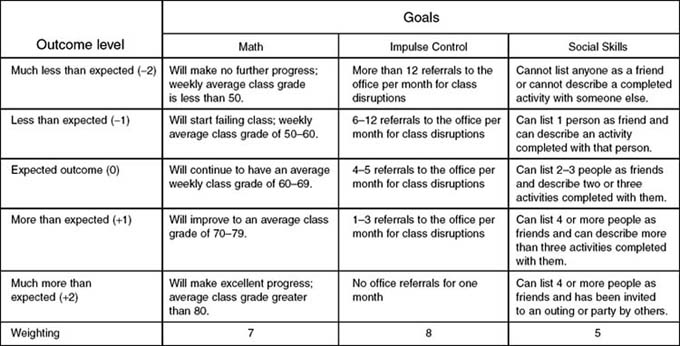
The development of GAS has several steps. To begin, the major problems that need to be addressed are stated. For example, to use GAS with a student, the major issues may be numerous referrals to the office for misbehavior, failing class, or social problems. Next, goals are created to address the major issues. In the creation of goals, it is generally best to state the goals in simple, jargon-free terms. It is also necessary to create a few goals; three is optimal. To continue with the example, three goals are set; the student will pass math class, limit the number of referrals to the office for class disruptions, and improve social skills.
In GAS, goals must be operationally defined. How can these goals be described in a way that could be rated? What behavior (or feeling) can be rated that applies to the goal? In the example, good choices might be average of daily grades in math, number of referrals to the office, and listing of friends and activities successfully completed with peers. While typically only one indicator of progress is used for each goal, it is possible to use more.
The major component of GAS is the addition of expected levels of progress. Where is the student expected to be at the end of the intervention(s)? After a set period of time, what is the expected progress of the student? This progress is typically expressed as a range, so a range of expected progress may be an average weekly class grade of 60 to 69, 4 to 5 office referrals a month, a list 2 to 3 individuals who are friends, and completion of 2 to 3 activities with these friends. Having defined expected progress, GAS then identifies what “slightly better” and “slightly worse” levels of accomplishment would look like. It is important that goal levels are continuous and discrete (i.e., no gaps between two goal levels, and no overlapping goal levels). Having defined slightly better and slightly worse progress, GAS then defines what “much better” and “much worse” progress would look like. While this process represents the basic use of a GAS, it is also possible to give weights to the different goals to indicate the level of importance attached to each one. These weights typically range from 1 (low importance) to 10 (high importance), but other weighting scales can be used.
GAS was first described in 1969 by Thomas Kiresuk and Robert Sherman. GAS was used as a program evaluation tool to study the effectiveness of treatment options and therapists. Kiresuk and Sherman proposed that goals should be set by a group of therapists who are not involved with the treatment of the individual. They also designed GAS originally to have independent raters to assess the client's level of progress. In this way, both individual therapists and treatment options could be evaluated. More modern uses of GAS have altered the original idea of independent goal setters and evaluators in favor of self-selected goals and evaluation by the client. As a clinical tool, the GAS is ultimately the responsibility of the therapist, but in some cases there may be benefit in collaborating with the client and negotiating the goals. GAS can also be effective when a multidisciplinary team—a decision-making group composed of different professionals such as a regular education teacher, special education teacher, school psychologist, principal, and parents—collaborates to set goals for a student.
...
- Assessment
- Academic Achievement
- Adaptive Behavior Assessment
- Applied Behavior Analysis
- Authentic Assessment
- Behavioral Assessment
- Bias (Testing)
- Buros Mental Measurements Yearbook
- Career Assessment
- Classroom Observation
- Criterion-Referenced Assessment
- Curriculum-Based Assessment
- Fluid Intelligence
- Functional Behavioral Assessment
- Infant Assessment
- Intelligence
- Interviewing
- Mental Age
- Motor Assessment
- Neuropsychological Assessment
- Outcomes-Based Assessment
- Performance-Based Assessment
- Personality Assessment
- Portfolio Assessment
- Preschool Assessment
- Projective Testing
- Psychometric G
- Reports (Psychological)
- Responsiveness to Intervention Model
- Social–Emotional Assessment
- Sociometric Assessment
- Written Language Assessment
- Behavior
- Consultation
- Demographic Variables
- Development
- Diagnosis
- Disorders
- DSM-IV
- Adjustment Disorder
- Attention Deficit Hyperactivity Disorder
- Autism Spectrum Disorders
- Bipolar Disorder (Childhood Onset)
- Communication Disorders
- Conduct Disorder
- Depression
- Dyslexia
- Echolalia
- Fears
- Generalized Anxiety Disorder
- Learning Disabilities
- Mental Retardation
- Obsessive–Compulsive Disorder
- Oppositional Defiant Disorder
- Pedophilia
- Posttraumatic Stress Disorder
- Psychopathology in Children
- Reactive Attachment Disorder of Infancy and Early Childhood
- Selective Mutism
- Separation Anxiety Disorder
- Somatoform Disorders
- Stuttering
- Ethical/Legal Issues in School Psychology
- Family and Parenting
- Interventions
- Issues Students Face
- Learning and Motivation
- Legislation
- Medical Conditions
- Multicultural Issues
- Peers
- Prevention
- Reading
- Research
- School Actions
- School Personnel
- School Psychologist Roles
- Careers in School Psychology
- Consultation: Behavioral
- Consultation: Conjoint Behavioral
- Consultation: Ecobehavioral
- Consultation: Mental Health
- Counseling
- Diagnosis and Labeling
- Home–School Collaboration
- Multidisciplinary Teams
- Parent Education and Parent Training
- Program Evaluation
- Reports (Psychological)
- Research
- Responsiveness to Intervention Model
- School Reform
- School Psychology Organizations
- American Board of Professional Psychology
- American Psychological Association
- Council of Directors of School Psychology Programs
- Division of School Psychology (Division 16)
- International School Psychology Association
- Licensing and Certification in School Psychology
- National Association of School Psychologists
- School-Related Terms
- School Types
- Schools as Organizations
- Special Education
- Statistical and Measurement Terms
- Student Problematic Behavior
- Technology
- Loading...
Get a 30 day FREE TRIAL
-
 Watch videos from a variety of sources bringing classroom topics to life
 -
Read modern, diverse business cases
-
Explore hundreds of books and reference titles

Read next

More like this
Sage Recommends
We found other relevant content for you on other Sage platforms.
Have you created a personal profile? Login or create a profile so that you can save clips, playlists and searches