
Entry
Reader's guide
Entries A-Z
Subject index
NVivo (Software)
The trustworthiness of qualitative research depends upon the integrity of data gathering and analysis, the robustness of processes, and the demonstration of thoroughness. One tool that assists a researcher to manage these tasks well is the NVivo data management and searching program, which enables a researcher to demonstrate the integrity, robustness, and therefore, trustworthiness of an investigation.
NVivo Screen View
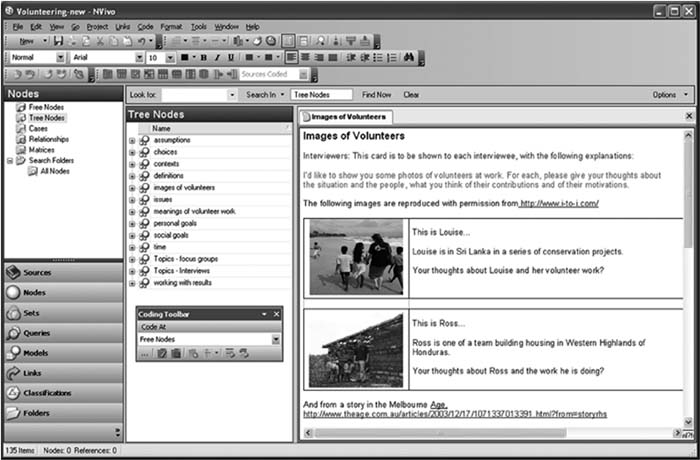
The benefits of NVivo lie in its user-intuitive interface and its extensive data storage, search, and retrieval capacity. The program uses a coding system that underpins generation of relationships between elements in the data. It is an effective relational database that provides the researcher with the flexibility to
- test tentative theorizing about relationships within the data;
- discover and explore new relationships as data analysis unfolds;
- map relationships;
- track data analysis; and
- log and save search results.
Another essential feature is the ability of NVivo's memos to record the researcher's thoughts and processes alongside, but not within, the data analysis. Creating memos for this purpose provides a rich source of information about research processes, theorizing and searching implications that are particularly useful when a project is protracted, and involves multiple researchers or is multinational. Because memos are separate from the actual data, the independence and integrity of data are maintained by ensuring against contamination from the researcher's perspective. In this way, trustworthiness are in-built into the data management process, provided the researcher is mindful about using the potential of the software with integrity.
These features make NVivo a sophisticated addition to a qualitative researcher's toolkit, but it remains the researcher's responsibility to ensure the authenticity of the research project and output by aligning methodology, epistemology, and ontology. Because NVivo makes it easier for researchers to demonstrate robustness in their practice by assisting the management of data and by establishing trustworthiness, the research process becomes more transparent and therefore is open to closer scrutiny. As a result, the researcher needs to think carefully through the methodological approach as well as the process of analysis. The aim is to ensure that the research questions are answered from the relationships emerging out of the data being searched.
NVivo does not analyze data for the researcher. It is a management tool enabling greater depth in analysis and facilitating the searching of large quantities of transcript data so that the researcher can make considered judgments. Although NVivo is able to assist the researcher to manage data efficiently in rapid time frames, it takes time to learn to how utilize NVivo's power so that the researcher's first judgment will be to ascertain the efficacy of this tool in each research project.
- NVivo: http://www.qsrinternational.com
Web Sites
- Approaches and Methodologies
- A/r/tography
- Action Research
- Advocacy Research
- Aesthetics
- Applied Research
- Appreciative Inquiry
- Artifact Analysis
- Arts-Based Research
- Arts-Informed Research
- Autobiography
- Autoethnography
- Basic Research
- Biography
- Case Study
- Clinical Research
- Collaborative Research
- Community-Based Research
- Comparative Research
- Content Analysis
- Conversation Analysis
- Covert Research
- Critical Action Research
- Critical Arts-Based Inquiry
- Critical Discourse Analysis
- Critical Ethnography
- Critical Hermeneutics
- Critical Research
- Cross-Cultural Research
- Discourse Analysis
- Document Analysis
- Duoethnography
- Ecological Research
- Emergent Design
- Empirical Research
- Empowerment Evaluation
- Ethnodrama
- Ethnography
- Ethnomethodology
- Evaluation Research
- Evidence-Based Practice
- Explanatory Research
- Exploratory Data Analysis
- Feminist Research
- Field Research
- Foucauldian Discourse Analysis
- Genealogical Approach
- Grounded Theory
- Hermeneutics
- Heuristic Inquiry
- Historical Discourse Analysis
- Historical Research
- Historiography
- Indigenous Research
- Institutional Ethnography
- Institutional Research
- Interdisciplinary Research
- Internet in Qualitative Research
- Interpretive Inquiry
- Interpretive Phenomenology
- Interpretive Research
- Market Research
- Meta-Analysis
- Meta-Ethnography
- Meta-Synthesis
- Methodological Holism Versus Individualism
- Methodology
- Methods
- Mixed Methods Research
- Multicultural Research
- Narrative Analysis
- Narrative Genre Analysis
- Narrative Inquiry
- Naturalistic Inquiry
- Observational Research
- Oral History
- Orientational Perspective
- Para-Ethnography
- Participatory Action Research (PAR)
- Performance Ethnography
- Phenomenography
- Phenomenology
- Place/Space in Qualitative Research
- Playbuilding
- Portraiture
- Program Evaluation
- Q Methodology
- Readers Theater
- Social Justice
- Social Network Analysis
- Survey Research
- Systemic Inquiry
- Theatre of the Oppressed
- Transformational Methods
- Unobtrusive Research
- Value-Free Inquiry
- Virtual Ethnography
- Virtual Research
- Visual Ethnography
- Visual Narrative Inquiry
- Arts-Based Research, Ties to
- A/r/tography
- Aesthetics
- Artifact Analysis
- Arts-Based Research
- Arts-Informed Research
- Audience
- Autobiography
- Bricolage and Bricoleur
- Collage
- Connoisseurship
- Critical Arts-Based Inquiry
- Dance in Qualitative Research
- Dramaturgy
- Ethnodrama
- Ethnopoetics
- Fictional Writing
- Film and Video in Qualitative Research
- Literature in Qualitative Research
- Memoirs
- Multimedia in Qualitative Research
- Music in Qualitative Research
- Performance Ethnography
- Photographs in Qualitative Research
- Photonovella and Photovoice
- Place/Space in Qualitative Research
- Playbuilding
- Poetry in Qualitative Research
- Portraiture
- Readers Theater
- Researcher as Artist
- Resonance
- Storytelling
- Theatre of the Oppressed
- Transformational Methods
- Vignettes
- Visual Ethnography
- Visual Narrative Inquiry
- Visual Research
- Associations, Centers, and Institutes
- Computer-Assisted Data Analysis
- Data Analysis
- Abduction
- Analytic Induction
- Artifact Analysis
- ATLAS.ti (Software)
- Audience Analysis
- Auditing
- Axial Coding
- Bricolage and Bricoleur
- Categories
- Categorization
- Co-Constructed Narrative
- Codes and Coding
- Coding Frame
- Collage
- Comparative Analysis
- Computer-Assisted Data Analysis
- Concept Mapping
- Conceptual Ordering
- Constant Comparison
- Content Analysis
- Context and Contextuality
- Context-Centered Knowledge
- Conversation Analysis
- Core Category
- Counternarrative
- Creative Writing
- Critical Discourse Analysis
- Cultural Context
- Data
- Data Analysis
- Data Management
- Data Saturation
- Deduction
- Descriptive Statistics
- Diction (Software)
- Discourse
- Discourse Analysis
- Discovery
- Discursive Practice
- Diversity Issues
- Document Analysis
- Embodied Knowledge
- Emergent Themes
- Emic/Etic Distinction
- Emotions in Qualitative Research
- Essence
- Ethnograph (Software)
- Ethnographic Content Analysis
- Ethnostatistics
- Evaluation Criteria
- Everyday Life
- Experiential Knowledge
- Explanation
- Exploratory Data Analysis
- Findings
- Foucauldian Discourse Analysis
- Framework (Software)
- Gender Issues
- Grounded Theory
- Heteroglossia
- Historical Context
- Historical Discourse Analysis
- Horizonalization
- HyperRESEARCH (Software)
- Imagination in Qualitative Research
- In Vivo Coding
- Indexicality
- Induction
- Interpretation
- Intertextuality
- Knowledge
- Liminal Perspective
- Literature Review
- Lived Experience
- Marginalization
- MAXqda (Software)
- Meaning
- Membership Categorization Device Analysis (MCDA)
- Memos and Memoing
- Meta-Analysis
- Meta-Narrative
- Meta-Synthesis
- Metaphor
- Narrative Analysis
- Narrative Genre Analysis
- Negative Case Analysis
- Nonverbal Communication
- NVivo (Software)
- Open Coding
- Otherness
- Peer Review
- Perception
- Photonovella and Photovoice
- Power
- Psychological Generalization
- Qualrus (Software)
- Rapid Assessment Process
- Reconstructive Analysis
- Recursivity
- Reflexivity
- Research Diaries and Journals
- Research Literature
- Researcher as Artist
- Researcher as Instrument
- Researcher Sensitivity
- Response Groups
- Rhythmanalysis
- Rigor in Qualitative Research
- Secondary Analysis
- Selective Coding
- Situatedness
- Social Context
- Social Network Analysis
- SuperHyperQual (Software)
- Systematic Sociological Introspection
- Tacit Knowledge
- TextQuest (Software)
- Textual Analysis
- Thematic Coding and Analysis
- Themes
- Theoretical Memoing
- Theoretical Saturation
- Thick Description
- Transana (Software)
- Transcript
- Transcription
- Truth
- Typological Analysis
- Understanding
- Video Intervention/Prevention Assessment
- Vignettes
- Visual Data
- Visual Data Displays
- Writing Process
- Data Collection
- Access
- Active Listening
- Artifacts
- Audiorecording
- Captive Population
- Checklists
- Closed Question
- Cognitive Interview
- Collage
- Convenience Sample
- Convergent Interviewing
- Conversational Interviewing
- Covert Observation
- Creative Writing
- Critical Incident Technique
- Data
- Data Archive
- Data Collection
- Data Generation
- Data Management
- Data Security
- Data Storage
- Debriefing
- Deception
- Dialogue
- Diaries and Journals
- Documents
- Dramaturgy
- Email Interview
- Emotions in Qualitative Research
- Empathy
- Ethnopoetics
- Fictional Writing
- Field Data
- Fieldnotes
- Fieldwork
- Film and Video in Qualitative Research
- Focus Groups
- Free Association Narrative Interview
- Funding
- Hypothesis
- In-Depth Interview
- In-Person Interview
- Interactive Focus Groups
- Interactive Interview
- Internet in Qualitative Research
- Interview Guide
- Interviewing
- Leaving the Field
- Life Stories
- Literature in Qualitative Research
- Literature Review
- Lived Experience
- Memoirs
- Memos and Memoing
- Multimedia in Qualitative Research
- Narrative Interview
- Narrative Texts
- Natural Setting
- Naturalistic Data
- Naturalistic Observation
- Negotiating Exit
- Neutral Question
- Neutrality in Qualitative Research
- Nonparticipant Observation
- Nonprobability Sampling
- Nonverbal Communication
- Observation Schedule
- Open-Ended Question
- Participant Observation
- Peer Debriefing
- Perception
- Photographs in Qualitative Research
- Pilot Study
- Poetry in Qualitative Research
- Population
- Probes and Probing
- Projective Techniques
- Prolonged Engagement
- Psychoanalytically Informed Observation
- Purposive Sampling
- Quota Sampling
- Random Sampling
- Rapport
- Raw Data
- Recruiting Participants
- Research Diaries and Journals
- Research Literature
- Research Problem
- Research Question
- Research Setting
- Research Team
- Researcher as Instrument
- Researcher Roles
- Researcher Safety
- Researcher Sensitivity
- Rich Data
- Rigor in Qualitative Research
- Risk
- Sample
- Sample Size
- Sampling
- Sampling Frame
- Secondary Data
- Semi-Structured Interview
- Sensitizing Concepts
- Serendipity
- Snowball Sampling
- Stratified Sampling
- Structured Interview
- Structured Observation
- Subjectivity Statement
- Telephone Interview
- Text
- Theoretical Sampling
- Triangulation
- Unstructured Interview
- Unstructured Observation
- Videorecording
- Vignettes
- Virtual Interview
- Dissemination and Writing
- Ethnography (Journal)
- Field Methods (Journal)
- Forum: Qualitative Social Research (Journal)
- International Journal of Qualitative Methods
- Journal of Contemporary Ethnography
- Journal of Mixed Methods Research
- Narrative Inquiry (Journal)
- Oral History Review (Journal)
- Qualitative Health Research (Journal)
- Qualitative Inquiry (Journal)
- Qualitative Report, The (Journal)
- Qualitative Research (Journal)
- Advances in Qualitative Methods Conference
- Creative Writing
- Ethnographic and Qualitative Research Conference
- Fictional Writing
- Film and Video in Qualitative Research
- Findings
- First-Person Voice
- Interdisciplinary Qualitative Studies Conference
- International Congress of Qualitative Inquiry
- International Human Science Research Conference
- Internet in Qualitative Research
- Literature in Qualitative Research
- Literature Review
- Memoirs
- Multimedia in Qualitative Research
- Peer Review
- Poetry in Qualitative Research
- Portraiture
- Publishing and Publication
- Qualitative Health Research Conference
- QualPage
- Representational Forms of Dissemination
- Research Literature
- Research Proposal
- Rhetoric
- Storytelling
- Subjectivity Statement
- Vignettes
- Voice
- Writing Process
- History of Qualitative Research
- Participants
- Access
- Agency
- Audience
- Captive Population
- Confidentiality
- Conflict of Interest
- Debriefing
- Deception
- Disengagement
- Disinterestedness
- Diversity Issues
- Emotions in Qualitative Research
- Empathy
- Empowerment
- Ethics
- First-Person Voice
- Harm
- Identity
- Informant
- Informed Consent
- Insider/Outsider Status
- Intersubjectivity
- Key Informant
- Leaving the Field
- Lived Experience
- Marginalization
- Marginalized Populations
- Member Check
- Negotiating Exit
- Otherness
- Over-Rapport
- Participant
- Participant Observation
- Participants as Co-Researchers
- Participatory Action Research
- Population
- Privacy
- Pseudonym
- Rapport
- Reciprocity
- Researcher–Participant Relationships
- Respondent
- Secondary Participants
- Trust
- Virtual Community
- Voice
- Vulnerability
- Quantitative Research, Ties to
- Research Design and Planning
- Access
- Data Analysis
- Data Archive
- Data Collection
- Data Generation
- Data Management
- Data Security
- Data Storage
- Ethics Review Process
- Funding
- Literature Review
- Methodology
- Methods
- Mixed Methods Research
- Participants as Co-Researchers
- Pilot Study
- Politics of Qualitative Research
- Project Management
- Publishing and Publication
- Qualitative Research Summer Intensive
- Quantitative Research
- Recruiting Participants
- Research Design
- Research Justification
- Research Literature
- Research Problem
- Research Proposal
- Research Question
- Research Setting
- Research Team
- Researcher as Artist
- Researcher as Instrument
- Researcher Roles
- Researcher Safety
- Researcher Sensitivity
- Researcher–Participant Relationships
- Rigor in Qualitative Research
- Sampling
- Secondary Analysis
- Secondary Data
- Theoretical Frameworks
- Theory
- Thinking Qualitatively Workshop Conference
- Triangulation
- Writing Process
- Research Ethics
- Access
- Accountability
- Anonymity
- Auditing
- Authenticity
- Benefit
- Bias
- Captive Population
- Confidentiality
- Conflict of Interest
- Data Security
- Debriefing
- Deception
- Ethics
- Ethics and New Media
- Ethics Codes
- Ethics Review Process
- Harm
- Informant
- Informed Consent
- Institutional Review Boards
- Integrity in Qualitative Research
- Key Informant
- Leaving the Field
- Negotiating Exit
- Over-Rapport
- Participant
- Participants as Co-Researchers
- Peer Debriefing
- Power
- Privacy
- Pseudonym
- Reciprocity
- Recruiting Participants
- Relational Ethics
- Researcher–Participant Relationships
- Respondent
- Risk
- Secondary Participants
- Sensitive Topics
- Trust
- Unobtrusive Research
- Vulnerability
- Rigor
- Audit Trail
- Authority
- Bias
- Bracketing
- Confirmability
- Constant Comparison
- Credibility
- Dependability
- Disengagement
- Disinterestedness
- Evidence
- Generalizability
- Inter- and Intracoder Reliability
- Member Check
- Negative Case Analysis
- Neutrality in Qualitative Research
- Objectivity
- Observer Bias
- Over-Rapport
- Peer Review
- Reactivity
- Reliability
- Replication
- Resonance
- Rigor in Qualitative Research
- Subjectivity
- Transferability
- Translatability
- Transparency
- Triangulation
- Trustworthiness
- Validity
- Value-Free Inquiry
- Verification
- Textual Analysis, Ties to
- Artifact Analysis
- Artifacts
- Autobiography
- Biography
- Content Analysis
- Conversation Analysis
- Creative Writing
- Critical Discourse Analysis
- Diaries and Journals
- Discourse
- Discourse Analysis
- Discursive Practice
- Discursive Psychology
- Document Analysis
- Documents
- Film and Video in Qualitative Research
- Historical Discourse Analysis
- Historical Research
- Historiography
- Internet in Qualitative Research
- Intertextuality
- Literature in Qualitative Research
- Multimedia in Qualitative Research
- Narrative Analysis
- Narrative Inquiry
- Narrative Interview
- Narrative Texts
- Poetry in Qualitative Research
- Rhetoric
- Text
- Textual Analysis
- Theoretical and Philosophical Frameworks
- Axiology
- Chaos and Complexity Theories
- Constructivism
- Critical Humanism
- Critical Pragmatism
- Critical Race Theory
- Critical Realism
- Critical Theory
- Deconstruction
- Discursive Psychology
- Empiricism
- Epistemology
- Essentialism
- Existentialism
- Feminist Epistemology
- Grand Narrative
- Grand Theory
- Hegemony
- Idealism
- Ideology
- Knowledge
- Nonessentialism
- Objectivism
- Ontology
- Paradigm
- Pluralism
- Positivism
- Postcolonialism
- Postmodernism
- Postpositivism
- Postrepresentation
- Poststructuralism
- Pragmatism
- Praxis
- Queer Theory
- Realism
- Reality and Multiple Realities
- Relativism
- Representation
- Semiotics
- Social Constructionism
- Structuralism
- Subjectivism
- Symbolic Interactionism
- Theoretical Frameworks
- Theory
- Truth
- Loading...
Get a 30 day FREE TRIAL
-
 Watch videos from a variety of sources bringing classroom topics to life
 -
Read modern, diverse business cases
-
Explore hundreds of books and reference titles

Read next

More like this
Sage Recommends
We found other relevant content for you on other Sage platforms.
Have you created a personal profile? Login or create a profile so that you can save clips, playlists and searches