
Entry
Reader's guide
Entries A-Z
Subject index
Discursive Psychology
Discursive psychology (DP) starts with psychological phenomena as things that are constructed, attended to, and understood in interaction. It is not just psychology as it appears in interaction; rather, it understands psychological language, and broader “mental practices,” as organized for action and interaction. It is a specifically discursive psychology because discourse—talk and texts—is the primary medium for social action. Part of its focus is on the organized resources used to build actions.
DP works with three fundamental principles in its approach to discourse:
- Action orientation. DP analyzes discourse as the primary means through which actions are done and interaction is coordinated. Actions are seen as typically embedded in broader practices. This focus on action rather than cognition differentiates it theoretically from cognitive psychology and underpins the analytic focus on discourse rather than experimental comparisons of input and output.
- Situation. DP treats discourse as situated in three complementary senses. First, it is organized sequentially, such that the primary environment for any utterance is the immediately prior utterance and the new utterance provides the context for what comes next. Second, discourse is situated institutionally, highlighting the potential relevance of institutional identities (e.g., counselor, client) and tasks (e.g., assessing trauma, offering advice). Third, discourse is situated rhetorically, such that any description can be inspected for how it counters relevant alternative descriptions (often from the immediately prior talk).
- Construction. In DP, discourse is understood as both constructed and constructive. Discourse is constructed from resources (e.g., words, membership categories, rhetorical commonplaces, interpretive repertoires). Discourse is constructive of versions of the world, including versions of events and actions, settings and structures, psychological entities and experiences. DP studies both the actions done with these constructions and the way in which these constructions are built to be stable, objective, and independent of the speaker.
Methodologically, DP performs intensive qualitative studies of audio or video records of interaction in everyday and institutional settings. Research will typically study a corpus of examples of some phenomenon and will work simultaneously with the digitized video or audio and a full Jeffersonian transcription (named after its developer, Gail Jefferson). Increasingly, DP has drawn on the analytic power of conversation analysis. Notable research areas have included counseling and therapy talk, helpline interaction, mediation, police interrogation, food, and interaction. At the same time, DP has offered new approaches to familiar social science topics, such as race and gender, attitudes and scripts, social representations and emotion, and also has formulated new topics, such as the role of descriptions in the formation of actions, the management of stake and interest in delicate circumstances, and the way in which talk is organized to display psychological states.
DP can be illustrated through Derek Edwards's research on script formulations. Traditional social psychology treats scripts as mentally encoded templates that guide action. DP focuses on the prior issue of how descriptions are produced to present actions as following standardized routines. Consider the following fragment from a couples' counseling session:
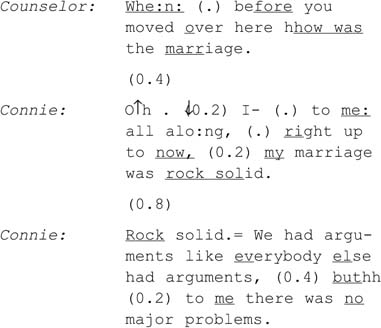
Jefferson's transcription system has been used here. It marks features of the delivery of talk that have been found to be relevant to interaction in a large body of conversation analytic work. In this extract, underlining is used for emphasis; colons mark extensions of the preceding sounds; arrows show marked upward or downward pitch shifts; dashes mark cutoff sounds; numbers in parentheses show delay timed in seconds; and equals signs mark hearably fast transitions or rush-throughs.
...
- Approaches and Methodologies
- A/r/tography
- Action Research
- Advocacy Research
- Aesthetics
- Applied Research
- Appreciative Inquiry
- Artifact Analysis
- Arts-Based Research
- Arts-Informed Research
- Autobiography
- Autoethnography
- Basic Research
- Biography
- Case Study
- Clinical Research
- Collaborative Research
- Community-Based Research
- Comparative Research
- Content Analysis
- Conversation Analysis
- Covert Research
- Critical Action Research
- Critical Arts-Based Inquiry
- Critical Discourse Analysis
- Critical Ethnography
- Critical Hermeneutics
- Critical Research
- Cross-Cultural Research
- Discourse Analysis
- Document Analysis
- Duoethnography
- Ecological Research
- Emergent Design
- Empirical Research
- Empowerment Evaluation
- Ethnodrama
- Ethnography
- Ethnomethodology
- Evaluation Research
- Evidence-Based Practice
- Explanatory Research
- Exploratory Data Analysis
- Feminist Research
- Field Research
- Foucauldian Discourse Analysis
- Genealogical Approach
- Grounded Theory
- Hermeneutics
- Heuristic Inquiry
- Historical Discourse Analysis
- Historical Research
- Historiography
- Indigenous Research
- Institutional Ethnography
- Institutional Research
- Interdisciplinary Research
- Internet in Qualitative Research
- Interpretive Inquiry
- Interpretive Phenomenology
- Interpretive Research
- Market Research
- Meta-Analysis
- Meta-Ethnography
- Meta-Synthesis
- Methodological Holism Versus Individualism
- Methodology
- Methods
- Mixed Methods Research
- Multicultural Research
- Narrative Analysis
- Narrative Genre Analysis
- Narrative Inquiry
- Naturalistic Inquiry
- Observational Research
- Oral History
- Orientational Perspective
- Para-Ethnography
- Participatory Action Research (PAR)
- Performance Ethnography
- Phenomenography
- Phenomenology
- Place/Space in Qualitative Research
- Playbuilding
- Portraiture
- Program Evaluation
- Q Methodology
- Readers Theater
- Social Justice
- Social Network Analysis
- Survey Research
- Systemic Inquiry
- Theatre of the Oppressed
- Transformational Methods
- Unobtrusive Research
- Value-Free Inquiry
- Virtual Ethnography
- Virtual Research
- Visual Ethnography
- Visual Narrative Inquiry
- Arts-Based Research, Ties to
- A/r/tography
- Aesthetics
- Artifact Analysis
- Arts-Based Research
- Arts-Informed Research
- Audience
- Autobiography
- Bricolage and Bricoleur
- Collage
- Connoisseurship
- Critical Arts-Based Inquiry
- Dance in Qualitative Research
- Dramaturgy
- Ethnodrama
- Ethnopoetics
- Fictional Writing
- Film and Video in Qualitative Research
- Literature in Qualitative Research
- Memoirs
- Multimedia in Qualitative Research
- Music in Qualitative Research
- Performance Ethnography
- Photographs in Qualitative Research
- Photonovella and Photovoice
- Place/Space in Qualitative Research
- Playbuilding
- Poetry in Qualitative Research
- Portraiture
- Readers Theater
- Researcher as Artist
- Resonance
- Storytelling
- Theatre of the Oppressed
- Transformational Methods
- Vignettes
- Visual Ethnography
- Visual Narrative Inquiry
- Visual Research
- Associations, Centers, and Institutes
- Computer-Assisted Data Analysis
- Data Analysis
- Abduction
- Analytic Induction
- Artifact Analysis
- ATLAS.ti (Software)
- Audience Analysis
- Auditing
- Axial Coding
- Bricolage and Bricoleur
- Categories
- Categorization
- Co-Constructed Narrative
- Codes and Coding
- Coding Frame
- Collage
- Comparative Analysis
- Computer-Assisted Data Analysis
- Concept Mapping
- Conceptual Ordering
- Constant Comparison
- Content Analysis
- Context and Contextuality
- Context-Centered Knowledge
- Conversation Analysis
- Core Category
- Counternarrative
- Creative Writing
- Critical Discourse Analysis
- Cultural Context
- Data
- Data Analysis
- Data Management
- Data Saturation
- Deduction
- Descriptive Statistics
- Diction (Software)
- Discourse
- Discourse Analysis
- Discovery
- Discursive Practice
- Diversity Issues
- Document Analysis
- Embodied Knowledge
- Emergent Themes
- Emic/Etic Distinction
- Emotions in Qualitative Research
- Essence
- Ethnograph (Software)
- Ethnographic Content Analysis
- Ethnostatistics
- Evaluation Criteria
- Everyday Life
- Experiential Knowledge
- Explanation
- Exploratory Data Analysis
- Findings
- Foucauldian Discourse Analysis
- Framework (Software)
- Gender Issues
- Grounded Theory
- Heteroglossia
- Historical Context
- Historical Discourse Analysis
- Horizonalization
- HyperRESEARCH (Software)
- Imagination in Qualitative Research
- In Vivo Coding
- Indexicality
- Induction
- Interpretation
- Intertextuality
- Knowledge
- Liminal Perspective
- Literature Review
- Lived Experience
- Marginalization
- MAXqda (Software)
- Meaning
- Membership Categorization Device Analysis (MCDA)
- Memos and Memoing
- Meta-Analysis
- Meta-Narrative
- Meta-Synthesis
- Metaphor
- Narrative Analysis
- Narrative Genre Analysis
- Negative Case Analysis
- Nonverbal Communication
- NVivo (Software)
- Open Coding
- Otherness
- Peer Review
- Perception
- Photonovella and Photovoice
- Power
- Psychological Generalization
- Qualrus (Software)
- Rapid Assessment Process
- Reconstructive Analysis
- Recursivity
- Reflexivity
- Research Diaries and Journals
- Research Literature
- Researcher as Artist
- Researcher as Instrument
- Researcher Sensitivity
- Response Groups
- Rhythmanalysis
- Rigor in Qualitative Research
- Secondary Analysis
- Selective Coding
- Situatedness
- Social Context
- Social Network Analysis
- SuperHyperQual (Software)
- Systematic Sociological Introspection
- Tacit Knowledge
- TextQuest (Software)
- Textual Analysis
- Thematic Coding and Analysis
- Themes
- Theoretical Memoing
- Theoretical Saturation
- Thick Description
- Transana (Software)
- Transcript
- Transcription
- Truth
- Typological Analysis
- Understanding
- Video Intervention/Prevention Assessment
- Vignettes
- Visual Data
- Visual Data Displays
- Writing Process
- Data Collection
- Access
- Active Listening
- Artifacts
- Audiorecording
- Captive Population
- Checklists
- Closed Question
- Cognitive Interview
- Collage
- Convenience Sample
- Convergent Interviewing
- Conversational Interviewing
- Covert Observation
- Creative Writing
- Critical Incident Technique
- Data
- Data Archive
- Data Collection
- Data Generation
- Data Management
- Data Security
- Data Storage
- Debriefing
- Deception
- Dialogue
- Diaries and Journals
- Documents
- Dramaturgy
- Email Interview
- Emotions in Qualitative Research
- Empathy
- Ethnopoetics
- Fictional Writing
- Field Data
- Fieldnotes
- Fieldwork
- Film and Video in Qualitative Research
- Focus Groups
- Free Association Narrative Interview
- Funding
- Hypothesis
- In-Depth Interview
- In-Person Interview
- Interactive Focus Groups
- Interactive Interview
- Internet in Qualitative Research
- Interview Guide
- Interviewing
- Leaving the Field
- Life Stories
- Literature in Qualitative Research
- Literature Review
- Lived Experience
- Memoirs
- Memos and Memoing
- Multimedia in Qualitative Research
- Narrative Interview
- Narrative Texts
- Natural Setting
- Naturalistic Data
- Naturalistic Observation
- Negotiating Exit
- Neutral Question
- Neutrality in Qualitative Research
- Nonparticipant Observation
- Nonprobability Sampling
- Nonverbal Communication
- Observation Schedule
- Open-Ended Question
- Participant Observation
- Peer Debriefing
- Perception
- Photographs in Qualitative Research
- Pilot Study
- Poetry in Qualitative Research
- Population
- Probes and Probing
- Projective Techniques
- Prolonged Engagement
- Psychoanalytically Informed Observation
- Purposive Sampling
- Quota Sampling
- Random Sampling
- Rapport
- Raw Data
- Recruiting Participants
- Research Diaries and Journals
- Research Literature
- Research Problem
- Research Question
- Research Setting
- Research Team
- Researcher as Instrument
- Researcher Roles
- Researcher Safety
- Researcher Sensitivity
- Rich Data
- Rigor in Qualitative Research
- Risk
- Sample
- Sample Size
- Sampling
- Sampling Frame
- Secondary Data
- Semi-Structured Interview
- Sensitizing Concepts
- Serendipity
- Snowball Sampling
- Stratified Sampling
- Structured Interview
- Structured Observation
- Subjectivity Statement
- Telephone Interview
- Text
- Theoretical Sampling
- Triangulation
- Unstructured Interview
- Unstructured Observation
- Videorecording
- Vignettes
- Virtual Interview
- Dissemination and Writing
- Ethnography (Journal)
- Field Methods (Journal)
- Forum: Qualitative Social Research (Journal)
- International Journal of Qualitative Methods
- Journal of Contemporary Ethnography
- Journal of Mixed Methods Research
- Narrative Inquiry (Journal)
- Oral History Review (Journal)
- Qualitative Health Research (Journal)
- Qualitative Inquiry (Journal)
- Qualitative Report, The (Journal)
- Qualitative Research (Journal)
- Advances in Qualitative Methods Conference
- Creative Writing
- Ethnographic and Qualitative Research Conference
- Fictional Writing
- Film and Video in Qualitative Research
- Findings
- First-Person Voice
- Interdisciplinary Qualitative Studies Conference
- International Congress of Qualitative Inquiry
- International Human Science Research Conference
- Internet in Qualitative Research
- Literature in Qualitative Research
- Literature Review
- Memoirs
- Multimedia in Qualitative Research
- Peer Review
- Poetry in Qualitative Research
- Portraiture
- Publishing and Publication
- Qualitative Health Research Conference
- QualPage
- Representational Forms of Dissemination
- Research Literature
- Research Proposal
- Rhetoric
- Storytelling
- Subjectivity Statement
- Vignettes
- Voice
- Writing Process
- History of Qualitative Research
- Participants
- Access
- Agency
- Audience
- Captive Population
- Confidentiality
- Conflict of Interest
- Debriefing
- Deception
- Disengagement
- Disinterestedness
- Diversity Issues
- Emotions in Qualitative Research
- Empathy
- Empowerment
- Ethics
- First-Person Voice
- Harm
- Identity
- Informant
- Informed Consent
- Insider/Outsider Status
- Intersubjectivity
- Key Informant
- Leaving the Field
- Lived Experience
- Marginalization
- Marginalized Populations
- Member Check
- Negotiating Exit
- Otherness
- Over-Rapport
- Participant
- Participant Observation
- Participants as Co-Researchers
- Participatory Action Research
- Population
- Privacy
- Pseudonym
- Rapport
- Reciprocity
- Researcher–Participant Relationships
- Respondent
- Secondary Participants
- Trust
- Virtual Community
- Voice
- Vulnerability
- Quantitative Research, Ties to
- Research Design and Planning
- Access
- Data Analysis
- Data Archive
- Data Collection
- Data Generation
- Data Management
- Data Security
- Data Storage
- Ethics Review Process
- Funding
- Literature Review
- Methodology
- Methods
- Mixed Methods Research
- Participants as Co-Researchers
- Pilot Study
- Politics of Qualitative Research
- Project Management
- Publishing and Publication
- Qualitative Research Summer Intensive
- Quantitative Research
- Recruiting Participants
- Research Design
- Research Justification
- Research Literature
- Research Problem
- Research Proposal
- Research Question
- Research Setting
- Research Team
- Researcher as Artist
- Researcher as Instrument
- Researcher Roles
- Researcher Safety
- Researcher Sensitivity
- Researcher–Participant Relationships
- Rigor in Qualitative Research
- Sampling
- Secondary Analysis
- Secondary Data
- Theoretical Frameworks
- Theory
- Thinking Qualitatively Workshop Conference
- Triangulation
- Writing Process
- Research Ethics
- Access
- Accountability
- Anonymity
- Auditing
- Authenticity
- Benefit
- Bias
- Captive Population
- Confidentiality
- Conflict of Interest
- Data Security
- Debriefing
- Deception
- Ethics
- Ethics and New Media
- Ethics Codes
- Ethics Review Process
- Harm
- Informant
- Informed Consent
- Institutional Review Boards
- Integrity in Qualitative Research
- Key Informant
- Leaving the Field
- Negotiating Exit
- Over-Rapport
- Participant
- Participants as Co-Researchers
- Peer Debriefing
- Power
- Privacy
- Pseudonym
- Reciprocity
- Recruiting Participants
- Relational Ethics
- Researcher–Participant Relationships
- Respondent
- Risk
- Secondary Participants
- Sensitive Topics
- Trust
- Unobtrusive Research
- Vulnerability
- Rigor
- Audit Trail
- Authority
- Bias
- Bracketing
- Confirmability
- Constant Comparison
- Credibility
- Dependability
- Disengagement
- Disinterestedness
- Evidence
- Generalizability
- Inter- and Intracoder Reliability
- Member Check
- Negative Case Analysis
- Neutrality in Qualitative Research
- Objectivity
- Observer Bias
- Over-Rapport
- Peer Review
- Reactivity
- Reliability
- Replication
- Resonance
- Rigor in Qualitative Research
- Subjectivity
- Transferability
- Translatability
- Transparency
- Triangulation
- Trustworthiness
- Validity
- Value-Free Inquiry
- Verification
- Textual Analysis, Ties to
- Artifact Analysis
- Artifacts
- Autobiography
- Biography
- Content Analysis
- Conversation Analysis
- Creative Writing
- Critical Discourse Analysis
- Diaries and Journals
- Discourse
- Discourse Analysis
- Discursive Practice
- Discursive Psychology
- Document Analysis
- Documents
- Film and Video in Qualitative Research
- Historical Discourse Analysis
- Historical Research
- Historiography
- Internet in Qualitative Research
- Intertextuality
- Literature in Qualitative Research
- Multimedia in Qualitative Research
- Narrative Analysis
- Narrative Inquiry
- Narrative Interview
- Narrative Texts
- Poetry in Qualitative Research
- Rhetoric
- Text
- Textual Analysis
- Theoretical and Philosophical Frameworks
- Axiology
- Chaos and Complexity Theories
- Constructivism
- Critical Humanism
- Critical Pragmatism
- Critical Race Theory
- Critical Realism
- Critical Theory
- Deconstruction
- Discursive Psychology
- Empiricism
- Epistemology
- Essentialism
- Existentialism
- Feminist Epistemology
- Grand Narrative
- Grand Theory
- Hegemony
- Idealism
- Ideology
- Knowledge
- Nonessentialism
- Objectivism
- Ontology
- Paradigm
- Pluralism
- Positivism
- Postcolonialism
- Postmodernism
- Postpositivism
- Postrepresentation
- Poststructuralism
- Pragmatism
- Praxis
- Queer Theory
- Realism
- Reality and Multiple Realities
- Relativism
- Representation
- Semiotics
- Social Constructionism
- Structuralism
- Subjectivism
- Symbolic Interactionism
- Theoretical Frameworks
- Theory
- Truth
- Loading...
Get a 30 day FREE TRIAL
-
 Watch videos from a variety of sources bringing classroom topics to life
 -
Read modern, diverse business cases
-
Explore hundreds of books and reference titles

Read next

More like this
Sage Recommends
We found other relevant content for you on other Sage platforms.
Have you created a personal profile? Login or create a profile so that you can save clips, playlists and searches