
Entry
Reader's guide
Entries A-Z
Subject index
Public Relations Field Dynamics (PRFD)
Public Relations Field Dynamics (PRFD) is a model that allows for the concurrent measurement and monitoring of multiple parties in a perceptual environment. PRFD is adapted from the study of small group communication and derived from Bales and Cohen's System for the Multiple Level Observation of Groups. At the center of PRFD is the notion of a fluid field encompassing all relevant actors. These actors (e.g., an organization and its publics) can be measured at one point in time or across the development of a controversial issue. A field theory like PRFD takes into account that every behavioral act takes place within the overall context of the interactive field.
Jeffrey Springston adapted the group system to macro-level applications vital to public relations. The dimensions in the PRFD system reflect (a) a friendly versus unfriendly relationship, (b) selforientation versus community orientation, and a (c) low influence versus high influence capability. These three dimensions are essential to the study of public relations. Perceptions of friendly versus unfriendly behavior are relevant at all levels of interaction. This dimension taps fundamental notions of friend or foe.
The community versus self-orientation dimension reflects perceptions of how motivated an organization is to achieve either an integrative or distributive outcome in a given situation. This ties directly into perceptions of trust. Companies that are perceived to be more interested in the bottom line at the expense of the community have serious public image problems. One such example in recent times is the managed care industry, which has been accused by some as being more interested in costs than care. Members of the media are often particularly skeptical of an organization's community orientation. In general, the more an organization can demonstrate to the media and other publics that it has a genuine community orientation, the more successful the organization is in negotiating its position.
Finally, the influence dimension measures how much power or influence an actor is perceived to have in a given situation. Knowledge of this can help an organization determine which groups will be most attentive and involved in a public relations situation. For example, if a group perceives an organization to have a large influence on them, they will likely be more attentive to the organization than groups that perceive little organizational influence. Conversely, knowledge of how influential a public sees itself to be in relation to the organization provides insight into how likely that public is to exhibit active behavior, helping practitioners determine communication strategy.
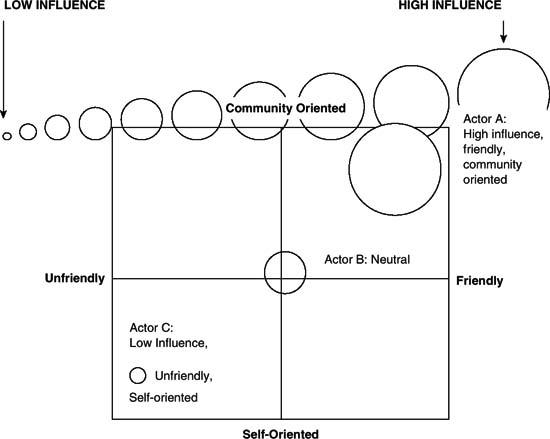
PRFD allows organizations to identify allies, antagonists, and potential mediators. Combined, the three dimensions provide a powerful framework to map the entire field or public relations environment. The system is graphically displayed placing the friendly-unfriendly dimension on the horizontal axis and the community versus self on the vertical axis. The influence dimension is represented by circle size—the more perceived influence, the larger the circle. Figure 1 displays three hypothetical actors in a relational field.
Figure 1 Field diagrams of the perceived relational landscape.
...
- Crisis Communication and Management
- Cyberspace
- Ethics
- Global Public Relations
- Africa, practice of public relations in
- Asia, practice of public relations in
- Australia and New Zealand, practice of public relations in
- Canada, practice of public relations in
- Confederation Europeenne des Relations Publiques (CERP)
- Europe, practice of public relations in
- Institute of Public Relations (IPR)
- International Public Relations Association
- South Africa, practice of public relations in
- Sweden, practice of public relations in
- Groups
- History
- Age of deference (end of)
- Ailes, Roger Eugene
- Antecedents of modern public relations
- Baker, Joseph Varney
- Barkelew, Ann H.
- Barnum, P. T.
- Battle of the currents
- Baxter, Leone, and Whitaker, Clem
- Beeman, Alice L.
- Berlowe, Phyllis
- Bernays, Edward
- Black, Sam
- Block, Ed
- Bogart, Judith S.
- Boulwarism
- Burson, Harold
- Byoir, Carl
- Chase, W. Howard
- Colorado Coal Strike
- Committee on Public Information
- Crisis communications and the Tylenol poisonings
- Cutlip, Scott M.
- Davis, Elmer, and the Office of War Information
- Deontology
- Drobis, David
- Druckenmiller, Robert T.
- Dudley, Pendleton
- Ellsworth, James Drummond
- Epley, Joe
- Exxon and the Valdez crisis
- Fleischman, Doris Elsa
- Four-Minute Men
- Frede, Ralph E.
- Golin, Al
- Gregg, Dorothy
- Griswold, Denny
- Hammond, George
- Hill, John Wiley
- Hood, Caroline
- Hoog, Thomas W.
- Howlett, E. Roxie
- Hunter, Barbara W.
- Industrial barons (of the 1870s–1920s)
- Insull, Samuel
- Jaffe, Lee K.
- Kaiser, Inez Y.
- Kassewitz, Ruth B.
- Kendrix, Moss
- Laurie, Marilyn
- Lee, Ivy
- Lesly, Phillip
- Lobsenz, Amelia
- Lucky Strike Green Campaign
- Muckrakers (and the age of progressivism)
- Newsom, Earl
- Oeckl, Albert
- Page, Arthur W.
- Parke, Isobel
- Parker, George
- Penney, Pat
- Perjury
- Plank, Betsy
- Propaganda
- Railroad industry in the 19th century
- Regulated monopolies
- Roberts, Rosalee A.
- Ross, Thomas J. “Tommy”
- Schoonover, Jean
- Smith, Rea
- Sonnenberg, Ben
- Spin
- Traverse-Healy, Tim
- Jargon
- Actuality
- Advance
- Backgrounder
- Beat
- Benchmarking
- Bio
- Bridge
- Byline
- Campaign
- Caption/cutline
- Chat
- Clip (news clip) and clipping services
- Co-optation
- Collateral
- Communitarianism
- Control
- Copy
- Credits
- Culture
- De-positioning
- Deadline
- Dialogue
- Differentiation
- Direct mail
- Discussion board
- Doublespeak
- Editing
- Editorial
- Endorsement
- Environmental scanning
- Event
- Fact sheet
- FAQs
- Feature
- Flack
- Flame
- Flier
- Focus group
- Font
- Frame
- Freelance writers
- Fundraising
- Gatekeepers
- Ghostwriting
- Goals
- Goodwill
- Graphics
- Gross impressions
- Hearing
- Hold and Hold for release
- Home page
- Hotline
- Human interest
- Hyperlink
- Identification
- Image
- Impressions
- Infomercial
- Internship
- Issues management
- Layout
- Legitimacy and legitimacy gap
- Lobbying
- Localize
- Logo
- Market share
- Mean and median
- Measuring/measures
- Media calls
- Media conferences
- Media effects
- Media relations
- Media release
- Mentoring
- Mission and vision statements
- Multimedia
- Narrowcasting/broadcasting
- News and newsworthy
- News services
- News story
- Newsletter
- Op-ed
- Openness
- Opportunity and threat
- Parent/student newsletter
- Perjury
- Philanthropy
- Photo-op
- Pitch letter
- Political speech
- Portfolio
- Position and positioning
- Practice
- Press agentry
- Press kit
- Privatizing public opinion (and “publictizing” private opinion)
- Proactivity and reactivity
- Professional and professionalism
- Promotion
- Propaganda
- Psychographics
- Psychological processing
- Public affairs
- Public interest
- Public opinion and opinion leaders
- Public relations department
- Public sector
- Public service announcements (PSAs)
- Publicist
- Publicity
- Publics
- Puffery
- Pyramid style
- Reach
- Reliability
- Reputation management
- Return on investment
- Risk communication
- Sampling
- Scales
- Search engine
- Segmentation
- Society
- Sound bite
- Spin
- Stakes
- Straight news
- Strain
- Strategies
- Stylebook
- Survey
- Symmetry
- Tactics
- Tag
- Target
- Third-party endorsement
- Trade associations (and Hill & Knowlton's role in)
- Trust
- Two-way and one-way communication
- Validity
- Wire service
- Management
- Media
- Organizations
- Agenda Online
- Business Wire
- Committee on Public Information
- Confederation Europeenne des Relations Publiques (CERP)
- Davis, Elmer, and the Office of War Information
- EDGAR Online
- Editor and publisher
- Federal Communications Commission
- Federal Trade Commission
- Institute for Public Relations (IPR)
- International Association of Business Communicators (IABC)
- International Public Relations Association
- Issue Management Council
- National Black Public Relations Society (NBPRS)
- National Investor Relations Institute
- PR Newswire
- PR Watch
- ProfNet
- Public Affairs Council
- Public Relations Society of America
- Public Relations Student Society of America
- Securities and Exchange Commission
- Practitioners
- Ailes, Roger Eugene
- Baker, Joseph Varney
- Barkelew, Ann H.
- Barnum, P. T.
- Baxter, Leone, and Whitaker, Clem
- Beeman, Alice L.
- Berlowe, Phyllis
- Bernays, Edward
- Black, Sam
- Block, Ed
- Bogart, Judith S.
- Burson, Harold
- Byoir, Carl
- Chase, W. Howard
- Cutlip, Scott M.
- Davis, Elmer, and the Office of War Information
- Drobis, David
- Druckenmiller, Robert T.
- Dudley, Pendleton
- Ellsworth, James Drummond
- Epley, Joe
- Fleischman, Doris Elsa
- Frede, Ralph E.
- Golin, Al
- Gregg, Dorothy
- Griswold, Denny
- Hammond, George
- Hill, John Wiley
- Hood, Caroline
- Hoog, Thomas W.
- Howlett, E. Roxie
- Hunter, Barbara W.
- Insull, Samuel
- Jaffe, Lee K.
- Kaiser, Inez Y.
- Kassewitz, Ruth B.
- Kendrix, Moss
- Laurie, Marilyn
- Lee, Ivy
- Lesly, Phillip
- Lobsenz, Amelia
- Newsom, Earl
- Oeckl, Albert
- Page, Arthur W.
- Parke, Isobel
- Parker, George
- Penney, Pat
- Plank, Betsy
- Roberts, Rosalee A.
- Ross, Thomas J. “Tommy”
- Schoonover, Jean
- Smith, Rea
- Sonnenberg, Ben
- Traverse-Healy, Tim
- Vail, Theodore Newton
- Relations
- Africa, practice of public relations in
- Alumni relations
- Annual community reports
- Antecedents of modern public relations
- Asia, practice of public relations in
- Australia and New Zealand, practice of public relations in
- Canada, practice of public relations in
- Codes of public relations practice
- College and university public relations
- Community relations
- Confederation Europeenne des Relations Publiques (CERP)
- Consumer/customer relations
- Europe, practice of public relations in
- Functions of public relations
- Government relations
- Institute of Public Relations (IPR)
- International Public Relations Association
- Investor relations
- Labor union public relations
- Managing the corporate public relations department
- Media relations
- Minorities in public relations
- National Black Public Relations Society (NBPRS)
- Online public relations
- Postcolonialism theory and public relations
- Public relations
- Public relations agency
- Public relations department
- Public Relations Field Dynamics (PRFD)
- Public relations research
- Public Relations Society of America
- Public Relations Student Society of America
- South Africa, practice of public relations in
- Sweden, practice of public relations in
- Travel and tourism public relations
- United Kingdom, practice of public relations in
- United States government and public relations
- Voter and constituent relations
- Warfare and public relations
- Women in public relations
- Reports
- Research and Analysis
- Benchmarking
- Case study
- Content analysis
- Experiment/experimental methods
- Fantasy theme analysis theory
- Focus group
- Formative research
- Interview as a research tool
- Process research
- Public relations research
- Qualitative research
- Quantitative research
- Reliability
- Research goals
- Sampling
- Scales
- Situation analysis
- Statistical analysis
- Survey
- Validity
- Theories and Models
- Accommodation: contingency theory
- Agenda-setting theory
- Apologia theory
- Attribution theory
- Chaos and complexity theory
- Co-creation of meaning theory
- Co-orientation theory
- Communitarianism
- Constructionism theory
- Contingency theory
- Critical theory
- Cultivation theory
- Decision theory
- Diffusion of innovations theory
- Discourse theory
- Dramatism and dramatism theory
- Encroachment theory
- Excellence theory
- Fantasy theme analysis theory
- Feminization theory
- Framing theory
- Game theory
- Health Belief Model
- Image restoration theory
- Impression management theory
- Information integration theory
- Intercultural communication theory
- Interpersonal communication theory
- Learning theory
- Management theory
- Motivation theory
- Narrative theory
- Network theory
- Perspectivism theory
- Persuasion theory
- Postcolonialism theory and public relations
- Power resource management theory
- Reinforcement theory
- Relationship management theory
- Rhetorical theory
- Rules theory
- Semiotics theory
- Situational theory of publics
- Social construction of reality theory
- Social exchange theory
- Social movement theory
- Spiral of silence theory
- Stakeholder theory
- Subjective expected utilities theory
- Symbolic interactionism theory
- Systems theory
- Theory of reasoned action
- Theory-based practice
- Transtheoretical model of behavior change
- Two-step flow theory
- Uncertainty reduction theory
- Uses and gratifications theory
- Loading...
Get a 30 day FREE TRIAL
-
 Watch videos from a variety of sources bringing classroom topics to life
 -
Read modern, diverse business cases
-
Explore hundreds of books and reference titles

Read next

More like this
Sage Recommends
We found other relevant content for you on other Sage platforms.
Have you created a personal profile? Login or create a profile so that you can save clips, playlists and searches