
Entry
Reader's guide
Entries A-Z
Subject index
Four-Minute Men
During World War I, the Four-Minute Men were a division of the Committee on Public Information (CPI) that helped to persuade Americans to support the war effort; they did this by giving speeches, usually in movie theaters during intermissions. Theaters were particularly effective because 10 to 13 million people attended them daily. These speeches helped to mobilize support for the war and to provide for the essentials of war. The Four-Minute Men overcame the primary weaknesses inherent in other communication channels so that they could present their message to the entire nation, since broadcasting was not yet available.
Donald Ryerson originated the idea for the Four-Minute Men and was the first head of the division. The division was organized in a state-by-state network and eventually included all states in the union and eight territories. Each state or territory had a chairman who was responsible for coordinating activities and for picking the local chairmen, who, in turn, were responsible for the selection and training of the speakers. Despite receiving no pay or reimbursement for expenses, speakers were never hard to find.
The Four-Minute Men division of the CPI maintained control over the network of speakers, including the selection of address topics and the preparation of associated materials. Speakers were trained through a series of bulletins published by the division. From May 1917 to the end of 1918, 46 bulletins were published. Ten dealt with the organization itself. Of the remaining 36, 6 messages concerned raising money and 5 discussed conserving or acquiring food. These messages were essential for the nation to create the materials necessary for war.
Although each speech topic fulfilled a specific function, the bulletins usually provided speakers with some essential elements: an opening letter of encouragement from the division head; points to be covered in every speech and suggested optional points; sample speeches; and sometimes even answers for crowd objections. The speeches presented by the Four-Minute Men were normally delivered in theaters during the intermissions and were limited to four minutes. The organization had a series of auxiliary organizations, including groups with female speakers and Junior Four-Minute Men groups in schools.
“When the armistice brought activities to a conclusion the Four Minute Men numbered 75,000 speakers, more than 755,190 speeches had been made and a fair estimate of audiences makes it certain that a total of 134,454,514 people had been addressed” (Creel, 1920, p. 85). Creel noted that if allowances are made for those communities that made no reports, a final estimate would place the figures at 1 million speeches heard by 400 million individuals for the 18 months the organization was in operation. Creel also noted that for the total government expenditures of $100,000 for the Four-Minute Men division, the organization accrued over $9 million in financial benefits.
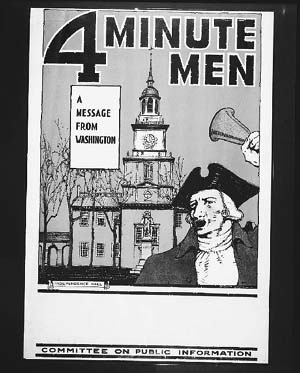
A 1917 poster for one of the Four-Minute Men speeches. President Woodrow Wilson recruited 75,000 speakers called Four-Minute Men to give short talks on United States war aims to the public at theater intermissions and other venues.
...
- Crisis Communication and Management
- Cyberspace
- Ethics
- Global Public Relations
- Africa, practice of public relations in
- Asia, practice of public relations in
- Australia and New Zealand, practice of public relations in
- Canada, practice of public relations in
- Confederation Europeenne des Relations Publiques (CERP)
- Europe, practice of public relations in
- Institute of Public Relations (IPR)
- International Public Relations Association
- South Africa, practice of public relations in
- Sweden, practice of public relations in
- Groups
- History
- Age of deference (end of)
- Ailes, Roger Eugene
- Antecedents of modern public relations
- Baker, Joseph Varney
- Barkelew, Ann H.
- Barnum, P. T.
- Battle of the currents
- Baxter, Leone, and Whitaker, Clem
- Beeman, Alice L.
- Berlowe, Phyllis
- Bernays, Edward
- Black, Sam
- Block, Ed
- Bogart, Judith S.
- Boulwarism
- Burson, Harold
- Byoir, Carl
- Chase, W. Howard
- Colorado Coal Strike
- Committee on Public Information
- Crisis communications and the Tylenol poisonings
- Cutlip, Scott M.
- Davis, Elmer, and the Office of War Information
- Deontology
- Drobis, David
- Druckenmiller, Robert T.
- Dudley, Pendleton
- Ellsworth, James Drummond
- Epley, Joe
- Exxon and the Valdez crisis
- Fleischman, Doris Elsa
- Four-Minute Men
- Frede, Ralph E.
- Golin, Al
- Gregg, Dorothy
- Griswold, Denny
- Hammond, George
- Hill, John Wiley
- Hood, Caroline
- Hoog, Thomas W.
- Howlett, E. Roxie
- Hunter, Barbara W.
- Industrial barons (of the 1870s–1920s)
- Insull, Samuel
- Jaffe, Lee K.
- Kaiser, Inez Y.
- Kassewitz, Ruth B.
- Kendrix, Moss
- Laurie, Marilyn
- Lee, Ivy
- Lesly, Phillip
- Lobsenz, Amelia
- Lucky Strike Green Campaign
- Muckrakers (and the age of progressivism)
- Newsom, Earl
- Oeckl, Albert
- Page, Arthur W.
- Parke, Isobel
- Parker, George
- Penney, Pat
- Perjury
- Plank, Betsy
- Propaganda
- Railroad industry in the 19th century
- Regulated monopolies
- Roberts, Rosalee A.
- Ross, Thomas J. “Tommy”
- Schoonover, Jean
- Smith, Rea
- Sonnenberg, Ben
- Spin
- Traverse-Healy, Tim
- Jargon
- Actuality
- Advance
- Backgrounder
- Beat
- Benchmarking
- Bio
- Bridge
- Byline
- Campaign
- Caption/cutline
- Chat
- Clip (news clip) and clipping services
- Co-optation
- Collateral
- Communitarianism
- Control
- Copy
- Credits
- Culture
- De-positioning
- Deadline
- Dialogue
- Differentiation
- Direct mail
- Discussion board
- Doublespeak
- Editing
- Editorial
- Endorsement
- Environmental scanning
- Event
- Fact sheet
- FAQs
- Feature
- Flack
- Flame
- Flier
- Focus group
- Font
- Frame
- Freelance writers
- Fundraising
- Gatekeepers
- Ghostwriting
- Goals
- Goodwill
- Graphics
- Gross impressions
- Hearing
- Hold and Hold for release
- Home page
- Hotline
- Human interest
- Hyperlink
- Identification
- Image
- Impressions
- Infomercial
- Internship
- Issues management
- Layout
- Legitimacy and legitimacy gap
- Lobbying
- Localize
- Logo
- Market share
- Mean and median
- Measuring/measures
- Media calls
- Media conferences
- Media effects
- Media relations
- Media release
- Mentoring
- Mission and vision statements
- Multimedia
- Narrowcasting/broadcasting
- News and newsworthy
- News services
- News story
- Newsletter
- Op-ed
- Openness
- Opportunity and threat
- Parent/student newsletter
- Perjury
- Philanthropy
- Photo-op
- Pitch letter
- Political speech
- Portfolio
- Position and positioning
- Practice
- Press agentry
- Press kit
- Privatizing public opinion (and “publictizing” private opinion)
- Proactivity and reactivity
- Professional and professionalism
- Promotion
- Propaganda
- Psychographics
- Psychological processing
- Public affairs
- Public interest
- Public opinion and opinion leaders
- Public relations department
- Public sector
- Public service announcements (PSAs)
- Publicist
- Publicity
- Publics
- Puffery
- Pyramid style
- Reach
- Reliability
- Reputation management
- Return on investment
- Risk communication
- Sampling
- Scales
- Search engine
- Segmentation
- Society
- Sound bite
- Spin
- Stakes
- Straight news
- Strain
- Strategies
- Stylebook
- Survey
- Symmetry
- Tactics
- Tag
- Target
- Third-party endorsement
- Trade associations (and Hill & Knowlton's role in)
- Trust
- Two-way and one-way communication
- Validity
- Wire service
- Management
- Media
- Organizations
- Agenda Online
- Business Wire
- Committee on Public Information
- Confederation Europeenne des Relations Publiques (CERP)
- Davis, Elmer, and the Office of War Information
- EDGAR Online
- Editor and publisher
- Federal Communications Commission
- Federal Trade Commission
- Institute for Public Relations (IPR)
- International Association of Business Communicators (IABC)
- International Public Relations Association
- Issue Management Council
- National Black Public Relations Society (NBPRS)
- National Investor Relations Institute
- PR Newswire
- PR Watch
- ProfNet
- Public Affairs Council
- Public Relations Society of America
- Public Relations Student Society of America
- Securities and Exchange Commission
- Practitioners
- Ailes, Roger Eugene
- Baker, Joseph Varney
- Barkelew, Ann H.
- Barnum, P. T.
- Baxter, Leone, and Whitaker, Clem
- Beeman, Alice L.
- Berlowe, Phyllis
- Bernays, Edward
- Black, Sam
- Block, Ed
- Bogart, Judith S.
- Burson, Harold
- Byoir, Carl
- Chase, W. Howard
- Cutlip, Scott M.
- Davis, Elmer, and the Office of War Information
- Drobis, David
- Druckenmiller, Robert T.
- Dudley, Pendleton
- Ellsworth, James Drummond
- Epley, Joe
- Fleischman, Doris Elsa
- Frede, Ralph E.
- Golin, Al
- Gregg, Dorothy
- Griswold, Denny
- Hammond, George
- Hill, John Wiley
- Hood, Caroline
- Hoog, Thomas W.
- Howlett, E. Roxie
- Hunter, Barbara W.
- Insull, Samuel
- Jaffe, Lee K.
- Kaiser, Inez Y.
- Kassewitz, Ruth B.
- Kendrix, Moss
- Laurie, Marilyn
- Lee, Ivy
- Lesly, Phillip
- Lobsenz, Amelia
- Newsom, Earl
- Oeckl, Albert
- Page, Arthur W.
- Parke, Isobel
- Parker, George
- Penney, Pat
- Plank, Betsy
- Roberts, Rosalee A.
- Ross, Thomas J. “Tommy”
- Schoonover, Jean
- Smith, Rea
- Sonnenberg, Ben
- Traverse-Healy, Tim
- Vail, Theodore Newton
- Relations
- Africa, practice of public relations in
- Alumni relations
- Annual community reports
- Antecedents of modern public relations
- Asia, practice of public relations in
- Australia and New Zealand, practice of public relations in
- Canada, practice of public relations in
- Codes of public relations practice
- College and university public relations
- Community relations
- Confederation Europeenne des Relations Publiques (CERP)
- Consumer/customer relations
- Europe, practice of public relations in
- Functions of public relations
- Government relations
- Institute of Public Relations (IPR)
- International Public Relations Association
- Investor relations
- Labor union public relations
- Managing the corporate public relations department
- Media relations
- Minorities in public relations
- National Black Public Relations Society (NBPRS)
- Online public relations
- Postcolonialism theory and public relations
- Public relations
- Public relations agency
- Public relations department
- Public Relations Field Dynamics (PRFD)
- Public relations research
- Public Relations Society of America
- Public Relations Student Society of America
- South Africa, practice of public relations in
- Sweden, practice of public relations in
- Travel and tourism public relations
- United Kingdom, practice of public relations in
- United States government and public relations
- Voter and constituent relations
- Warfare and public relations
- Women in public relations
- Reports
- Research and Analysis
- Benchmarking
- Case study
- Content analysis
- Experiment/experimental methods
- Fantasy theme analysis theory
- Focus group
- Formative research
- Interview as a research tool
- Process research
- Public relations research
- Qualitative research
- Quantitative research
- Reliability
- Research goals
- Sampling
- Scales
- Situation analysis
- Statistical analysis
- Survey
- Validity
- Theories and Models
- Accommodation: contingency theory
- Agenda-setting theory
- Apologia theory
- Attribution theory
- Chaos and complexity theory
- Co-creation of meaning theory
- Co-orientation theory
- Communitarianism
- Constructionism theory
- Contingency theory
- Critical theory
- Cultivation theory
- Decision theory
- Diffusion of innovations theory
- Discourse theory
- Dramatism and dramatism theory
- Encroachment theory
- Excellence theory
- Fantasy theme analysis theory
- Feminization theory
- Framing theory
- Game theory
- Health Belief Model
- Image restoration theory
- Impression management theory
- Information integration theory
- Intercultural communication theory
- Interpersonal communication theory
- Learning theory
- Management theory
- Motivation theory
- Narrative theory
- Network theory
- Perspectivism theory
- Persuasion theory
- Postcolonialism theory and public relations
- Power resource management theory
- Reinforcement theory
- Relationship management theory
- Rhetorical theory
- Rules theory
- Semiotics theory
- Situational theory of publics
- Social construction of reality theory
- Social exchange theory
- Social movement theory
- Spiral of silence theory
- Stakeholder theory
- Subjective expected utilities theory
- Symbolic interactionism theory
- Systems theory
- Theory of reasoned action
- Theory-based practice
- Transtheoretical model of behavior change
- Two-step flow theory
- Uncertainty reduction theory
- Uses and gratifications theory
- Loading...
Get a 30 day FREE TRIAL
-
 Watch videos from a variety of sources bringing classroom topics to life
 -
Read modern, diverse business cases
-
Explore hundreds of books and reference titles

Read next

More like this
Sage Recommends
We found other relevant content for you on other Sage platforms.
Have you created a personal profile? Login or create a profile so that you can save clips, playlists and searches