
Entry
Reader's guide
Entries A-Z
Subject index
Utility
Introduction
Utility is always subjective and refers to the amount of personal or institutional satisfaction of an alternative. The personal satisfaction associated with the outcome of good food, a holiday trip or a sports car depends on taste, interests and needs. Institutional satisfaction associated with the outcome of employment strategies or treatment selection predominantly depends on economic considerations. It is assumed that both individuals and institutions try to maximize their utility. Choosing alternatives according to their utility lies at the heart of all summative evaluation procedures.
Prescriptive Utility Theory
Utility Function
The measurement of utility has a long history in economics, starting with the measurement of preferences on an ordinal scale. Since von Neumann and Morgenstern (1947) developed the axiomatic foundation of utility, it can be measured on an interval scale. It is derived from personal preferences for either a sure thing or a gamble (Figure 1a). The decision maker is presented with a choice between obtaining either outcome o for sure or a gamble that returns with probability p a better outcome (o∗) and with complementary probability (1-p) a worse outcome (o∗). The gamble is written as [p o∗, (1-p) o∗] or simply [p o∗, o∗] (the square denotes a decision, the circle a chance node).
With o∗ and o∗ as best and worst outcomes and all outcomes oi in-between, the indifference probability πi, where the decision maker is indifferent between the sure thing and the gamble, can be determined as oi ∼ [πi o∗, o∗]. Pairs (o∗, πi) of these indifferences constitute the utility function (Figure 2a). Above the function the gamble is preferred, below the function the sure thing is preferred. For outcomes with the following preference order o∗ ϕo1 ϕo2ϕ … oi …ϕo∗ the corresponding indifference probabilities with 1.0 = π∗ > p > p >… >p, >… > π∗ = 0 (as well as their linear transformations) are the utilities of the corresponding outcomes. Whenever the preference oi ϕoj holds, the utility measurement of oi exceeds oj and πi > πj.
Axiomatic Foundation
The perceived utility of outcomes is the basis for expressing preferences. These preferences are analysed in order to measure true internal utilities. If the expressed preferences with respect to outcomes of alternatives (objects, commodities, events, strategies) and gambles meet the following six axioms, utility can be measured on an interval scale.
Ordering
A decision maker should be able to compare outcomes and either prefer one to the other or be indifferent.
Transitivity
If one outcome is preferred to a second, and this second is preferred to a third, the first should also be preferred to the third.
Dominance
A rational decision maker should never accept a dominated gamble whose best outcome matches the outcome of the sure thing and should always accept a gamble whose worst outcome matches the outcome of the sure thing.
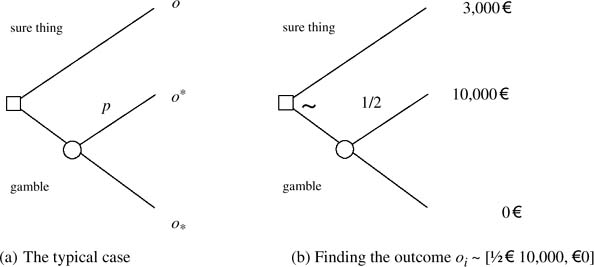
Figure 1. The choice between a sure thing and a gamble.
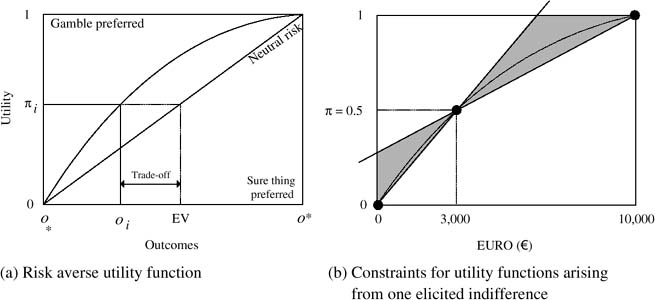
Figure 2. Utility functions.
Cancellation
Preferences for gambles must not depend on identical and equally probable outcomes.
Invariance
As long as the probabilities with which certain outcomes are obtained are the same, the form in which gambles are presented must not affect preferences.
...
- 1. Theory and Methodology
- Ambulatory Assessment
- Assessment Process
- Assessor's Bias
- Automated Test Assembly Systems
- Classical and Modern Item Analysis
- Classical Test Theory
- Classification (General, including Diagnosis)
- Criterion-Referenced Testing: Methods and Procedures
- Cross-Cultural Assessment
- Decision (including Decision Theory)
- Diagnosis of Mental and Behavioural Disorders
- Diagnostic Testing in Educational Settings
- Dynamic Assessment (Learning Potential Testing, Testing the Limits)
- Ethics
- Evaluability Assessment
- Evaluation: Programme Evaluation (General)
- Explanation
- Factor Analysis: Confirmatory
- Factor Analysis: Exploratory
- Formats for Assessment
- Generalizability Theory
- History of Psychological Assessment
- Intelligence Assessment through Cohort and Time
- Item Banking
- Item Bias
- Item Response Theory: Models and Features
- Latent Class Analysis
- Multidimensional Item Response Theory
- Multidimensional Scaling Methods
- Multimodal Assessment (including Triangulation)
- Multitrait-Multimethod Matrices
- Needs Assessment
- Norm-Referenced Testing: Methods and Procedures
- Objectivity
- Outcome Assessment/Treatment Assessment
- Person/Situation (Environment) Assessment
- Personality Assessment through Longitudinal Designs
- Prediction (General)
- Prediction: Clinical vs. Statistical
- Qualitative Methods
- Reliability
- Report (General)
- Reporting Test Results in Education
- Self-Presentation Measurement
- Self-Report Distortions (including Faking, Lying, Malingering, Social Desirability)
- Test Adaptation/Translation Methods
- Test User Competence/Responsible Test Use
- Theoretical Perspective: Cognitive
- Theoretical Perspective: Cognitive-Behavioural
- Theoretical Perspective: Constructivism
- Theoretical Perspective: Psychoanalytic
- Theoretical Perspective: Psychological Behaviourism
- Theoretical Perspective: Psychometrics
- Theoretical Perspective: Systemic
- Trait-State Models
- Utility
- Validity (General)
- Validity: Construct
- Validity: Content
- Validity: Criterion-Related
- 2. Methods, Tests and Equipment
- Adaptive and Tailored Testing
- Analogue Methods
- Autobiography
- Behavioural Assessment Techniques
- Brain Activity Measurement
- Case Formulation
- Coaching Candidates to Score Higher on Tests
- Computer-Based Testing
- Equipment for Assessing Basic Processes
- Field Survey: Protocols Development
- Goal Attainment Scaling (GAS)
- Idiographic Methods
- Interview (General)
- Interview in Behavioural and Health Settings
- Interview in Child and Family Settings
- Interview in Work and Organizational Settings
- Neuropsychological Test Batteries
- Observational Methods (General)
- Observational Techniques in Clinical Settings
- Observational Techniques in Work and Organizational Settings
- Projective Techniques
- Psychoeducational Test Batteries
- Psychophysiological Equipment and Measurements
- Self-Observation (Self-Monitoring)
- Self-Report Questionnaires
- Self-Reports (General)
- Self-Reports in Behavioural Clinical Settings
- Self-Reports in Work and Organizational Settings
- Socio-Demographic Conditions
- Sociometric Methods
- Standard for Educational and Psychological Testing
- Subjective Methods
- Test Accommodations for Disabilities
- Test Anxiety
- Test Designs: Developments
- Test Directions and Scoring
- Testing through the Internet
- Unobtrusive Measures
- 3. Personality
- Anxiety Assessment
- Attachment
- Attitudes
- Attribution Styles
- Big Five Model Assessment
- Burnout Assessment
- Cognitive Styles
- Coping Styles
- Emotions
- Empowerment
- Interest
- Leadership Personality
- Locus of Control
- Motivation
- Optimism
- Person/Situation (Environment) Assessment
- Personal Constructs
- Personality Assessment (General)
- Personality Assessment through Longitudinal Designs
- Prosocial Behaviour
- Self-Control
- Self-Efficacy
- Self-Presentation Measurement
- Self, The (General)
- Sensation Seeking
- Social Competence (including Social Skills, Assertion)
- Temperament
- Time Orientation
- Trait-State Models
- Values
- Weil-Being (including Life Satisfaction)
- 4. Intelligence
- Attention
- Cognitive Ability: g Factor
- Cognitive Ability: Multiple Cognitive Abilities
- Cognitive Decline/Impairment
- Cognitive Plasticity
- Cognitive Processes: Current Status
- Cognitive Processes: Historical Perspective
- Cognitive/Mental Abilities in Work and Organizational Settings
- Creativity
- Dynamic Assessment (Learning Potential Testing, Testing the Limits)
- Emotional Intelligence
- Equipment for Assessing Basic Processes
- Fluid and Crystallized Intelligence
- Intelligence Assessment (General)
- Intelligence Assessment through Cohort and Time
- Language (General)
- Learning Disabilities
- Memory (General)
- Mental Retardation
- Practical Intelligence: Conceptual Aspects
- Practical Intelligence: Its Measurement
- Problem Solving
- Triarchic Intelligence Components
- Wisdom
- 5. Clinical and Health
- Anger, Hostility and Aggression Assessment
- Antisocial Disorders Assessment
- Anxiety Assessment
- Anxiety Disorders Assessment
- Applied Behavioural Analysis
- Applied Fields: Clinical
- Applied Fields: Gerontology
- Applied Fields: Health
- Caregiver Burden
- Child and Adolescent Assessment in Clinical Settings
- Clinical Judgement
- Coping Styles
- Counselling, Assessment in
- Couple Assessment in Clinical Settings
- Dangerous/Violence Potential Behaviour
- Dementia
- Diagnosis of Mental and Behavioural Disorders
- Dynamic Assessment (Learning Potential Testing, Testing the Limits)
- Eating Disorders
- Health
- Identity Disorders
- Interview in Behavioural and Health Settings
- Irrational Beliefs
- Learning Disabilities
- Mental Retardation
- Mood Disorders
- Observational Techniques in Clinical Settings
- Outcome Assessment/Treatment Assessment
- Palliative Care
- Prediction: Clinical vs. Statistical
- Psychoneuroimmunology
- Quality of Life
- Self-Observation (Self-Monitoring)
- Self-Reports in Behavioural Clinical Settings
- Social Competence (including Social Skills, Assertion)
- Stress
- Substance Abuse
- Test Anxiety
- Thinking Disorders Assessment
- Type A: A Proposed Psychosocial Risk Factor for Cardiovascular Diseases
- Type C: A Proposed Psychosocial Risk Factor for Cancer
- 6. Educational and Child Assessment
- Achievement Testing
- Applied Fields: Education
- Child Custody
- Children with Disabilities
- Coaching Candidates to Score Higher on Tests
- Cognitive Psychology and Assessment Practices
- Communicative Language Abilities
- Development (General)
- Development: Intelligence/Cognitive
- Development: Language
- Development: Psychomotor
- Development: Socio-Emotional
- Diagnostic Testing in Educational Settings
- Dynamic Assessment (Learning Potential Testing, Testing the Limits)
- Evaluation in Higher Education
- Giftedness
- Instructional Strategies
- Interview in Child and Family Settings
- Item Banking
- Learning Strategies
- Performance
- Performance Standards: Constructed Response Item Formats
- Performance Standards: Selected Response Item Formats
- Planning
- Planning Classroom Tests
- Pre-School Children
- Psychoeducational Test Batteries
- Reporting Test Results in Education
- Standard for Educational and Psychological Testing
- Test Accommodations for Disabilities
- Test Directions and Scoring
- Testing in the Second Language in Minorities
- 7. Work and Organizations
- Achievement Motivation
- Applied Fields: Forensic
- Applied Fields: Organizations
- Applied Fields: Work and Industry
- Career and Personnel Development
- Centres (Assessment Centres)
- Cognitive/Mental Abilities in Work and Organizational Settings
- Empowerment
- Interview in Work and Organizational Settings
- Job Characteristics
- Job Stress
- Leadership in Organizational Settings
- Leadership Personality
- Motor Skills in Work Settings
- Observational Techniques in Work and Organizational Settings
- Organizational Culture
- Performance
- Personnel Selection, Assessment in
- Physical Abilities in Work Settings
- Risk and Prevention in Work and Organizational Settings
- Self-Reports in Work and Organizational Settings
- Total Quality Management
- 8. Neurophysiopsychological Assessment
- Applied Fields: Neuropsychology
- Applied Fields: Psychophysiology
- Brain Activity Measurement
- Dementia
- Equipment for Assessing Basic Processes
- Executive Functions Disorders
- Memory Disorders
- Neuropsychological Test Batteries
- Outcome Evaluation in Neuropsychological Rehabilitation
- Psychoneuroimmunology
- Psychophysiological Equipment and Measurements
- Visuo-Perceptual Impairments
- Voluntary Movement
- 9. Environmental Assessment
- Behavioural Settings and Behaviour Mapping
- Cognitive Maps
- Couple Assessment in Clinical Settings
- Environmental Attitudes and Values
- Family
- Landscapes and Natural Environments
- Life Events
- Organizational Structure, Assessment of
- Perceived Environmental Quality
- Person/Situation (Environment) Assessment
- Post-Occupancy Evaluation for the Built Environment
- Residential and Treatment Facilities
- Social Climate
- Social Networks
- Social Resources
- Stressors: Physical
- Stressors: Social
- Loading...
Get a 30 day FREE TRIAL
-
 Watch videos from a variety of sources bringing classroom topics to life
 -
Read modern, diverse business cases
-
Explore hundreds of books and reference titles

Read next

More like this
Sage Recommends
We found other relevant content for you on other Sage platforms.
Have you created a personal profile? Login or create a profile so that you can save clips, playlists and searches